PuriActives® Crystal RetinalCyclodextrin-Included Retinal
PuriPharm Co., Ltd. · Retinal science
PuriActives® Crystal Retinal Cyclodextrin-Included Retinal

High-performance retinal through molecular inclusion science
Retinal · Cyclodextrin inclusion · Skin and scalp renewal
Scientific and technical report for cosmetic formulators and brand R&D teams
PART I · NEXT-GENERATION RETINAL
The evolution of vitamin A skincare
RETINYL ESTERS
Storage forms requiring hydrolysis before entering metabolism.
RETINOL
An established cosmetic benchmark, oxidized to retinal in skin.
RETINAL (RAL)
One oxidation step from retinoic acid: its direct metabolic precursor.
RETINOIC ACID
The receptor-active form; prescription-only in many markets.
Esterases · Retinol dehydrogenases (RDH/ADH) · Retinaldehyde dehydrogenases (ALDH1A)
FROM STORAGE FORM TO SIGNALING MOLECULE
Cosmetic vitamin A ingredients follow the skin’s own metabolic pathway. Moving closer to retinoic acid reduces the number of enzymatic conversions.
Retinal is the direct biosynthetic precursor of retinoic acid, the active form that binds nuclear retinoid receptors and drives epidermal renewal.
Metabolic proximity is a mechanistic rationale, not a clinical conclusion. Relative efficacy requires controlled human studies, reviewed in Part III.
2 → 1
Oxidation steps to retinoic acid: two for retinol, one for retinal.
1994
Topical retinal was first biologically characterized in human skin (Saurat et al.).
125+
Participants indicated in the source’s milestone vehicle-controlled profilometry trial comparing retinal with retinoic acid (1998).
Saurat JH et al. J Invest Dermatol. 1994;103(6):770–774. Creidi P et al. J Am Acad Dermatol. 1998;39(6):960–965. Retinoid metabolism: RDH/ADH and ALDH1A enzyme families.
PART I · NEXT-GENERATION RETINAL
One conversion from retinoic acid: retinal biology
All-trans-retinal (C20H28O; molecular weight 284.4)
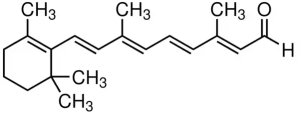
The β-ionone ring, conjugated polyene chain and terminal aldehyde underlie both biological activity and chemical vulnerability.
The conjugated system responsible for sensitivity to light and oxidation also contributes to retinal’s biological activity.
Stabilizing this molecule without changing its chemistry is the formulation challenge addressed by cyclodextrin inclusion.
A NATURAL INTERMEDIATE IN VITAMIN A METABOLISM
Retinal forms from retinol in skin and can convert further to retinoic acid.
DIRECT PRECURSOR
One oxidation by retinaldehyde dehydrogenases produces retinoic acid, a ligand for nuclear RAR receptors involved in epidermal gene regulation.
DOCUMENTED BIOACTIVITY IN HUMAN SKIN
Early human studies reported measurable effects of topical retinal, including epidermal hyperplasia and increased dermal elastin, with good tolerability.
THREE DECADES OF CLINICAL LITERATURE
Human studies since 1994 have assessed texture, wrinkles, elasticity, tone, hydration and tolerability.
COSMETIC POSITIONING
The source identifies retinal (INCI: RETINAL) as a cosmetic retinoid, in contrast to retinoic acid, supporting science-led formulation development.
Saurat JH et al. J Invest Dermatol. 1994;103(6):770–774. Sorg O, Saurat JH. Dermatology. 2014;228(4):314–325. Formula and molecular weight: PubChem CID 638015.
PART I · NEXT-GENERATION RETINAL
High potential with demanding formulation requirements
Retinal’s conjugated polyene chain and terminal aldehyde are chemically reactive. In conventional formulations, degradation through several documented pathways can reduce the available active.
PHOTOCHEMICAL SENSITIVITY
UV and visible light induce polyene photoisomerization and photodegradation.
OXIDATIVE DEGRADATION
Autoxidation of the conjugated chain generates peroxide intermediates and breakdown products.
THERMAL INSTABILITY
Heat accelerates degradation, affecting manufacturing, transport and shelf life.
ISOMERIZATION
Light and heat can convert the all-trans form into cis isomers with altered biological activity.
VERY LOW WATER SOLUBILITY
The lipophilic molecule is difficult to disperse uniformly in aqueous and emulsified systems.
ACTIVE RETENTION IN FORMULATIONS
Interactions with oils, surfactants and packaging may reduce the retinal available at the point of use.
PATENT STRESS TESTS
Under accelerated UV aging (200–400 nm, 48 hours), an unstabilized retinal gel faded from deep yellow toward near-complete degradation, with a color score of 1/20. Under thermal stress (45 °C, 7 days), the unstabilized group showed complete degradation, scored 20/20.
US 10,864,148 B2 (2020), Example 3, Table 6: visual color-scoring degradation tests of retinal formulations.
Selecting retinal is the first step. Its molecular environment determines how it can be formulated.
PART II · THE SCIENCE OF CRYSTAL RETINAL
Introducing PuriActives® Crystal Retinal Cyclodextrin-Included Retinal
A cyclodextrin-included retinal system designed around molecular stabilization and formulation flexibility, connecting retinal biology with host–guest chemistry.
PRODUCT
PuriActives® Crystal Retinal Cyclodextrin-Included Retinal
INCI NAME
RETINAL
CORE TECHNOLOGY
Cyclodextrin molecular inclusion
APPLICATIONS
Premium skincare and science-led scalp care
RETINAL BIOLOGY
The direct metabolic precursor of retinoic acid, supported by three decades of human research.
MOLECULAR INCLUSION
Cyclodextrin host–guest chemistry provides a protective environment for a vulnerable active.
FORMULATION INNOVATION
A solid, dispersible ingredient format opens formulation routes that are difficult for free retinal.
Designed for formulators seeking a stabilization strategy at the ingredient level while retaining retinal’s biological identity.
PART II · THE SCIENCE OF CRYSTAL RETINAL
Cyclodextrins: molecular architecture from starch
Cyclodextrins are cyclic oligosaccharides produced by enzymatic conversion of starch. Their truncated-cone geometry creates a relatively hydrophilic exterior and a relatively hydrophobic cavity suited to lipophilic guests such as retinoids.
α-CYCLODEXTRIN
6 glucopyranose units; the smallest cavity, approximately 4.7–5.3 Å.
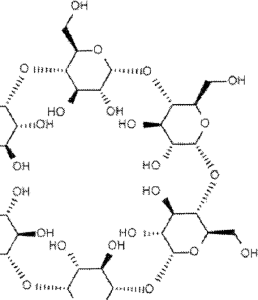
β-CYCLODEXTRIN
7 glucopyranose units; a medium cavity, approximately 6.0–6.5 Å.
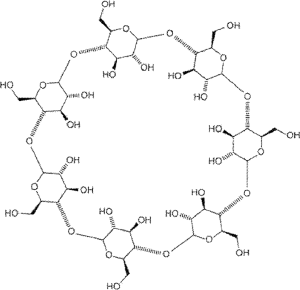
γ-CYCLODEXTRIN
8 glucopyranose units; the largest cavity, approximately 7.5–8.3 Å.
Cavity size affects which guests enter and how they are accommodated. In cited vitamin A tests, the larger γ-cyclodextrin cavity provided greater protection than β-cyclodextrin, making cavity geometry an important formulation variable.
After 48 days of UVA stress, a retinol/γ-CD complex retained 18.0% retinol, while the corresponding β-CD complex retained none (US 5,985,296, Example 3, Table 1).
Structure figures: US 8,410,079 B2 (2013), Figures 1–3. Cavity dimensions: Loftsson T, Brewster ME. J Pharm Sci. 1996;85(10):1017–1025.
PART II · THE SCIENCE OF CRYSTAL RETINAL
Molecular inclusion: a protective environment for retinal
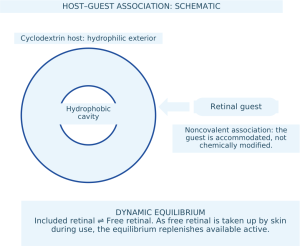
HOST–GUEST ASSOCIATION: SCHEMATIC
Cyclodextrin host: hydrophilic exterior
Hydrophobic
cavity
Retinal guest
Noncovalent association: the guest is accommodated, not chemically modified.
DYNAMIC EQUILIBRIUM
Included retinal ⇌ Free retinal. As free retinal is taken up by skin during use, the equilibrium replenishes available active.
HOST–GUEST ASSOCIATION
Hydrophobic and van der Waals interactions drive lipophilic guests into the nonpolar cavity.
REDUCED ENVIRONMENTAL EXPOSURE
The included fraction has reduced exposure to bulk solvent, oxygen and light, key contributors to retinal degradation.
DISPERSION AND HANDLING
A lipophilic crystalline active becomes a water-dispersible solid ingredient for easier weighing, dispersion and processing.
EQUILIBRIUM-DRIVEN AVAILABILITY
Guest release follows the association equilibrium without shell rupture or a triggered chemical reaction.
DISTINCT FROM COVALENT DERIVATIVES
Inclusion is a physical association. The retinal–cyclodextrin hemiacetals discussed in the patent section are covalently bonded molecules of another class.
Loftsson T, Brewster ME. J Pharm Sci. 1996;85(10):1017–1025. Yap KL et al. Eur J Pharm Sci. 2005;25(1):49–56. Schematic for illustration; partial inclusion geometries of polyene guests have been reported.
PART II · THE SCIENCE OF CRYSTAL RETINAL
Stability through molecular design: interpreting stress tests
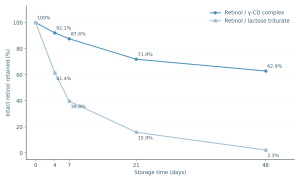
RETINOL RETENTION DURING OPEN STORAGE IN DAYLIGHT AT ROOM TEMPERATURE
Intact retinol measured by HPLC relative to day 0. US 5,985,296, Example 4, Table 2.
UVA AT 366 NM FOR 48 DAYS
18.0% retinol retained in the γ-CD complex
0% retained in the β-CD complex under the same conditions
US 5,985,296, Example 3, Table 1.
Protection depends on the molecular environment. In the patent comparisons, the γ-cyclodextrin complex retained most retinol after three weeks of open daylight storage, whereas the lactose triturate lost almost all of it.
Under UVA stress, γ-CD outperformed the smaller β-CD cavity, indicating the importance of inclusion geometry.
These data concern retinol, the immediate precursor of retinal, which shares related conjugated degradation chemistry.
US 5,985,296 A (Wacker-Chemie, 1999), Examples 3–4, Tables 1–2. Stability is complex-specific. These results characterize the tested materials and do not represent a particular commercial ingredient.
PART II · THE SCIENCE OF CRYSTAL RETINAL
Four decades of retinal and cyclodextrin patent science
1983
WATER-SOLUBLE RETINOID COMPLEXES
Retinal–polymer conjugates with cyclodextrin for water-compatible vitamin A systems.
US 4,371,673 (Pitha): an early approach to water-compatible retinoid delivery.
1999
γ-CD INCLUSION FOR VITAMIN A STABILITY
Quantified improvements in light and storage stability of retinol/γ-CD complexes.
US 5,985,296 (Wacker-Chemie): HPLC comparisons with β-CD and lactose controls.
2013
RETINAL–CD HEMIACETAL DERIVATIVES
Covalent retinal–cyclodextrin structures developed for skin-tone applications.
US 8,410,079 B2: chemically distinct from noncovalent inclusion complexes.
2020
MODERN RETINAL STABILIZATION
Cyclodextrin-encapsulated retinal combined with antioxidant systems.
US 10,864,148 B2: thermal and UV stress tests of encapsulated retinal gels.
WHAT THE PATENT HISTORY SHOWS
Successive approaches address retinoid instability through solubilization, inclusion, covalent derivatives and integrated formulations. Cyclodextrin inclusion is a route that protects the active without changing its molecular identity.
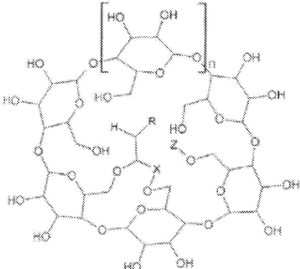
General retinal–cyclodextrin acetal structure
CN 103987391 B, Formula (Ib).
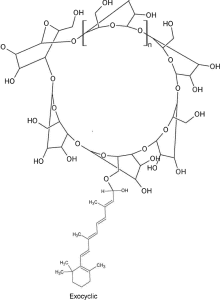
Exocyclic retinal–CD hemiacetal (VIII)
EP 2 755 664 B1 / HK 1200172 B, page 8.
US 4,371,673 A (1983) · US 5,985,296 A (1999) · US 8,410,079 B2 (2013) · US 10,864,148 B2 (2020).
PART II · THE SCIENCE OF CRYSTAL RETINAL
Comparing retinal formulation approaches
Three approaches to retinal formulation involve different practical considerations. This table compares formulation principles rather than ranking performance.
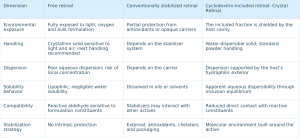
This is a qualitative comparison of formulation principles. Actual performance depends on the complex, manufacturing process and finished formulation. Validation parameters must be established during product development.
PART III · RETINAL BIOLOGY AND SKIN BENEFITS
From retinal to skin renewal: the signaling cascade
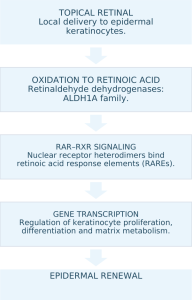
DOCUMENTED IN SKIN
RETINAL INCREASES CUTANEOUS RETINOIC ACID
Topical retinal increased retinoic acid content and retinoid activity in mouse skin, supporting enzymatic conversion within tissue (Didierjean et al., 1996; Sorg et al., 1999).
HUMAN EPIDERMAL RENEWAL MARKERS
In human skin, topical retinal induced epidermal hyperplasia and increased dermal elastin with good tolerability, consistent with retinoid-mediated renewal (Saurat et al., 1994).
RECEPTOR SPECIFICITY
In human keratinocytes, retinoid signaling at physiological, nanomolar ligand concentrations acts mainly through RAR–RXR heterodimers at βRARE elements (Xiao et al., 1995).
DOWNSTREAM VISIBLE ENDPOINTS
Texture, wrinkles, firmness, tone and barrier quality are mapped to human evidence in the following sections.
Didierjean L et al. J Invest Dermatol. 1996;107(5):714–719. Sorg O et al. Dermatology. 1999;199(Suppl 1):13–17. Saurat JH et al. J Invest Dermatol. 1994;103(6):770–774. Xiao JH et al. J Biol Chem. 1995;270(7):3001–3011.
PART III · RETINAL BIOLOGY AND SKIN BENEFITS
Skin texture: measurable renewal
Skin-surface refinement is an instrumentally measurable retinoid endpoint. Retinal supports orderly keratinocyte renewal, and changes can be assessed by profilometry and 3D imaging.
WHY THE SURFACE RESPONDS
Retinoic acid generated in skin modulates keratinocyte differentiation and epidermal turnover. Replacement of accumulated, disorganized corneocytes produces a more regular surface, measured as lower roughness in 3D imaging.
Retinal’s single-step conversion provides a rationale for renewal at cosmetic use concentrations.
+13.7%
Texture improvement with 0.1% retinal
+12.6%
Texture improvement with 0.05% retinal
Randomized double-blind trial: 40 women with photoaged skin, twice-daily use for 3 months; texture quantified by Antera 3D imaging.
BENCHMARK PROFILOMETRY STUDY
Creidi et al. J Am Acad Dermatol. 1998.
125 participants · 44 weeks · 0.05% retinal
DESIGN
Double-blind comparison of 0.05% retinal, 0.05% retinoic acid and vehicle in photoaged skin, with objective surface profilometry.
RESULTS
Both vitamin A groups reduced wrinkles and roughness versus vehicle, with significant improvement from week 18. Efficacy did not differ significantly between the active groups.
TOLERABILITY
Retinal was significantly better tolerated than retinoic acid at the same concentration.
For formulation development, these results support retinal as a cosmetic option with surface efficacy comparable to retinoic acid under the tested conditions. Inclusion provides a stabilization rationale that must be verified in the formulation.
Kwon HS et al. J Cosmet Dermatol. 2018;17(3):471–476. Creidi P et al. J Am Acad Dermatol. 1998;39(6):960–965. Studies used finished creams; results characterize the retinal active class.
PART III · RETINAL BIOLOGY AND SKIN BENEFITS
Wrinkles and fine lines: clinical evidence
TWELVE WEEKS, TWO CONCENTRATIONS, FOUR ENDPOINTS
Percentage change from baseline; randomized double-blind trial; 40 women; twice-daily use.
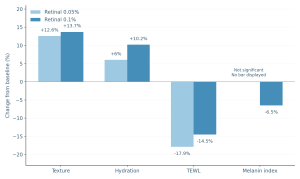
All displayed changes were significant versus baseline except the 0.05% group’s melanin endpoint, which was not significant and is therefore shown without a bar. Lower TEWL and melanin index indicate improvement.
LONG-TERM CONTROLLED EVIDENCE
Week 18: significant reduction versus vehicle
44-week follow-up; n = 125
Creidi P et al. J Am Acad Dermatol. 1998.
At the same 0.05% concentration, retinal provided wrinkle improvement comparable to retinoic acid by profilometry, with significantly less irritation.
The response persisted through the 44-week observation period, supporting a sustained rather than transient surface effect.
DOSE-SELECTION RATIONALE
In the reported results, 0.1% showed greater texture and pigment changes, while 0.05% showed the greater TEWL reduction. These endpoints inform different formulation concepts.
Kwon HS et al. J Cosmet Dermatol. 2018;17(3):471–476 (randomized double-blind trial, n = 40, 3 months; Antera 3D, corneometry, TEWL and pigment measurement). Creidi P et al. J Am Acad Dermatol. 1998;39(6):960–965 (n = 125, 44 weeks; profilometry).
PART III · RETINAL BIOLOGY AND SKIN BENEFITS
Dermal matrix: collagen and elastic-fiber support
Photoaging involves disrupted collagen and elastic fibers. Histology in skin explants and instrumental measurements in vivo provide evidence relevant to retinal and matrix-related care.
HUMAN SKIN EXPLANTS: UVA REPAIR MODEL
Fibers restored toward unexposed levels
Human skin explants were photoaged with UVA in organ culture and treated with 0.05% retinal cream for 2 weeks. In all examined specimens, collagen and elastic fibers returned to unexposed-skin levels, and UVA-suppressed collagen synthesis normalized.
Boisnic S et al. Dermatology. 1999;199(Suppl 1):43–48.
CLINICAL STUDY: ULTRASOUND AND RHEOLOGY
Instrumentally measured thickness and elasticity
Topical 0.05% retinal significantly increased epidermal thickness and skin elasticity in aging skin, quantified by high-frequency ultrasound and rheology.
Diridollou S et al. Dermatology. 1999;199(Suppl 1):37–41.
p < 0.01
Significance reported for increased epidermal thickness and elasticity with 0.05% retinal.
These findings provide a rationale for firmness and density concepts alongside surface smoothing.
SIGNALING BEHIND THE STRUCTURE
RAR-mediated transcription in epidermal keratinocytes is the main documented pathway. Explant data show matrix recovery consistent with renewed collagen synthesis after UV damage.
Active retention through stabilization is a formulation prerequisite that requires product-level confirmation.
Boisnic S et al. Dermatology. 1999;199(Suppl 1):43–48 (human skin explants, UVA + 0.05% retinal, 2 weeks). Diridollou S et al. Dermatology. 1999;199(Suppl 1):37–41 (0.05% retinal; ultrasound and rheology endpoints).
PART III · RETINAL BIOLOGY AND SKIN BENEFITS
Skin tone and pigmentation
MELANIN INDEX AT 12 WEEKS
−6.5%
A significant reduction in the 0.1% retinal group in the randomized double-blind photoaging trial.
Kwon HS et al. J Cosmet Dermatol. 2018.
The pigment endpoint was significant at 0.1% and not significant at 0.05%. This supports a concentration-specific rather than universal skin-tone claim.
HOW RETINAL RELATES TO SKIN TONE
PIGMENT CLEARANCE THROUGH TURNOVER
Accelerated epidermal renewal replaces melanin-containing keratinocytes and reduces surface pigment residence.
REPORTED DEPIGMENTING ACTIVITY
A dedicated study in pigmentary disorders reported measurable depigmenting activity of topical retinal, supporting even-tone formulation development.
Sorg O et al. Dermatology. 2013;227(3):231–237.
THE ROLE OF PHOTOSTABILITY
The source proposes light-stable inclusion as a way to retain activity in tone-care products intended for daytime use. This performance must be established for the specific complex and formulation.
POSITIONING
Combine tone-care evidence with texture and tolerability endpoints to support an even, refined skin appearance. Final product claims require validation.
Kwon HS et al. J Cosmet Dermatol. 2018;17(3):471–476 (n = 40, 3 months; significant melanin reduction only at 0.1%). Sorg O et al. Dermatology. 2013;227(3):231–237.
PART III · RETINAL BIOLOGY AND SKIN BENEFITS
Refined skin: pores and blemish-related mechanisms
The source reports direct antibacterial activity of retinal against Cutibacterium acnes, formerly Propionibacterium acnes, distinguishing it from the retinol and retinoic acid comparators discussed.
IN VITRO: MINIMUM INHIBITORY CONCENTRATION
4–8 mg/L
Retinal MIC against three P. acnes reference strains.
COMPARATOR
>128 mg/L
Retinoic acid MIC against the same strains.
This activity is attributed to retinal’s aldehyde group, a property of the molecule rather than a finished product.
Pechère M et al. Dermatology. 1999;199(Suppl 1):29–31.
IN VIVO: SINGLE-BLIND RANDOMIZED STUDY
The source slide records the median viable-count decrease per cm² as “≈ −10² log” after 2 weeks of daily 0.05% retinal. Vehicle alone was ineffective.
The numerical notation is ambiguous and is retained as written rather than converted to a different unit.
COMPLEMENTARY EVIDENCE
COMEDOLYTIC ACTIVITY
Topical retinal reduced comedones in the rhino mouse model, providing a complementary mechanism for pore-focused concepts.
Fort-Lacoste L et al. Dermatology. 1999;199(Suppl 1):33–35.
Use as mechanistic support for clarifying and blemish-prone-skin positioning, rather than a standalone acne-treatment claim.
Pechère M et al. Dermatology. 1999;199(Suppl 1):29–31. Fort-Lacoste L et al. Dermatology. 1999;199(Suppl 1):33–35. In vitro and animal findings provide mechanistic support, not clinical acne efficacy.
PART III · RETINAL BIOLOGY AND SKIN BENEFITS
Barrier function, hydration and tolerability
BARRIER FUNCTION: KWON 2018 RANDOMIZED TRIAL
−14.5%
TEWL in the 0.1% group
−17.9%
TEWL in the 0.05% group
+10.2%
Skin hydration in the 0.1% group
+6.0%
Skin hydration in the 0.05% group
After 12 weeks of twice-daily retinal use, lower TEWL and greater stratum corneum hydration indicated improvements versus baseline.
TOLERABILITY UNDER CHALLENGE
MAXIMIZED AND LONG-TERM EXPOSURE
In a tolerability study with 355 volunteers under maximized and long-term conditions, retinoic acid caused significantly more erythema and scaling, while retinal was closer to vehicle.
Fluhr JW et al. Dermatology. 1999;199(Suppl 1):57–60.
NO PHOTOTOXICITY SIGNAL
A dedicated human tolerability review involving 357 subjects reported a favorable safety profile for topical retinal, including no phototoxic reactions.
Sachsenberg-Studer EM. Dermatology. 1999;199(Suppl 1):61–63.
MINIMAL SYSTEMIC EXPOSURE
Plasma retinoid levels were essentially unchanged after topical use in human skin, supporting local-action positioning.
Sass JO et al. Skin Pharmacol. 1996;9(5):322–326.
FORMULATION VALUE
Tolerability is important for retinoid adherence. The cited barrier and tolerability findings inform the development of everyday retinal products.
Kwon HS et al. J Cosmet Dermatol. 2018;17(3):471–476. Fluhr JW et al. Dermatology. 1999;199(Suppl 1):57–60. Sachsenberg-Studer EM. Dermatology. 1999;199(Suppl 1):61–63. Sass JO et al. Skin Pharmacol. 1996;9(5):322–326.
PART IV · SCALP SCIENCE AND HAIRCARE INNOVATION
The scalp is skin and responds to retinoid signaling
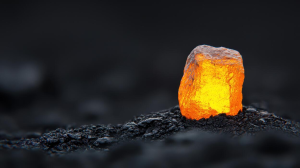
PuriActives® Crystal Retinal: retinal held within a cyclodextrin inclusion complex.
Scalp care draws on skincare concepts such as renewal, barrier support and the microbiome. The scalp is a specialized, follicle-rich skin surface with relevant retinoid biology.
A RETINOID-RESPONSIVE SURFACE
Scalp epidermis shares retinoid receptor mechanisms with facial skin. The retinal-to-retinoic-acid pathway can operate in keratinocytes across body sites.
A MICROBIAL DIMENSION
The follicle-rich scalp carries dense microbial communities, including C. acnes. Retinal’s reported activity against this organism provides a follicular-environment rationale.
FORMULATION CHALLENGES
Scalp products are often water-rich, surfactant-containing and transparent, creating stability challenges for unprotected retinal.
Retinoid skin biology: Saurat JH et al. J Invest Dermatol. 1994;103(6):770–774. Antibacterial activity: Pechère M et al. Dermatology. 1999;199(Suppl 1):29–31.
PART IV · SCALP SCIENCE AND HAIRCARE INNOVATION
Follicular biology: interpreting receptor evidence
The follicle is a retinoid-sensitive mini-organ. Receptor genetics defines the biological rationale and the limits of scalp-care positioning.
GENETIC EVIDENCE: RXRα AND THE HAIR CYCLE
Keratinocyte RXRα is required for a normal hair cycle.
Mice with targeted RXRα loss in epidermal and follicular keratinocytes developed progressive alopecia and failed to initiate anagen, establishing a requirement for this receptor signaling in the hair cycle.
Li M et al. Development. 2001;128(5):675–688.
REVIEW EVIDENCE: THE PILOSEBACEOUS UNIT
Retinoids act on follicular glands and epithelium.
An endocrine review of pilosebaceous biology discusses retinoid effects on sebocyte differentiation and follicular keratinization, processes relevant to scalp condition, oiliness and scaling.
Deplewski D, Rosenfield RL. Endocr Rev. 2000;21(4):363–392.
POSITIONING WITHIN THE EVIDENCE
Retinoid effects are dose-dependent, and excessive systemic exposure is associated with hair loss.
Crystal Retinal’s scalp positioning therefore concerns a balanced, comfortable scalp and follicular environment.
No hair-growth, density-increase or hair-loss-prevention claim is made or implied.
TAKEAWAY
Follicular retinoid sensitivity is established biology; cosmetic development opportunities concern scalp condition.
Li M et al. Development. 2001;128(5):675–688. Deplewski D, Rosenfield RL. Endocr Rev. 2000;21(4):363–392. Mechanistic evidence, not clinical validation of Crystal Retinal.
PART IV · SCALP SCIENCE AND HAIRCARE INNOVATION
Scalp-care opportunities from the formulation bench
Premium haircare increasingly uses skincare actives. Retinal development requires stability in realistic scalp formats: water-rich systems with surfactants and potentially prolonged residence.
THE CHALLENGE
Free retinal is difficult to stabilize in scalp formats.
Water, oxygen, light and surfactant environments can promote loss of unprotected retinal during product development and storage.
THE INCLUSION APPROACH
A protected guest available at the interface.
The inclusion complex reduces exposure of retinal’s conjugated system in the bulk formulation and allows guest exchange at the skin interface through water activity and lipid affinity.
A BRAND DEVELOPMENT CONCEPT
Skincare renewal adapted for the scalp.
Scalp comfort, balance, gentle renewal and follicular-environment care are anchored in published skin biology rather than hair-growth promises.
Stability engineering creates an opportunity to explore retinal in demanding scalp formats.
PART V · FORMULATION AND APPLICATIONS
Formulating Crystal Retinal: working principles
Inclusion chemistry provides a stabilization rationale, but processing remains important. Confirm each of these eight principles in the customer’s own stability program.
01 ADD DURING COOL-DOWN
Introduce the complex below typical hot-process temperatures to protect host–guest equilibrium.
02 CONTROL LIGHT FROM THE START
Use amber or opaque handling through production and filling.
03 BUILD ANTIOXIDANT SUPPORT
Chelators and antioxidant systems remain useful for retinoids, whether included or free.
04 SET pH USING MEASUREMENTS
Mildly acidic conditions are generally favorable; confirm the suitable window in the final base.
05 SCREEN COMPETING GUESTS
Hydrophobic fragrance constituents and oils may compete for the cyclodextrin cavity. Check displacement risk in compatibility tests.
06
AVOID STRONG OXIDATIVE CHALLENGES
Peroxides and aggressive preservative boosters can affect the polyene chain. Screen the full combination.
07
SPECIFY PROTECTIVE PACKAGING
Airless, low-permeability, light-protective packaging supports shelf-life retention.
08
VALIDATE IN THE REAL FORMULATION
Run accelerated and real-time stability tests on the finished product. Complex data guide development but do not replace product-level evidence.
Principles are drawn from retinoid and cyclodextrin literature. PuriPharm technical support can advise on specific bases.
Loftsson T, Brewster ME. J Pharm Sci. 1996;85(10):1017–1025. Yap KL et al. Eur J Pharm Sci. 2005;25(1):49–56. These principles are not validated specifications for a particular formulation.
PART V · FORMULATION AND APPLICATIONS
Skincare concepts informed by the evidence
NIGHT RENEWAL SERUM
Texture and wrinkle endpoints from randomized studies provide claim-development anchors. Inclusion is intended to support active retention during shelf life.
Evidence anchors: Kwon 2018; Creidi 1998.
GENTLE EVERYDAY RETINAL MOISTURIZER
Barrier findings and vehicle-like tolerability support routine-use development.
Evidence anchors: Fluhr 1999; Kwon 2018, TEWL and hydration.
FIRMING AND DENSITY CREAM
Ultrasound and explant evidence concerning thickness, elasticity and matrix recovery informs firmness concepts.
Evidence anchors: Diridollou 1999; Boisnic 1999.
EVEN-TONE SERUM
Significant melanin-index reduction at 0.1% and reported depigmenting activity support a concentration-specific concept.
Evidence anchors: Kwon 2018; Sorg 2013.
CLARIFYING CARE FOR BLEMISH-PRONE SKIN
C. acnes activity and comedolytic findings provide mechanistic support for pore-focused formulations.
Evidence anchors: Pechère 1999; Fort-Lacoste 1999.
EYE-AREA RENEWAL CARE
The source proposes retinal’s efficacy and tolerability profile as a development rationale for thin, sensitive skin around the eyes.
Evidence anchor: the cited tolerability literature.
Concepts only. Validate all claims in the final marketed product. Evidence anchors refer to the skin-benefit studies reviewed above.
PART V · FORMULATION AND APPLICATIONS
Scalp-care concepts
Four dosage-form concepts explore stabilized retinal for scalp care while retaining the limits of the evidence.
LEAVE-ON SCALP SERUM
A night-care concept for surface renewal and comfort, informed by retinal epidermal biology and tolerability literature.
BALANCING TONIC FOR OILY, CONGESTION-PRONE SCALPS
Reported C. acnes activity and follicular keratinization mechanisms support a clean, balanced follicular-environment concept.
INTENSIVE PRE-WASH CARE
A weekly concentrated step in an aqueous base, with active retention as a formulation-development objective.
CONDITIONER AND HAIR-MASK ADDITION
Explore rinse-off systems. Guest release and rinse compatibility require joint engineering by the brand and PuriPharm.
Concepts only. Use scalp-condition wording. The cited evidence does not support hair-growth, density-increase or hair-loss-prevention claims.
PART V · FORMULATION AND APPLICATIONS
Patent evidence: what the documents show
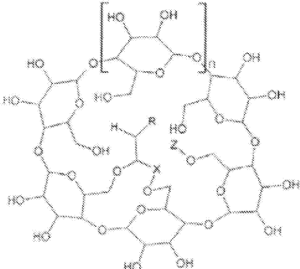
CN 103987391 B: a granted Chinese patent showing retinal–cyclodextrin acetal conjugate structures.
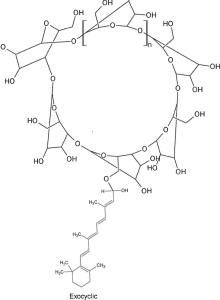
CN 103987391 B patent family: exocyclic retinal–cyclodextrin hemiacetal structure (VIII).
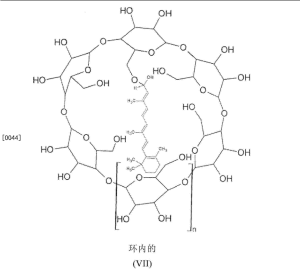
CN 103987391 B patent family: endocyclic structure (VII).
INTERPRETING THE RECORD
Patent documents cover both noncovalent inclusion complexes and covalent conjugates. PuriActives® Crystal Retinal is positioned as a molecular inclusion complex based on physical equilibrium. Related patent test data are discussed in the stability and patent-history sections.
Figures reproduced from granted patent documents for technical discussion: CN 103987391 B; the source also cites the US 10,864,148 B2 family. Patent structures and comparisons are not product specifications for Crystal Retinal.
PART VI · COMMERCIAL POSITIONING
One ingredient, four value pillars
MOLECULAR STABILIZATION
Cyclodextrin inclusion reduces environmental exposure of retinal’s conjugated system, informed by host–guest chemistry and retinoid-stabilization patents.
EFFICACY INFORMED BY RETINOIC ACID COMPARISONS
One metabolic step from the active form, with randomized cosmetic-concentration studies on texture, wrinkles, barrier function, hydration and pigmentation.
FORMULATION FLEXIBILITY
Inclusion enables exploration of creams, aqueous serums and scalp formats, with guest release at the skin interface as the development rationale.
A DOCUMENTED SCIENTIFIC STORY
Peer-reviewed clinical literature, patent tests and receptor biology provide a framework for claim development and review.
PRODUCT & PARTNERSHIP
Retinal science. The possibilities of molecular inclusion.

PuriActives® Crystal Retinal Cyclodextrin-Included Retinal combines a direct cosmetic retinoid precursor with molecular stabilization for skin and scalp formulation development.
PuriPharm Co., Ltd.
PuriActives® Crystal Retinal · INCI: RETINAL
Samples, technical documentation and development support available on request.
www.puriactives.com
This report is intended for professionals and summarizes published research and granted patent documents. Data characterize the retinal active class and the cited test materials. Finished-product claims require product-level validation.