ENGLISH VERSION
NanoActive Alavelle™Aminolevulinic Acid Nanoliposomes
Product overview
NanoActive Alavelle™
Aminolevulinic Acid Nanoliposomes · Advanced ALA Delivery for Skin and Scalp Innovation
Powered by PURISOME® FlexVes™ Liposome Technology
Purui Biomedical Technology Co., Ltd. · Innovation for Health and Beauty
Product identity
One active ingredient, engineered for delivery
Product name
NanoActive Alavelle™ Aminolevulinic Acid Nanoliposomes
Active ingredient INCI name
AMINOLEVULINIC ACID
Scientific identity
5-Aminolevulinic acid (5-ALA)
Delivery platform
PURISOME® FlexVes™ Liposome Technology
AMINOLEVULINIC ACID identifies the active component. The complete raw material is a multicomponent liposomal composition; see the technical documentation for the full INCI list.
5-ALA is a natural biochemical precursor of protoporphyrin IX (PpIX) in the heme pathway.
Application development landscape
■ Sprays for facial and scalp coverage
■ Topical aqueous gels
■ Scalp serums and tonics
■ Professional photoactivated treatments
■ Daylight photodynamic applications
■ Oral formulation development
Why this ingredient, why now
Development opportunities
5-ALA is one of the most extensively studied actives in photodynamic dermatology—and one of the most challenging to formulate.
4 Interconnected opportunities, one delivery platform
01 Stabilize the active. Protect a pH-sensitive hydrophilic molecule within engineered vesicles, turning aqueous stability measured in days into a usable shelf life.
02 Deliver where it matters. Improve transport to target skin compartments and sebum-rich follicles, rather than leaving the active on the surface.
One platform, multiple formats. Sprays, gels, scalp care, professional photoactivation and daylight photodynamic applications, with a separate oral development pathway.
Design for comfort. Build dose, incubation and light exposure into the protocol so efficacy and tolerability are developed together.
Mechanism of action
ALA in cell biology: the heme pathway

What happens when ALA is supplied externally?
Exogenous ALA bypasses the rate-limiting ALA synthase step and heme feedback control. In metabolically active cells, including sebaceous glands and proliferative epidermis, limited ferrochelatase capacity favors PpIX accumulation in target tissue.
Schematic of heme biosynthesis. 5-ALA is a metabolic precursor of PpIX; it is not itself a photoactivated photosensitizer.
Innovation pathways
Two routes to application innovation
Route A—photoactivated chemistry
Vesicular delivery → intracellular PpIX → controlled illumination → photodynamic response
Skin renewal and photorejuvenation: 0.5% liposomal ALA spray + IPL has been studied for wrinkles and photodamage.
Pilosebaceous care: follicular delivery combined with IPL has been studied in inflammatory acne.
Daylight protocols: continuous low-dose activation has clinical validation in actinic keratosis studies.
Piccioni et al. | J Dermatolog Treat | 2011 · Yeung et al. | Dermatol Surg | 2011 · Dirschka et al. | JEADV | 2019
Route B—non-photodynamic combinations
ALA + iron/peptide cofactors → dermal papilla signaling → follicle research
No light required. ALA combined with ferric ammonium citrate activates ERK/AKT signaling in dermal papilla cells and supports hair-shaft elongation in ex vivo human follicles.
Combination logic. Peptide (GHK) and iron partners define the studied systems; results belong to the combination, not to ALA alone.
Ryu et al. | FEBS Open Bio | 2026 · Lee et al. | Ann Dermatol | 2016 · Morokuma et al. | Int J Dermatol | 2008
Formulation science
Why formulation matters: ALA is highly formulation-sensitive
1 · A hydrophilic zwitterion facing a lipid barrier
At physiological pH, ALA carries both positive and negative groups and partitions poorly into the lipid-rich stratum corneum. Unformulated aqueous ALA largely remains on the surface.
2 · pH-triggered dimerization, followed by oxidation
Above approximately pH 5, the deprotonated amino group of one ALA molecule attacks another molecule’s ketone group. The resulting dihydropyrazine (DHPY) oxidizes in air to inactive pyrazine (PY), with loss of PpIX-forming activity.
3 · Second-order decay that antioxidants cannot stop
Degradation accelerates with the square of the free ALA concentration. Chelators and antioxidants cannot stop the primary pathway; effective controls are pH, temperature and oxygen exclusion.
Measured half-life of 1% aqueous ALA (50 °C)
3 h
pH 7.42—near physiological pH
257 h
pH 4.81—mild acidification
37 d
Stable at pH 2.35—fully protonated amino group
The active’s microenvironment—pH, oxygen and molecular mobility—determines shelf life. Formulation creates the challenge and provides the solution.
Bunke et al. | J Pharm Sci | 2000 | PMID: 10980508 · Elfsson et al. | Eur J Pharm Sci | 1999 | PMID: 9845784
Delivery platform
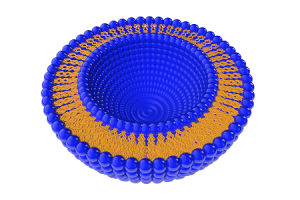
PURISOME® FlexVes™: an architecture for hydrophilic actives
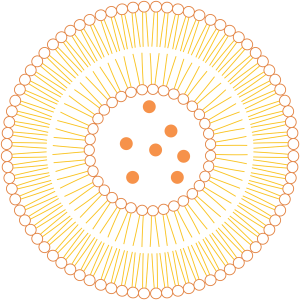
Phospholipid bilayer membrane
Aqueous core—hydrophilic ALA payload
Flexible, skin-compatible vesicle design
What this architecture does
Accommodates the payload correctly. ALA resides in aqueous and interfacial regions, associating with phospholipid headgroups rather than dissolving in oil.
Stabilizes the chemistry. Restricted molecular mobility and controlled local pH slow the dimerization that degrades aqueous ALA.
Prepares for delivery. A deformable lipid membrane supports partitioning into the stratum corneum and sebum-rich follicles.
Published studies of liposomal ALA delivery and treatment protocols are cited as technical background for this platform class.
PURISOME® FlexVes™ Liposome Technology
Formulation science
Stability through formulation design
01 Interfacial association. ALA associates with phospholipid headgroups, reducing free-molecule collisions that drive second-order dimerization.
02 Microenvironmental pH. A mildly acidic interface keeps amino groups protonated and unable to attack neighboring ketone groups.
03 Compartmentalization. Interfacial membranes restrict orientation and contact, turning one bulk phase into many isolated microenvironments.
04 Locally reduced oxygen. The lipid environment limits oxygen access to DHPY intermediates, slowing irreversible oxidation to inactive PY.
Published precedent. In a phospholipid nanovesicular gel containing 7.8% ALA, reported association with phosphatidylcholine polar headgroups extended stability from days in water to a shelf life of 24–36 months. PURISOME® vesicles apply the same physical rationale.
Days Aqueous solution → 24–36 months
Reported shelf life of a 7.8% ALA nanovesicular gel
Quality note: measure chemical stability (ALA content and pyrazine impurities) separately from vesicle size and appearance. Colloidal stability alone does not prove chemical stability. Antioxidants have little effect on the main condensation pathway; effective measures include pH below approximately 5 and oxygen exclusion.
Reinhold | Future Oncol | 2017 | PMID: 28805092 · Bunke et al. | J Pharm Sci | 2000 | PMID: 10980508
Formulation science
Aqueous vs nanovesicular systems: what changes for ALA?
Table expanded in original row order; all column labels and data are retained.

Read the shelf-life row correctly: 24–36 months refers to that specific proprietary nanovesicular gel. It is neither a general emulsion claim nor a NanoActive Alavelle™ specification. Every formulation needs its own stability program with ALA content and pyrazine impurities as endpoints; size and appearance alone cannot prove chemical stability.
Bunke et al. | J Pharm Sci | 2000 | PMID: 10980508 · Reinhold | Future Oncol | 2017 | PMID: 28805092 · Elfsson et al. | Eur J Pharm Sci | 1999
Delivery evidence
Delivery into skin and follicular compartments
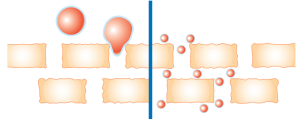
Schematic: smaller vesicles can pass between corneocytes

Confocal cross-sections: as particle size decreases (a → c), fluorescent material reaches deeper skin layers
Particle size defines the depth budget
Vesicle size and membrane deformability determine how far the carrier delivers its payload. Comparative studies show that deformable liposomes can substantially improve ALA delivery into skin.
Follicles provide a fast route
Hair follicles and sebaceous glands bypass the stratum corneum and extend into the dermis. Lipid vesicles readily partition into this sebum-rich environment.
Local retention rather than systemic absorption
The goal is retention in skin compartments where PpIX forms. After topical ALA application, plasma levels remained within normal reference ranges; delivery is intended to be local.
Oh et al. | Eur J Pharm Sci | 2011 | PMID: 21782942 · Schmitz et al. | Photodiagn Photodyn Ther | 2016 · Rick et al. | J Photochem Photobiol B | 1997
Evidence—delivery
Low-concentration liposomal ALA: rapid, self-limiting PpIX formation
A 0.5% liposomal ALA spray saturates skin fluorescence in approximately 2 hours, with clearance within 8 hours.
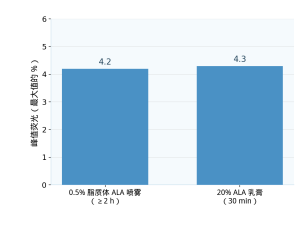
Mean peak skin PpIX fluorescence, expressed as a percentage of maximum (healthy volunteers, n = 10). The source describes the protocols as statistically equivalent (P = 0.47).
Plateau at about 2 h. Non-occluded 0.5% liposomal ALA reaches a fluorescence plateau after approximately two hours.
Return to baseline within 8 h. The signal declines within minutes after removal and clears fully within eight hours, giving a short photosensitivity window.
Comparison with 20% cream. Fluorescence continues rising for approximately eight hours after removal of the high-concentration cream, producing a longer, less controllable exposure tail.
Concentrations here describe dose and kinetics, not a fold-increase in bioavailability.
Christiansen et al. | Lasers Surg Med | 2007 | PMID: 17457834
Mechanism—light
Photoactivation: PpIX photochemistry needs photons and oxygen
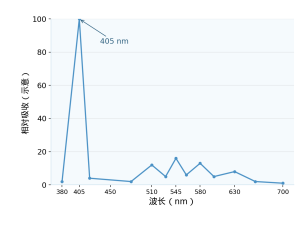
PpIX absorption profile: Soret band (approximately 405 nm) and Q bands (approximately 510–635 nm). Schematic, not to scale.
Blue light, 405–417 nm
Red light, 630–635 nm
Daylight and IPL cover the full activation spectrum
1 · Excitation. PpIX absorbs a photon and enters a long-lived triplet state.
2 · Energy transfer. Triplet PpIX transfers energy to dissolved molecular oxygen (Type II photochemistry), producing singlet oxygen and ROS.
3 · Local response. ROS act within micrometers of PpIX, mapping the response to the tissue reached by delivery.
4 · Dose rate is a design variable. Spectrum, irradiance and duration shape efficacy and comfort. Continuous low-rate daylight activation can deliver a comparable cumulative dose with much less pain than high-intensity lamps.
For photochemistry and PpIX photophysics, see Bunke et al. | J Pharm Sci | 2000 and Christiansen et al. | Lasers Surg Med | 2007.
Evidence—skin renewal
Photodynamic photorejuvenation: a measurable light dose guided by the skin
The liposomal ALA concept was developed for photodamaged skin: deliver a low-dose precursor, use skin fluorescence to indicate PpIX formation, then activate it with light.
1.7 vs 1.1
Mean participant-rated improvement in skin quality in a fluorescence-guided photodynamic rejuvenation study (0–4 scale)
2007
Mapping the fluorescence kinetics of 0.5% liposomal ALA in normal skin
2009
Fluorescence-controlled photorejuvenation: skin signals determine the light dose
2011
Wrinkle study: 30 participants, three liposomal ALA + IPL sessions
2011
A pilot study in inflammatory facial acne using the same spray + IPL approach
Implication for development: spray format, a 0.5% dose and IPL use have been published together, providing a literature template for professional photoactivated skin care.
Christiansen et al. | Lasers Surg Med | 2007 · Bjerring et al. | Lasers Surg Med | 2009; 41:327–336 · Piccioni et al. | 2011 · Yeung et al. | 2011
Clinical evidence—photorejuvenation
Wrinkle scores fall after three 0.5% liposomal ALA + IPL sessions
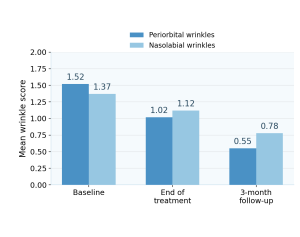
Mean modified Fitzpatrick wrinkle scores (lower is milder). These are means on an ordinal scale, not direct percentage measurements of wrinkle depth.
Study design
30 participants with facial photodamage
Three sessions of 0.5% liposomal ALA spray + IPL
Three-week intervals
Follow-up three months after the final session
Scores improved further between the last session and follow-up, consistent with ongoing post-treatment remodeling.
Piccioni et al. | J Dermatolog Treat | 2011 | DOI: 10.3109/09546634.2011.590791 | PMID: 21801099
Clinical evidence—dermal remodeling
Beyond wrinkle scores: the procollagen response after ALA-PDT
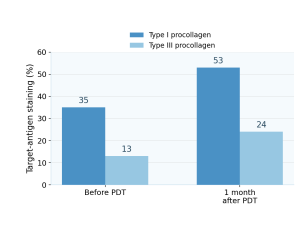
Mean target-antigen staining (%), paired biopsies before and one month after two ALA-PDT sessions. Values are approximate readings from Figure 2C. This is a photoactivation protocol, not evidence for unilluminated ALA.
Original histology (Figure 2B): Masson’s trichrome staining of dermal collagen

Study protocol
Two ALA-PDT sessions one month apart; 14 patients with facial actinic keratoses; 25 paired biopsies before treatment and one month afterward.
Histological findings
↑ Total dermal collagen; ↑ type I/III procollagen
↑ Epidermal TGF-β and TGF-β receptor II
↓ MMP-1, MMP-3 and MMP-12 (collagen-degrading enzymes)
↓ Solar elastosis; ↓ inflammatory infiltrates
ALA-PDT → ↑ TGF-β → ↑ procollagen I/III → ↓ MMP-1/3/12 → ↓ elastosis
Park MY, Sohn S, Lee ES, Kim YC | J Am Acad Dermatol | 2010;62:85–95 | DOI: 10.1016/j.jaad.2009.06.025 | PMID: 19926165
Clinical evidence—acne
Follicular delivery supports improvement in inflammatory acne
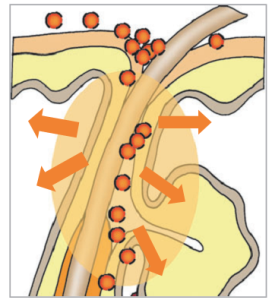
Pilosebaceous unit: the hair follicle and sebaceous gland as delivery targets
Why follicles matter. Inflammatory acne is a disease of the pilosebaceous unit, a structure preferentially accessed by lipid vesicles.
Delivery rationale. The lipophilic vesicle surface mixes with sebum, carrying the hydrophilic precursor down the follicular canal.
Activation rationale. PpIX forms in sebaceous tissue; IPL then drives a local photodynamic response.
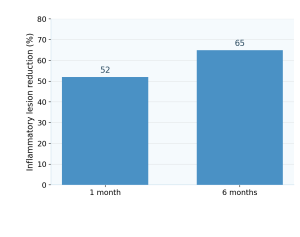
Mean reduction in inflammatory lesion counts (%) after 0.5% liposomal ALA spray + IPL; pilot study in 12 participants.
Yeung et al. | Dermatol Surg | 2011 | DOI: 10.1111/j.1524-4725.2011.01929.x | PMID: 21414073
Evidence—tissue level
Tissue evidence: PpIX forms where the carrier delivers ALA
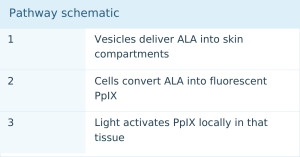
Full-thickness ex vivo skin—Maisch 2010
An ALA nanoemulsion induced measurable PpIX fluorescence in a full-thickness skin model: the delivered precursor reached viable epidermis and was metabolized there.
Ex vivo human skin comparison—Schmitz 2016
Formulation choice changed both epidermal ALA delivery and PpIX formation. The carrier, as well as the active, determines the tissue dose.
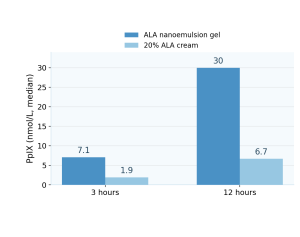
PpIX in tissue lysates (nmol/L, median), ex vivo human eyelid skin from 10 donors; redrawn from the reported data (Schmitz et al., 2016).
Maisch et al. | Exp Dermatol | 2010 | DOI: 10.1111/j.1600-0625.2009.01001.x · Schmitz et al. | Photodiagn Photodyn Ther | 2016 | DOI: 10.1016/j.pdpdt.2015.11.004
Evidence—imaging
Imaging evidence: fluorescence follows the carrier, not just the active
Schmitz 2016, Figure 2—original image
Placebo
Nanoemulsion gel
20% cream
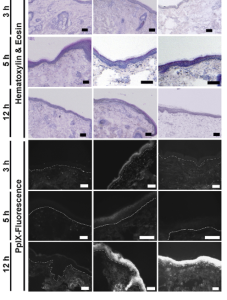
Image labels: 3 h, 6 h and 12 h; hematoxylin & eosin; PpIX fluorescence. Columns: placebo, nanoemulsion gel, 20% cream.
H&E and PpIX fluorescence cryosections; ex vivo human eyelid skin from 10 donors.
Christiansen 2007, Figure 6—original image
Follicle/lesion-selective signal (A) vs uniform signal (B)
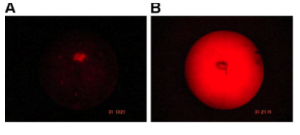
Measured skin-surface PpIX fluorescence: 0.5% liposomal ALA spray for 3 h without occlusion (A) vs occluded 20% ALA cream (B). The lipid carrier concentrates the signal in follicles and lesions.
de Leeuw 2010, Figure 3—original image
Split-face comparison, one day after identical IPL settings
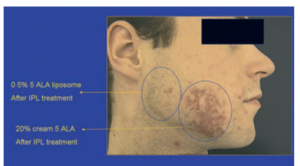
Image labels: 0.5% 5-ALA liposomes; 20% 5-ALA cream; after IPL treatment.
Non-occluded 0.5% liposomal ALA spray (left circled area) vs occluded 20% ALA cream (right). Tolerability differs with delivery and protocol, rather than with the active alone.
Original images reproduced from the cited publications for scientific reference. Third-party trademarks appearing in the source images were neutralized in the supplied PPT. Microscopy supports localization, not quantitative depth measurement.
Schmitz et al. | Photodiagn Photodyn Ther | 2016 | DOI: 10.1016/j.pdpdt.2015.11.004 · Christiansen et al. | Lasers Surg Med | 2007 | PMID: 17457834 · de Leeuw et al. | JEADV | 2010 | DOI: 10.1111/j.1468-3083.2009.03447.x
Protocol design
Designing for efficacy and comfort together
Table expanded in original row order; all column labels and data are retained.

Comfort is a property of the whole protocol—formulation, incubation and illumination—not encapsulation alone.
Christiansen et al. | Lasers Surg Med | 2007 | PMID: 17457834 · Dirschka et al. | JEADV | 2019 | PMID: 30022544
Daylight photodynamic applications
Daylight as the light source: a simple, continuous protocol
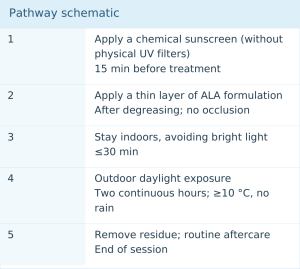
Why continuous low-intensity light can remain comfortable
During two hours of daylight, PpIX is activated and photobleached almost as soon as cells synthesize it. Tissue PpIX stays at a low steady state, delivering cumulative photochemical exposure without the concentration spikes associated with treatment pain.
Protocol flexibility: seasonal natural daylight or simulated-daylight lamps that avoid weather and latitude constraints, both evaluated clinically.

Image label: assessment after 12 weeks.
Original daylight PDT treatment schematic (Wiegell et al., 2008, Figure 1). A professional clinical protocol, not consumer sun-exposure guidance.
Schematic: Wiegell et al. | Br J Dermatol | 2008 | PMID: 18294318 · Protocol: Dirschka et al. | JEADV | 2019 | PMID: 30022544 · Simulated daylight: Bai-Habelski et al. | 2021
Clinical evidence—daylight
Daylight PDT: comparable clearance, lower recurrence and very little pain
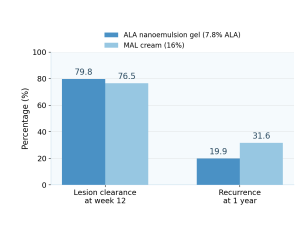
Values are percentages. Single-session daylight PDT; randomized intraindividual controlled phase III study in 52 patients with actinic keratoses. Non-inferiority P < 0.0001; recurrence difference P = 0.01.
1.2 vs >4
Mean maximum pain during daylight exposure (VAS 0–10), compared with reported mean values above 4 for conventional lamp-based PDT
Reading the evidence correctly
Indication: actinic keratosis, a clinical endpoint shown here as delivery-platform evidence, not cosmetic efficacy.
Carrier: a phospholipid nanoemulsion gel, related to liposomal technology, clinically demonstrating daylight-compatible ALA delivery.
Design: randomized split-face non-inferiority study; 52 randomized, 49 per protocol; gel = 10% ALA hydrochloride (approximately 7.8% free acid), versus 16% methyl aminolevulinate cream.
Dirschka et al. | J Eur Acad Dermatol Venereol | 2019 | DOI: 10.1111/jdv.15185 | PMID: 30022544
Scalp science
Follicle biology: a second home for vesicular delivery
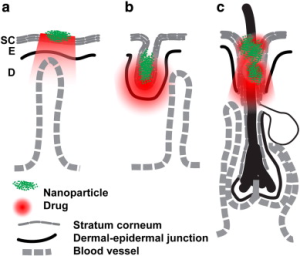
Image labels: nanoparticle, drug; SC = stratum corneum, E = epidermis, D = dermis; dermal–epidermal junction; blood vessel.
Particle-delivery pathways at the follicle: surface film, follicular canal and deeper follicular penetration
The follicle is a living, cycling mini-organ
Dermal papilla cells at its base drive the anagen–catagen–telogen cycle. Their metabolic activity makes them a relevant target for active combinations.
Follicles bypass the barrier
The follicular canal extends into the dermis, with no mature stratum corneum in deeper regions—a natural bypass available to vesicles.
Sebum supports lipid vesicles
The sebum-rich canal is chemically compatible with phospholipid vesicles, supporting retention and release near the papilla.
This development route requires no photoactivation: the non-photodynamic track for NanoActive Alavelle™.
Scalp science
Inside the papilla: ERK/AKT signaling triggered by ALA + iron
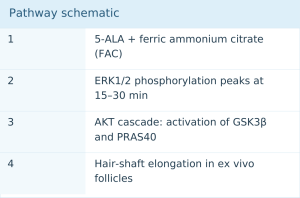
HMOX1 (HO-1) remained unchanged. Signaling involved ERK/AKT, rather than the sometimes-assumed ALA + iron heme oxygenase pathway.
Reading the evidence correctly
A combination, not ALA alone. Cellular and follicular responses were observed with joint 5-ALA and iron exposure and cannot be attributed to ALA itself.
Models, not patients. Immortalized dermal papilla cells and ex vivo follicle organ culture are mechanistic models. Clinical endpoints require clinical studies.
Ryu et al. | FEBS Open Bio | 2026 | DOI: 10.1002/2211-5463.70230 | PMID: 41873782
Scalp science
Original data from follicle models (open access)
Phospho-kinase array—Figure 3A (original)
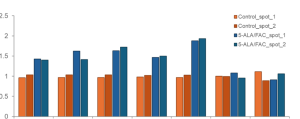
Image labels: Control_spot_1/2 and 5-ALA/FAC_spot_1/2. The supplied PPT image has no visible x-axis item names; none have been inferred.
Relative phosphorylation in dermal papilla cells, 1 µM 5-ALA/FAC vs control: increased kinases along the ERK/AKT axis.
Follicle organ culture—Figure 4B (original)
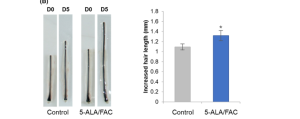
Image labels: D0/D5 = days 0/5; control; 5-ALA/FAC combination; increased hair length (mm). The asterisk is the original significance marker; P < 0.05 is specified in the text.
Hair-shaft elongation after five days of ex vivo human follicle organ culture, combination vs control, n = 20, P < 0.05.
Original images reproduced under CC BY 4.0 (© 2026 the authors; FEBS Open Bio / John Wiley & Sons). Results belong to the 5-ALA + FAC combination, not ALA alone, and to model systems rather than human clinical outcomes.
Ryu et al. | FEBS Open Bio | 2026;16:1527–1536 | DOI: 10.1002/2211-5463.70230 | PMID: 41873782 | Open access CC BY 4.0
Scalp science
Three levels of hair evidence: cells, follicles and humans
Table expanded in original row order; all column labels and data are retained.

What the three studies have in common
Every positive hair-related result combined ALA with an iron source or peptide partner: the combination is the active principle. None used photoactivation; this is a chemistry-and-delivery pathway, not PDT.
Ryu et al. | FEBS Open Bio | 2026 | PMID: 41873782 · Lee et al. | Ann Dermatol | 2016 | PMID: 27489425 · Morokuma et al. | Int J Dermatol | 2008 | PMID: 19126021
Product formats
Sprays and aqueous gels: built around vesicles
Leave-on spray
Forms a thin, even film without rubbing, treating the application site gently. Covers large areas and reaches the scalp through hair. Low viscosity naturally suits aqueous vesicle dispersions.
Precedent: the published liposomal ALA skin studies used spray formulations.
Aqueous gel
Provides longer residence at precisely targeted sites, with accurate, repeatable dosing.
A water-based gel keeps hydrophilic ALA in a compatible environment while vesicles handle delivery.
Formulation guardrails from the stability literature
pH approximately 5–6. Balance ALA chemical stability with skin compatibility.
Protect from oxygen and light. Packaging is part of the stability strategy.
Test chemistry, not just colloids. Track ALA content and pyrazine condensation impurities; size and PDI alone cannot establish active integrity.
Watch cosolvent levels. Published ALA nanoemulsion data associate excess polyols with impurity formation.
Bunke et al. | J Pharm Sci | 2000 | PMID: 10980508 · Christiansen et al. | Lasers Surg Med | 2007 | PMID: 17457834
Scalp science
Scalp-care concepts: the non-photodynamic route
Leave-on scalp serum
A vesicle dispersion targeting the follicular canal, designed for overnight residence near the papilla’s “doorway.”
Daily nourishing mist
A lightweight aqueous formula provides broad, even coverage through hair, using a format with published precedent in ALA scalp applications.
Pretreatment gel
Controlled, timed contact before rinsing, for consumers who prefer a defined exposure window.
Combination-first design
Published hair-study results belong to ALA combined with iron or peptide partners. Formulate the concept around the combination, not ALA alone.
Concepts, not specifications. These are development directions for brand partners. Concentration, packaging and shelf life depend on each partner’s formulation and stability studies. None of these concepts involves photoactivation.
Basis: Ryu et al. | FEBS Open Bio | 2026 | PMID: 41873782 · Lee et al. | Ann Dermatol | 2016 | PMID: 27489425 · Morokuma et al. | Int J Dermatol | 2008 | PMID: 19126021
Professional applications
Photoactivated formats: formulation, light and evidence
Table expanded in original row order; all column labels and data are retained.

How Purui Biomedical positions this evidence
These are professional protocols studied in clinical settings. For NanoActive Alavelle™, they provide platform evidence that low-concentration ALA in engineered carriers works under real illumination, rather than cosmetic product claims.
Piccioni et al. | J Dermatolog Treat | 2011 | PMID: 21801099 · Yeung et al. | Dermatol Surg | 2011 | PMID: 21414073 · Dirschka et al. | JEADV | 2019 | PMID: 30022544 · Bai-Habelski et al. | Photodiagn Photodyn Ther | 2021 | DOI: 10.1016/j.pdpdt.2021.102692
Route-specific science
Another route: lessons from oral ALA pharmacokinetics
≈60%
Oral 5-ALA bioavailability in healthy volunteers
≈45 min
Elimination half-life—rapid systemic clearance
Rapid absorption, onset and clearance: kinetics fundamentally different from a topical leave-on product.
Route-specific data cannot be transferred across routes
No cross-route extrapolation. Oral bioavailability and clearance do not establish topical penetration, and vesicular skin-delivery data do not establish oral exposure.
A separate development program is required. Any oral concept based on ALA chemistry needs its own regulatory and clinical pathway. The PURISOME® platform discussed here targets topical delivery.
Dalton et al. | J Pharmacol Exp Ther | 2002 | DOI: 10.1124/jpet.301.2.507 | PMID: 11961050
Formulator’s checklist
Six decisions that determine whether ALA survives and performs
Table expanded in original row order; all column labels and data are retained.

Elfsson et al. | Eur J Pharm Sci | 1999 | PMID: 9845784 · Bunke et al. | J Pharm Sci | 2000 | PMID: 10980508 · Dalton et al. | J Pharmacol Exp Ther | 2002 | PMID: 11961050
Platform overview
One platform, four evidence-informed directions
Table expanded in original row order; all column labels and data are retained.

Each evidence label corresponds to a full citation in the reference section. NanoActive Alavelle™ product specifications are provided by Purui Biomedical under project-specific agreements.
Closing perspective
One molecule, one platform, multiple thoughtfully designed formats.
01 Stabilize the chemistry
Control pH and oxygen; demonstrate integrity by testing ALA and its condensation impurities.
02 Deliver where it matters
Flexible phospholipid vesicles carry hydrophilic ALA across the barrier and along the follicular bypass.
03 Design for comfort
Low loading, short contact and gentle illumination: comfort is a protocol property.
Purui Biomedical Technology Co., Ltd.
NanoActive Alavelle™ Aminolevulinic Acid Nanoliposomes—powered by PURISOME® Liposome Technology
Innovation for Health and Beauty
Regulatory statement: finished products containing NanoActive Alavelle™ must comply with the laws and regulations of the countries or regions where they are manufactured and sold. The brand is responsible for final-product regulatory compliance.
References
References (Part 1 of 2)
01 · Rick K, Sroka R, Stepp H, Kriegmair M, Huber RM, Jacob K, Baumgartner R. Pharmacokinetics of 5-aminolevulinic acid-induced protoporphyrin IX in skin and blood. J Photochem Photobiol B. 1997;40(3):313–319. DOI: 10.1016/S1011-1344(97)00076-6 · PMID: 9372622
02 · Elfsson B, Wallin I, Eksborg S, Rudaeus K, Ros AM, Ehrsson H. Stability of 5-aminolevulinic acid in aqueous solution. Eur J Pharm Sci. 1999;7(2):87–91. DOI: 10.1016/S0928-0987(98)00098-8 · PMID: 9845784
03 · Bunke A, Zerbe O, Schmid H, Burmeister G, Merkle HP, Gander B. Degradation mechanism and stability of 5-aminolevulinic acid. J Pharm Sci. 2000;89(10):1335–1341. PMID: 10980508
04 · Dalton JT, Yates CR, Yin D, Straughn A, Marcus SL, Golub AL, Meyer MC. Clinical pharmacokinetics of 5-aminolevulinic acid in healthy volunteers and patients at high risk for recurrent bladder cancer. J Pharmacol Exp Ther. 2002;301(2):507–512. DOI: 10.1124/jpet.301.2.507 · PMID: 11961050
05 · Christiansen K, Bjerring P, Troilius A. 5-ALA for photodynamic photorejuvenation — optimization of treatment regime based on normal-skin fluorescence measurements. Lasers Surg Med. 2007;39(4):302–310. PMID: 17457834
06 · Morokuma Y, Yamazaki M, Maeda T, Yoshino I, Ishizuka M, Tanaka T, Ito Y, Tsuboi R. Hair growth stimulatory effect by a combination of 5-aminolevulinic acid and iron ion. Int J Dermatol. 2008;47(12):1298–1303. PMID: 19126021
07 · Bjerring P, Christiansen K, Troilius A, Bekhor P, de Leeuw J. Skin fluorescence controlled photodynamic photorejuvenation (wrinkle reduction). Lasers Surg Med. 2009;41(5):327–336.
08 · Maisch T, Santarelli F, Schreml S, Babilas P, Szeimies RM. Fluorescence induction of protoporphyrin IX by a new 5-aminolevulinic acid nanoemulsion used for photodynamic therapy in a full-thickness ex vivo skin model. Exp Dermatol. 2010;19(8):e302–e305. DOI: 10.1111/j.1600-0625.2009.01001.x · PMID: 19845760
09 · Oh EK, Jin SE, Kim JK, Park JS, Park Y, Kim CK. Retained topical delivery of 5-aminolevulinic acid using cationic ultradeformable liposomes for photodynamic therapy. Eur J Pharm Sci. 2011;44(1–2):149–157. DOI: 10.1016/j.ejps.2011.07.003 · PMID: 21782942
10 · Piccioni A, Fargnoli MC, Schoinas S, Suppa M, Frascione P, Ginebri A, Chimenti S, Peris K. Efficacy and tolerability of 5-aminolevulinic acid 0.5% liposomal spray and intense pulsed light in wrinkle reduction of photodamaged skin. J Dermatolog Treat. 2011;22(5):247–253. DOI: 10.3109/09546634.2011.590791 · PMID: 21801099
References
References (Part 2 of 2)
11 · Yeung CK, Shek SY, Yu CS, Kono T, Chan HH. Liposome-encapsulated 0.5% 5-aminolevulinic acid with intense pulsed light for the treatment of inflammatory facial acne: a pilot study. Dermatol Surg. 2011;37(4):450–459. DOI: 10.1111/j.1524-4725.2011.01929.x · PMID: 21414073
12 · Lee WJ, et al. Efficacy of a complex of 5-aminolevulinic acid and glycyl-histidyl-lysine peptide on hair growth. Ann Dermatol. 2016;28(4). PMID: 27489425
13 · Schmitz L, Novak B, Hoeh AK, Luebbert H, Dirschka T. Epidermal penetration and protoporphyrin IX formation of two different 5-aminolevulinic acid formulations in ex vivo human skin. Photodiagnosis Photodyn Ther. 2016;14:40–46. DOI: 10.1016/j.pdpdt.2015.11.004 · PMID: 26607556
14 · Ryu et al. Combined 5-aminolevulinic acid and ferric ammonium citrate treatment promotes hair follicle growth by activating dermal papilla cells. FEBS Open Bio. 2026. DOI: 10.1002/2211-5463.70230 · PMID: 41873782
15*Reinhold U. Review of a 7.8% ALA nanoemulsion gel for the photodynamic treatment of mild-to-moderate actinic keratosis. Future Oncol. 2017;13(27):2413–2428. DOI: 10.2217/fon-2017-0247 · PMID: 28805092
16*Dirschka T, Ekanayake-Bohlig S, Dominicus R, et al. Randomized, intraindividual, non-inferiority phase III study of daylight photodynamic therapy comparing a 7.8% ALA nanoemulsion gel with MAL cream in actinic keratosis. J Eur Acad Dermatol Venereol. 2019;33(2):288–297. DOI: 10.1111/jdv.15185 · PMID: 30022544
17*Bai-Habelski JC, Medrano K, Palacio A, Reinhold U. Prospective study of simulated daylight photodynamic therapy with an indoor daylight-reproducing system and a 7.8% ALA nanoemulsion gel in actinic keratosis. Photodiagnosis Photodyn Ther. 2021;37:102692. DOI: 10.1016/j.pdpdt.2021.102692
18 · Park MY, Sohn S, Lee ES, Kim YC. Photorejuvenation induced by 5-aminolevulinic acid photodynamic therapy in patients with actinic keratosis: a histologic analysis. J Am Acad Dermatol. 2010;62(1):85–95. DOI: 10.1016/j.jaad.2009.06.025 · PMID: 19926165
19de Leeuw J, van der Beek N, Bjerring P, Neumann HA. Photodynamic therapy of acne vulgaris using 5-aminolevulinic acid 0.5% liposomal spray and intense pulsed light in combination with topical keratolytic agents. J Eur Acad Dermatol Venereol. 2010;24(4):460–469. DOI: 10.1111/j.1468-3083.2009.03447.x
20 · Wiegell SR, Haedersdal M, Philipsen PA, Eriksen P, Enk CD, Wulf HC. Continuous activation of PpIX by daylight is as effective as and less painful than conventional photodynamic therapy for actinic keratoses; a randomized, controlled, single-blinded study. Br J Dermatol. 2008;158(4):740–746. DOI: 10.1111/j.1365-2133.2008.08450.x · PMID: 18294318
*Descriptive titles are used to avoid third-party trademarks in this document. Each publication can be identified uniquely by its DOI/PMID.