PuriActives® TocoPhos™Sodium Tocopheryl Phosphate
PRODUCT & BRAND
PuriActives® TocoPhos™ Sodium Tocopheryl Phosphate
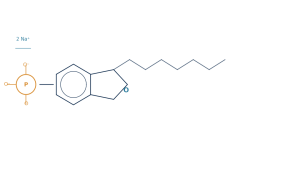
PuriPharm Co., Ltd.
Vitamin E, reimagined for skin and scalp.
INCI: SODIUM TOCOPHERYL PHOSPHATE
A phosphorylated vitamin E active with aqueous compatibility and biological activation in skin, supported by peer-reviewed studies on oxidative-stress protection and moisturization.
INGREDIENT OPPORTUNITY
One molecule, four formulation-relevant advantages
DESIGNED FOR AQUEOUS COMPATIBILITY
A 6-O-phosphate group masks the oxidation-sensitive phenolic hydroxyl, with sodium counterions converting an oily antioxidant into a water-dispersible powder for serums, essences and gels. Kato et al. 2011; Zingg 2018.
ACTIVATION AT THE SITE OF ACTION
After uptake, cellular phosphatases hydrolyze the phosphate to release active α-tocopherol within cells. Hydrolysis was not observed in the culture medium itself. Nishio et al. 2011; Saleh et al. 2021.
DUAL STRESS PROTECTION
In human keratinocytes, the sodium salt suppressed UVB-induced reactive nitrogen species (RNS) and reduced prostaglandin E2 (PGE2) responses to UVB, IL-1β and peroxide challenges. Nakama et al. 2009; Kato et al. 2011.
MOISTURE AND BARRIER SUPPORT
Topical treatment increased stratum corneum ceramides through serine palmitoyltransferase (SPT) and keratinocyte-differentiation pathways, improving moisture retention in hairless mouse skin. Kato & Takahashi 2012.
Phosphorylated vitamin E connects skin-defense research, moisturization mechanisms and contemporary formulation opportunities.
FORMULATION CHALLENGES
Why rethink vitamin E?
THE CLASSIC MOLECULE AND ITS FORMULATION CHALLENGES
OXIDATION SENSITIVITY
The phenolic hydroxyl is α-tocopherol’s antioxidant site and a key site of oxidation. Oxidation can deplete its activity.
AN OIL IN AN AQUEOUS WORLD
A viscous, hydrophobic liquid requires solubilization or emulsification for aqueous serums, essences and scalp formats.
ESTERS SOLVE ONLY PART OF THE PROBLEM
Tocopheryl acetate is stable but remains oily and depends on skin esterases. It produced much less tocopherol than the phosphate salt after 24 hours in a reconstructed human skin model. Kato et al. 2011, Figure 2A.
WHAT PHOSPHATE CHEMISTRY CHANGES
PROTECTED PHENOLIC HYDROXYL
The 6-O-phosphate masks the oxidizable hydroxyl until enzymatic hydrolysis. Kato et al. 2011.
A WATER-COMPATIBLE SALT
Sodium counterions yield a powder suitable for incorporation into the aqueous phase.
ACTIVATION AFTER UPTAKE
Cellular phosphatases release α-tocopherol after uptake, rather than in the culture medium. Nishio et al. 2011.
This chemistry supports development of water-based serums, essences, gels and leave-on scalp products.
MOLECULAR IDENTITY
A chromanol core with distinct functional regions
VITAMIN E FAMILY STRUCTURES
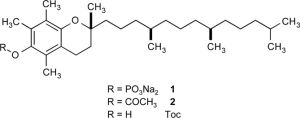
Adapted from Kato et al. 2011, Figure 1. Compound 1 is disodium tocopheryl phosphate, the TocoPhos™ active, shown with α-tocopherol and tocopheryl acetate.
IONIZATION OF THE PHOSPHATE GROUP
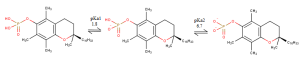
Adapted from Saleh et al. 2020, Figure 1. The phosphate undergoes two ionization steps, with pKa values of approximately 1.8 and 6.7. A predominantly dianionic state is described near pH 7.4.
CHROMANOL HEAD: ANTIOXIDANT CORE
The 6-position phenolic hydroxyl captures radicals in vitamin E; phosphorylation protects this site.
6-O-PHOSPHATE: AN IONIZABLE HANDLE
Ionization depends on pH. Near pH 7.4, the predominantly dianionic form supports water affinity while the phosphate protects the phenolic hydroxyl until hydrolysis.
SODIUM SALT: THE INCI-DEFINED FORM
Supplied as Sodium Tocopheryl Phosphate, a water-dispersible powder. The free acid has formula C29H51O5P, PubChem CID 94493.
PHYTYL TAIL: LIPID ANCHOR
After hydrolysis, the hydrophobic tail anchors released α-tocopherol in membranes, where it intercepts lipid peroxyl radicals.
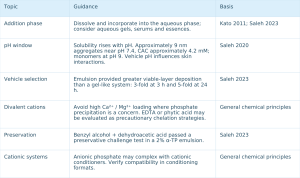
Near pH 7.4, this anionic amphiphile self-associates into approximately 9 nm aggregates, with a critical aggregation concentration (CAC) of approximately 4.2 mM. At pH 9 it is monomeric, providing a formulation variable. Saleh et al. 2020.
VITAMIN E OPTIONS
Choosing the appropriate vitamin E form
Conventional forms and formulation comparison
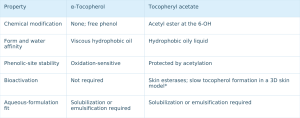
Corresponding phosphate-salt properties
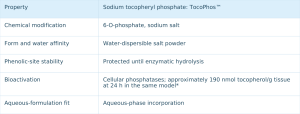
*Reconstructed human skin model: tocopherol accumulation after topical treatment, Kato et al. 2011, Figure 2A. General chemistry: Zingg 2018. Photostability of the phosphorylated form: Saleh et al. 2021.
Different systems call for different tools. The phosphate salt provides a route for aqueous and scalp-oriented formats.
UPTAKE · BIOCONVERSION · ANTIOXIDANT ACTION
Delivered as phosphate, activated as vitamin E
ACTIVATION PATHWAY
1 APPLICATION: an aqueous formulation deposits sodium tocopheryl phosphate at the skin surface.
2 UPTAKE: keratinocytes internalize the phosphorylated active.
3 BIOCONVERSION: cellular phosphatases hydrolyze the phosphate, releasing α-tocopherol.
4 ANTIOXIDANT ACTION: α-tocopherol associates with membranes and intercepts lipid peroxyl radicals.
• Deuterium tracing showed hydrolysis of α-TP to α-tocopherol in cells and mice, but not in culture medium, with lower plasma and liver lipid peroxidation. Nishio et al. 2011.
• In reconstructed human skin, tocopherol accumulation was approximately 190 nmol/g tissue at 24 hours with the phosphate salt; acetate remained near baseline. Kato et al. 2011, Figure 2A.
EVIDENCE: INTRACELLULAR BIOCONVERSION
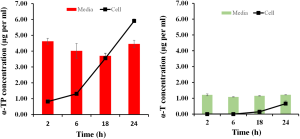
HaCaT keratinocytes were incubated with 133 µg/mL α-TP. Intracellular α-TP increased, and α-tocopherol (α-T) appeared in cell lysates at 2–24 hours, supporting uptake and enzymatic hydrolysis. Adapted from Saleh et al. 2021, Figure 8.
Saleh et al. Scientific Reports. 2021. doi:10.1038/s41598-021-01299-y
STRESS BIOLOGY
Addressing oxidative and nitrosative stress
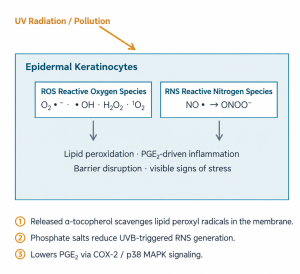
PUBLISHED EVIDENCE
UVB AND RNS IN HUMAN KERATINOCYTES
Real-time fluorescence imaging showed UVB-triggered RNS generation involving neuronal nitric oxide synthase (nNOS). Sodium dl-α-tocopheryl phosphate suppressed this response. Nakama et al. 2009.
SOOTHING-RELATED SIGNALS
In UVB-exposed NHEK, the sodium salt reduced Cox-2 mRNA by 33–51% at 0.5 µM, inhibited p38 MAPK phosphorylation and lowered PGE2. Kato et al. 2011.
MODEL CONTEXT MATTERS
Intact α-TP is a weak radical scavenger in cell-free DPPH / ORAC assays. Cellular protection follows bioconversion to α-tocopherol, making the experimental model essential to interpretation. Saleh et al. 2021, Figure 7.
KEY TERMS
ROS: reactive oxygen species. RNS: reactive nitrogen species. nNOS: neuronal nitric oxide synthase. PGE2: prostaglandin E2. NHEK: normal human epidermal keratinocytes.
EVIDENCE FOCUS: UV STRESS
Pretreated keratinocytes withstand high-dose UVA1 stress
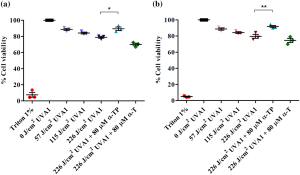
HaCaT keratinocytes were pretreated for 24 hours before UVA1 exposure. Viability was measured by Alamar Blue 24 hours later. Mean ± SD; *p < 0.05 and **p < 0.01 versus irradiated control. From Saleh et al. 2021, Figure 5.
Saleh et al. Scientific Reports. 2021. doi:10.1038/s41598-021-01299-y
VIABILITY AFTER 226 J/cm² UVA1
88% versus 70% cell viability
80 µM α-TP pretreatment versus irradiated control. α-Tocopherol at the same concentration provided no significant protection in this model.
INTRACELLULAR ROS AFTER 57 J/cm²
24.1% lower ROS versus control
100 µM α-TP; H2DCFDA measurement within 2 hours after irradiation. α-Tocopherol reduced ROS by 23.9%.
Protection coincided with phosphatase-mediated conversion to α-tocopherol. Intact α-TP was weak in cell-free assays but protective in cells. The phosphorylated form also had a higher LD50 in this model: 1676 versus 1070 µM.
Additional UVB evidence: suppression of UVB-induced RNS in human keratinocytes. Nakama et al. 2009. J SCCJ 43(1):19. doi:10.5107/sccj.43.19.
MOISTURIZATION MECHANISM
Supporting the skin’s ceramide-production machinery
Ceramides are part of the lipid mortar of the stratum corneum. In keratinocytes, sodium tocopheryl phosphate acts on upstream processes involved in their synthesis.

In NHEK, the sodium salt increased intracellular ceramides to approximately 1.8-fold at 50 µM (*), SPTLC2 expression to approximately 2.2-fold (**), differentiation markers and intracellular Ca²⁺. Kato & Takahashi 2012.
WHY THIS MATTERS TO FORMULATORS
• Support for endogenous ceramide synthesis complements formulations that directly supply ceramides.
• Differentiation markers such as TG1, involucrin and loricrin inform barrier-care positioning.
• Supporting literature reports vitamin E upregulation of transglutaminase-1 and PPARγ in human keratinocytes. De Pascale et al. 2006.
Kato & Takahashi. Bioorg Med Chem. 2012;20(12):3837–3842. PMID 22579618. The schematic synthesizes the study pathway. Fold changes are approximate readings from the original figures. SPT: serine palmitoyltransferase. TG1: transglutaminase-1. CK10: cytokeratin 10. PPARγ: peroxisome proliferator-activated receptor γ.
EVIDENCE FOCUS: MOISTURIZATION
From keratinocyte signaling to a more hydrated barrier
IN VITRO: HUMAN KERATINOCYTES, NHEK
▲ Intracellular ceramides: approximately 1.8-fold versus control at 50 µM (*).
▲ SPT genes: SPTLC2 mRNA approximately 2.2-fold (**); SPTLC1 also increased (*).
▲ Differentiation markers TGM1, KRT10, IVL and LOR: approximately 2.2–3.3-fold (*/**).
▲ Intracellular Ca²⁺: significantly higher at 50–75 µM (*), consistent with differentiation signaling.
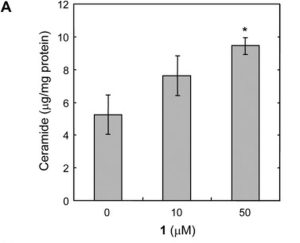
Original figure, panel 4A: intracellular NHEK ceramides increase with dose at 0 / 10 / 50 µM, measured as µg/mg protein.
IN VIVO: HAIRLESS MICE, TOPICAL 1% / 2% FOR 4 WEEKS
▲ Stratum corneum ceramides: approximately 4.8–5.0 µg/cm² in the 1% (*) and 2% (**) groups, versus approximately 3 µg/cm² in untreated and placebo groups.
▲ Hygroscopicity at 30 seconds: higher with both 1% (*) and 2% (**) versus untreated / placebo.
▲ Moisture retention at 60 seconds: significantly higher with both concentrations (*).
These findings link improved stratum corneum hydration with endogenous lipid processes.
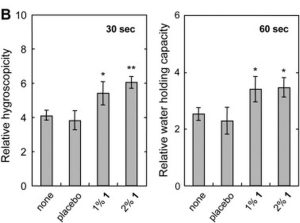
Original figure, panel 2B: stratum corneum hygroscopicity at 30 seconds and moisture retention at 60 seconds; untreated / placebo / 1% / 2%.
Kato & Takahashi. Bioorg Med Chem. 2012;20(12):3837–3842. doi:10.1016/j.bmc.2012.04.029. PMID 22579618. Panels 2B and 4A are excerpts from the paper. Fold changes are approximate readings from original axes; * / ** reproduce the authors’ significance notation.
EVIDENCE FOCUS: SKIN COMFORT
Modulating inflammatory cascades in stressed keratinocytes
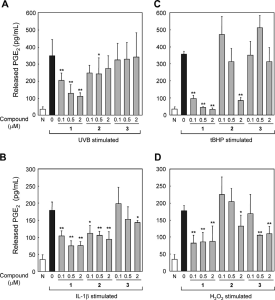
NHEK were pretreated with the sodium salt at 0.1–2 µM for 24 hours before UVB, IL-1β, tBHP or H2O2 challenge. PGE2 was measured in culture medium. Kato et al. 2011, Figure 3.
Kato et al. Bioorg Med Chem. 2011;19(21):6348–6355. doi:10.1016/j.bmc.2011.08.067
PGE2 REDUCTION VERSUS STIMULATED CONTROL
UVB: 44 / 65 / 69% at 0.1 / 0.5 / 2 µM.
tBHP: 74 / 87 / 90%; IL-1β: 41 / 58 / 57%.
H2O2: approximately 50%; UVB alone increased PGE2 approximately fivefold.
The acetate was weaker, and α-tocopherol had little effect at these concentrations.
CELL DEATH UNDER OXIDATIVE STRESS
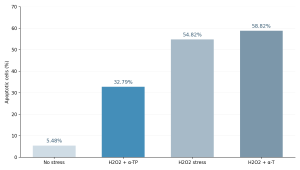
Redrawn from US20090104258A1, Example 1. Keratinocytes, 1 mM H2O2 for 24 hours; flow cytometry. The y-axis is the percentage of apoptotic cells.
Example 2 of the same patent publication: α-TP at 1 µg/mL increased large stem-cell-derived colonies by 104% in a clonogenic assay under oxidative stress.
DELIVERY SCIENCE
The vehicle influences delivery to viable skin
α-TP FLUX ACROSS A SYNTHETIC MEMBRANE
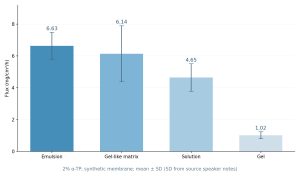
Redrawn from Saleh et al. 2023: steady-state flux of 2% α-TP from four vehicles across a synthetic membrane.
In human skin, the emulsion outperformed the gel-like system:
3× viable-layer deposition at 3 hours and 5× at 24 hours.
Human-skin flux: 328.6 versus 175.2 µg/cm²/h. Cell-free DPPH activity of the delivered dose was higher: 73% versus 46%.
SKIN DEPOSITION: pH 7.4 VERSUS α-TOCOPHEROL
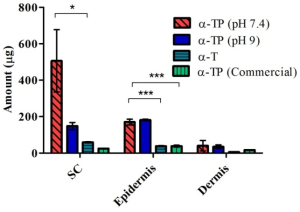
Porcine skin, 3 hours, infinite dose: α-TP at pH 7.4 reached approximately 506 ± 296 µg in the stratum corneum and 170 ± 29 µg in the epidermis. From Saleh et al. 2020, Figure 5. The source slide also describes approximately 8-fold / 4-fold differences; the comparison basis requires checking against the original paper.
At pH 7.4, α-TP forms approximately 9 nm aggregates that fuse with stratum corneum lipids in cryo-electron microscopy. At pH 9, monomer deposition is lower. Formulation pH therefore affects aggregation and skin interactions.
Saleh et al. Int J Pharm. 2023. doi:10.1016/j.ijpharm.2023.122781. PMID 36849039. Saleh et al. Int J Pharm. 2020. doi:10.1016/j.ijpharm.2020.120000.
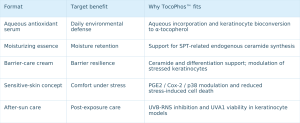
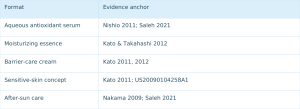
SKINCARE APPLICATION PORTFOLIO
Five formats with a shared evidence base
Formats and rationale
Corresponding evidence anchors
SCALPIFICATION
The scalp is skin with additional challenges
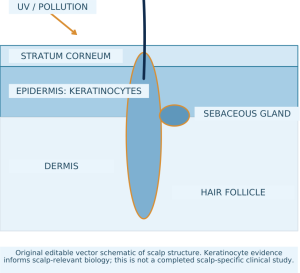
The scalp shares keratinocytes, a ceramide barrier and UV / pollution exposure with facial skin, together with dense follicles and sebum.
SHARED STRESS BIOLOGY
UV reaches the scalp surface. ROS / RNS responses documented in keratinocytes inform this application rationale. Nakama 2009; Saleh 2021.
SHARED HYDRATION MACHINERY
The ceramide barrier also matters to scalp dryness and tightness. Kato & Takahashi 2012.
SHARED COMFORT-RELATED SIGNALS
PGE2-related stress pathways provide a basis for conceptual extension to scalp comfort. Kato et al. 2011.
The scalp is a development extension for TocoPhos™. PuriPharm technical and application teams support joint scalp-formulation projects.
SCALP PROTECTION AND COMFORT
Three scalp-care opportunities
FOLLICULAR-ENVIRONMENT PROTECTION
The scalp surface is UV-exposed skin. Keratinocyte findings on UVA1 survival and UVB-triggered RNS provide a rationale for leave-on antioxidant scalp care. Nakama et al. 2009; Saleh et al. 2021.
HYDRATION BALANCE AND BARRIER SUPPORT
SPT-related ceramide synthesis and improved stratum corneum moisture retention inform concepts for dry, tight-feeling scalps. Kato & Takahashi 2012.
COMFORT FOR STRESSED SCALPS
PGE2 / Cox-2 / p38 modulation and reduced stress-induced keratinocyte death provide a rationale for comfort-oriented products. Kato et al. 2011; US20090104258A1, Example 1.
All three are development opportunities extrapolated from published epidermal evidence. Work with PuriPharm Co., Ltd. to translate them into scalp-care products.
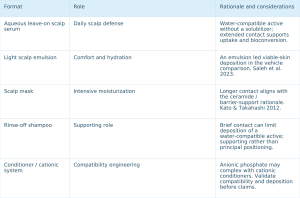
HAIRCARE FORMATS
TocoPhos™ in scalp and haircare formulations
PRACTICAL FORMULATION
Six practical principles for phosphate formulations
SOLUBILITY VERSUS pH
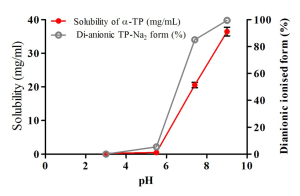
Adapted from Saleh et al. 2020, Figure 1. α-TP solubility rises with pH alongside changes in aggregation.
Contact PuriPharm technical and application teams for grade-specific use levels, processing-temperature limits, shelf life and full technical documentation.
Saleh et al. Int J Pharm. 2020. doi:10.1016/j.ijpharm.2020.120000. Saleh et al. Int J Pharm. 2023. doi:10.1016/j.ijpharm.2023.122781.
SKINCARE CONCEPT GALLERY
Three concepts to start development
FORMULATION CONCEPT
DAILY DEFENSE ANTIOXIDANT SERUM
Aqueous gel serum · Daily leave-on use
Suggested ingredients: Niacinamide · Panthenol · Glycerin
Aqueous delivery of a biologically activated antioxidant: keratinocyte uptake and conversion to α-tocopherol provide a rationale for ROS / RNS stress care.
Evidence: Nishio 2011; Saleh 2021; Nakama 2009.
FORMULATION CONCEPT
CERAMIDE-SUPPORTING MOISTURIZER
Oil-in-water cream · Daily moisturization
Suggested ingredients: Ceramide NP · Glycerin · Squalane
Two complementary routes: direct ceramide supplementation and support for endogenous SPT-related synthesis.
Evidence: Kato & Takahashi 2012.
FORMULATION CONCEPT
AFTER-SUN CARE LOTION
Light emulsion · After-sun comfort
Suggested ingredients: Sodium Ascorbyl Phosphate · Bisabolol · Betaine
A reported combination with magnesium ascorbyl phosphate inhibited PGE2 more than either ingredient alone. This informs a vitamin C phosphate combination concept; the proposed sodium derivative is not the identical tested combination.
Evidence: Kato 2011, Figure 6; Nakama 2009.
These concepts have published mechanistic evidence anchors. Contact PuriPharm Co., Ltd. for formulation collaboration.
SCALP AND HAIRCARE CONCEPT GALLERY
Scalp-first formats informed by skin science
FORMULATION CONCEPT
ANTIOXIDANT SCALP SERUM
Aqueous leave-on serum · Daily use
Suggested ingredients: Niacinamide · Panthenol · Glycerin
A scalp-surface serum with biologically activated antioxidant positioning, derived from epidermal UV-stress evidence.
Evidence: Nakama 2009; Saleh 2021.
FORMULATION CONCEPT
LIGHT SCALP COMFORT EMULSION
Fluid emulsion · Leave-on comfort
Suggested ingredients: Bisabolol · Betaine · Glycerin
Emulsion vehicles provided greater viable-skin deposition in the cited comparison. PGE2 modulation informs a scalp-comfort concept.
Evidence: Saleh 2023; Kato 2011.
FORMULATION CONCEPT
MOISTURIZING SCALP MASK
Cream mask · Weekly intensive care
Suggested ingredients: Ceramide NP · Butyrospermum Parkii (Shea) Butter
Longer contact is consistent with a ceramide-synthesis rationale for dry, tight-feeling scalps.
Evidence: Kato & Takahashi 2012.
Develop a coordinated scalp-care range, from serums to masks, with PuriPharm Co., Ltd.
FOUR KEY POINTS
Why PuriActives® TocoPhos™?
PROTECTED AND BIOLOGICALLY AVAILABLE
Phosphate chemistry protects the antioxidant site, with cellular phosphatases releasing α-tocopherol after uptake.
EVIDENCE FROM RELEVANT MODELS
Human keratinocytes, reconstructed skin, in vivo barrier models and human skin delivery studies provide traceable evidence.
FORMULATION DEVELOPMENT SUPPORT
Aqueous-phase use, published vehicle and pH data, and preservative-testing evidence from an emulsion prototype.
ONE ACTIVE, TWO CARE AREAS
Skin defense and moisturization, alongside scalp-care concepts extrapolated from the same evidence base.
Vitamin E, reimagined for formulation development.
Work with us on your next skincare or scalp-care concept.
PuriPharm Co., Ltd. · Technical and Application Team
SCIENTIFIC REFERENCES
Scientific references
1. Nakama M. et al. Inhibitory effect of sodium dl-α-tocopheryl-6-O-phosphate on UVB-induced reactive nitrogen species in human keratinocytes. J Soc Cosmet Chem Jpn 43(1):19–25, 2009. doi:10.5107/sccj.43.19
2. Kato E., Sasaki Y., Takahashi N. Sodium dl-α-tocopheryl-6-O-phosphate inhibits PGE2 production in keratinocytes induced by UVB, IL-1β and peroxidants. Bioorg Med Chem 19(21):6348–6355, 2011. doi:10.1016/j.bmc.2011.08.067. PMID 21945458.
3. Kato E., Takahashi N. Improvement by sodium dl-α-tocopheryl-6-O-phosphate treatment of moisture-retaining ability in stratum corneum through increased ceramide levels. Bioorg Med Chem 20(12):3837–3842, 2012. doi:10.1016/j.bmc.2012.04.029. PMID 22579618.
4. Nishio K. et al. α-Tocopheryl phosphate is hydrolyzed to α-tocopherol in cells and in vivo. Free Radic Biol Med 50(12):1794–1800, 2011. PMID 21443945.
5. Saleh M. et al. Tocopheryl phosphate in keratinocyte UV-stress models. Scientific Reports 11:22400, 2021. doi:10.1038/s41598-021-01299-y
6. Gianello R. et al. α-Tocopheryl phosphate: chemistry and biological activity. Free Radic Biol Med 39(7):970–976, 2005. PMID 16140216.
7. Nakayama S. et al. Protective effect of α-tocopheryl phosphate against UVB-induced damage in cultured mouse skin. J Invest Dermatol 121:406–411, 2003.
8. De Pascale M.C. et al. Vitamin E upregulates transglutaminase-1 and PPARγ in human keratinocytes. Arch Biochem Biophys 447:97–106, 2006.
9. Zingg J.-M. Vitamin E: regulatory role beyond antioxidant activity. Adv Food Nutr Res 83:311–363, 2018.
10. Ghayour-Mobarhan M. et al. Tocopheryl phosphate: a review of biological properties. J Diet Suppl, 2014. doi:10.3109/19390211.2014.952859
11. Ogru E. et al. Vitamin E phosphate: an endogenous form of vitamin E. Free Radic Res, 2003.
FORMULATION AND PATENT REFERENCES
Formulation and patent references
12. Saleh M. et al. Ionization, pH-dependent solubility, self-association and skin deposition of α-tocopheryl phosphate. Int J Pharm 594:120000, 2020. doi:10.1016/j.ijpharm.2020.120000
13. Saleh M. et al. Vehicle-dependent delivery of α-tocopheryl phosphate to viable skin. Int J Pharm 636:122781, 2023. PMID 36849039 · doi:10.1016/j.ijpharm.2023.122781
14. Patent publication US20090104258A1 (published 2009), cited by publication number and examples: Example 1 (oxidative-stress-induced keratinocyte apoptosis, flow cytometry) and Example 2 (clonogenic assay; large stem-cell-derived colonies +104%).
15. Gavin A. et al. Tocopheryl phosphate mixture (TPM) as a skin-delivery enhancer for co-formulated actives. Drug Deliv Transl Res, 2016. doi:10.1007/s13346-016-0331-x
16. Mozafari M. et al. Tocopheryl phosphate-based delivery systems (review). Int J Transl Res.