PuriActives® PMT-100 | Palmitoyl Methoxytryptamine
INCI: PALMITOYL METHOXYTRYPTAMINE
A lipophilic active for skin conditioning and anti-aging formulations
Molecular structure, human studies reported in patents, and formulation applications
PMT-100: Evidence for topical use and formulation applications
Human and skin studies
A cream containing 1.5% PMT was studied in humans for four weeks. A separate experiment tracked the distribution of radiolabeled analogues in skin.
Proposed mechanisms
Patents link PMT to skin surface conditioning and the biology of free 5-MT. The original cell study figures shown below concern free 5-MT.
Formulation development
The powder has an HPLC assay of ≥98.0% and is suitable for oil-phase formulation development. Historical patents provide examples across several product formats.
Greff D. WO1998006695A1, Examples 1 and 3. Janjetovic Z et al. J Pineal Res. 2014. DOI: 10.1111/jpi.12146. PuriPharm technical documentation.
The C16 acyl chain distinguishes PMT structurally
|
|
|
|---|---|
|
|
|
|
|
|
|
|
|
|
|
|
|
|
|
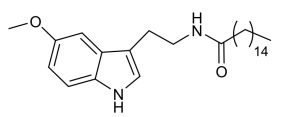
5-Methoxyindole + ethylamide linker + palmitoyl chain
Free 5-MT: no acyl group; melatonin: C2 acetyl group; PMT: C16 palmitoyl group.
PuriPharm technical documentation; NCATS: 2298R31N7A; Villano R, Di Marzo V. Front Chem. 2024. DOI: 10.3389/fchem.2024.1436008, Scheme 5.
Four-week human study of a 1.5% PMT cream
WO1998006695A1, Example 3
Split-face comparison within each participant
A 1.5% N-palmitoyl-5-MT cream was applied to one side of the face and a placebo cream to the other. Participants were blinded to assignment.
Outcomes: sebum measurements, stratum corneum hydration, firmness/tension, clinical assessments, and self-assessments.
Greff D. WO1998006695A1, Example 3, pp. 4–5 of the description.
The patent reports increases in skin hydration and firmness
1.5% N-palmitoyl-5-MT cream; 25 women; 4 weeks.
|
|
|
|
|---|---|---|
|
|
|
|
|
|
|
|
|
|
|
|
Adapted from Example 3. Values show changes from baseline. The source does not report variability measures or P values.
Greff D. WO1998006695A1, Example 3, pp. 4–5 of the description.
An ex vivo study tracked tracer distribution across skin layers
Example 1 compared radiolabeled 2-iodo derivatives in a Franz-type diffusion model.
30 min, 1 h, 2 h, and 4 h
Radioactivity in the different layers was measured by sequential tape stripping, tissue separation, and scintillation counting.
Test materials: ¹²⁵I-labeled 2-iodomelatonin and 2-iodo-N-palmitoyl-5-methoxytryptamine.
Greff D. WO1998006695A1, Example 1, pp. 3–4 of the description.
The patent reports epidermal retention of the palmitoylated tracer
|
|
|
|---|---|
|
|
|
|
|
|
|
|
|
The measurement time and variability for this ratio were not specified. The results describe tracer distribution in skin.
Greff D. WO1998006695A1, Example 1, pp. 3–4 of the description.
Regulation of keratinization as a proposed mechanism for skin surface care
The patent links lipophilic methoxytryptamine derivatives to the conditioning of keratinized surfaces.
This mechanism was proposed in the patent. The source did not quantify keratin biomarkers or verify receptor activation.
Poret JL. US20040022822A1, paragraphs 0021–0037 and Examples 1–4 and 7.
The patent proposes that PMT may be converted to free 5-MT
The proposed pathway involves enzymatic deacylation in the skin.
Free 5-MT provides biological context
Subsequent experiments tested free 5-MT in human keratinocytes. The cited patent did not quantify the extent of PMT conversion to 5-MT in skin.
Greff D. WO1998006695A1, pp. 1–2 of the description: proposed enzymatic release of 5-methoxytryptamine.
5-MT reduced nitrite at a UVB dose of 25 mJ/cm²
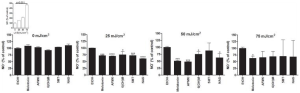
Original Figure 3. HaCaT cells; 50 µM; 24 h pretreatment; measured 30 min after UVB exposure. Original groups, error bars, and statistical symbols are retained.
Janjetovic Z et al. J Pineal Res. 2014;57:90–102. DOI: 10.1111/jpi.12146.
5-MT reduced H₂O₂ at UVB doses of 25 and 50 mJ/cm²
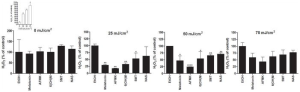
Original Figure 4. HaCaT cells; 50 µM; 24 h pretreatment; measured 30 min after UVB exposure. * P < 0.05, ** P < 0.01, *** P < 0.001, **** P < 0.0001.
Janjetovic Z et al. J Pineal Res. 2014;57:90–102. DOI: 10.1111/jpi.12146.
5-MT increased reduced glutathione after UVB exposure
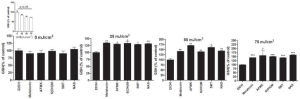
Original Figure 5. HaCaT cells; 50 µM; 24 h pretreatment; measured 1 h after UVB exposure. * P < 0.05, ** P < 0.01, *** P < 0.001.
Janjetovic Z et al. J Pineal Res. 2014;57:90–102. DOI: 10.1111/jpi.12146.
5-MT reduced CPD staining at 25 mJ/cm²
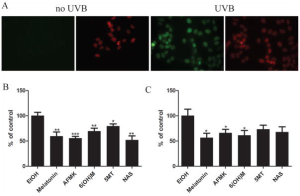
Original Figure 7
Primary keratinocytes (HEKn); 50 µM; 24 h pretreatment; measured 3 h after UVB exposure.
B: 25 mJ/cm², 5-MT P < 0.05; C: 50 mJ/cm², no significant difference for 5-MT.
CPD: cyclobutane pyrimidine dimer.
Janjetovic Z et al. J Pineal Res. 2014;57:90–102. DOI: 10.1111/jpi.12146.
The comet assay showed less DNA damage with 5-MT
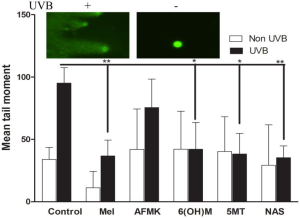
Original Figure 8
HEKn cells; 50 µM; 24 h pretreatment; 200 mJ/cm² UVB; 3 h treatment after UVB exposure.
5-MT reduced the mean tail moment versus the UVB control (P < 0.05).
Janjetovic Z et al. J Pineal Res. 2014;57:90–102. DOI: 10.1111/jpi.12146.
Topical studies inform three skin care concepts
Moisturizing lotion
For skin that feels dry. Combine PMT with humectants and emollients, then assess hydration and skin feel.
Firming cream
For a firmer appearance. Use the patent study’s firmness measures to guide finished-product testing.
Balancing facial lotion
For skin that feels oily. At the target use level, assess sebum, shine, and sensory comfort.
Greff D. WO1998006695A1, Examples 1 and 3, pp. 3–5 of the description. PuriPharm Co. Ltd.: Palmitoyl Methoxytryptamine powder technical documentation.
Supplier use levels for initial formulation development
|
|
|
|
|---|---|---|
|
|
|
|
|
|
|
|
|
|
|
|
PMT-100 is a product code. Calculate active content on the assay basis stated in the batch certificate of analysis (COA).
PuriPharm Co. Ltd.: Palmitoyl Methoxytryptamine powder technical documentation. Greff D. WO1998006695A1, Examples 1 and 3, pp. 3–5 of the description.
Formulation integration and nanoencapsulated product support
Choose a suitable oil phase
The supplier lists heated cosmetic esters and lipids, including caprylic/capric triglyceride, squalane, and C12-15 alkyl benzoate.
Dissolve fully before emulsification
The technical documentation specifies 75–80 °C for dissolution. Fully dissolve the powder before combining the phases.
Check the formula after cooling
Check for recrystallization, cloudiness, and texture changes in the complete formula and final packaging.
Support for formulation challenges
PuriPharm offers NanoActive PMT, a nanoliposomal palmitoyl methoxytryptamine product, to help address formulation challenges.
PuriPharm Co. Ltd.: PMT-100 technical documentation and NanoActive PMT supply information.
Published PMT examples cover five cosmetic product formats
|
|
|
|
|---|---|---|
|
|
|
|
|
|
|
|
|
|
|
|
|
|
|
|
|
|
|
|
These historical formulas use concentrations reported separately from supplier use levels and the human study concentration.
Poret JL. US20040022822A1, Examples 1–4 and 7. PMT concentration: % w/w.
The cream example includes aqueous and lipid phases
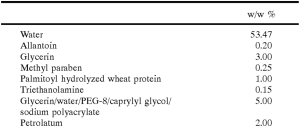
Editable transcription
|
|
|
|---|---|
|
|
|
|
|
|
|
|
|
|
|
|
|
|
|
|
|
|
|
|
|
|
|
|
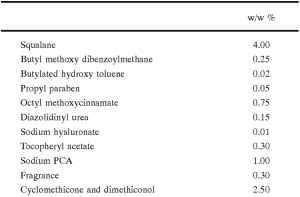
Editable transcription
|
|
|
|---|---|
|
|
|
|
|
|
|
|
|
|
|
|
|
|
|
|
|
|
|
|
|
|
|
|
|
|
|
|
|
|
|
|
|
The two portions of the original formula table are stacked in their original reading order. Original ingredient names and units are retained.
Poret JL. US20040022822A1, Example 1, first and middle portions of the original table.
The original cream formula contains 2.00% PMT
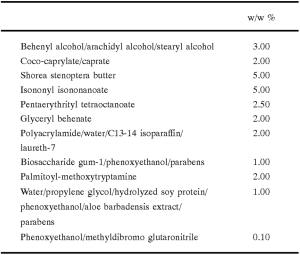
Editable transcription
|
|
|
|---|---|
|
|
|
|
|
|
|
|
|
|
|
|
|
|
|
|
|
|
|
|
|
|
|
|
|
|
|
|
|
|
|
|
|
A documented emulsion system
The continuation includes PMT, emollients, structuring ingredients, and preservatives.
All original rows are retained, and the w/w header is repeated for readability.
Poret JL. US20040022822A1, Example 1, final portion of the original table.
The toner example contains 0.50% PMT
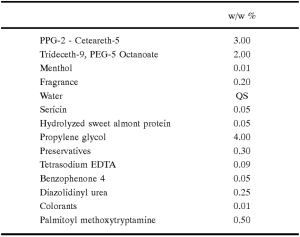
Editable transcription
|
|
|
|---|---|
|
|
|
|
|
|
|
|
|
|
|
|
|
|
|
|
|
|
|
|
|
|
|
|
|
|
|
|
|
|
|
|
|
|
|
|
|
|
|
|
|
|
QS = quantity sufficient.
An aqueous system with solubilizers
The example combines water and propylene glycol with solubilizing ingredients.
This is a historical formula. The patent does not report toner stability or efficacy in humans.
Poret JL. US20040022822A1, Example 3, original formula table.
The cleanser example contains 1.00% PMT
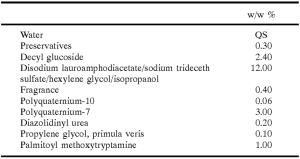
Editable transcription
|
|
|
|---|---|
|
|
|
|
|
|
|
|
|
|
|
|
|
|
|
|
|
|
|
|
|
|
|
|
|
|
|
|
|
|
QS = quantity sufficient.
A surfactant-based formula
The original formula combines cleansing ingredients with conditioning polymers.
It provides an example for rinse-off formulation development.
Poret JL. US20040022822A1, Example 4, original formula table.
Quality specifications for the powder
|
|
|
|
|---|---|---|
|
|
|
|
|
|
|
|
|
|
|
|
|
|
|
|
|
|
|
|
|
|
|
|
PuriPharm Co. Ltd.: Palmitoyl Methoxytryptamine powder technical documentation.
Storage conditions and microbial limits
|
|
|
|---|---|
|
|
|
|
|
|
|
|
|
24 months
Stated shelf life under specified storage conditions
Store tightly sealed in a cool, dry place. Long-term storage temperature: 2–8 °C.
PuriPharm Co. Ltd.: Palmitoyl Methoxytryptamine powder technical documentation.
Choose measures that match the product concept
|
|
|
|---|---|
|
|
|
|
|
|
|
|
|
|
|
|
|
|
|
Use the same base formula, conditions of use, and assessment schedule for the active and vehicle control groups.
Development recommendations draw on Greff D. WO1998006695A1, Example 3, and PuriPharm formulation documentation.
Developing PMT-100 skin care products together
Defined molecular structure; relevant topical research; powder format suited to formulation development.
Technical inquiries
service@puripharm.com+86-572-2745768www.puriactives.com
Contact PuriPharm for formulation support and to evaluate NanoActive PMT nanoliposomal palmitoyl methoxytryptamine. Inquiries about samples, specifications, and formulation testing are welcome.
PuriPharm technical and supply documentation; Greff D. WO1998006695A1, Examples 1 and 3.
Animal research provides context for the series of homologues
Experimental model
Mice received intraperitoneal injections of melatonin homologues followed 30 minutes later by 950 cGy photon irradiation.
Published results
The abstract reported protective effects across the series, with the C6 and C8 amides showing the best survival outcomes.
Scope of evidence
The indexed abstract provides no separate survival values for PMT and no topical skin outcomes. The study provides background for the N-acyl-5-MT series.
Blickenstaff RT et al. J Pharm Sci. 1994;83:216–218. DOI: 10.1002/jps.2600830220. Villano R, Di Marzo V. Front Chem. 2024;12:1436008. DOI: 10.3389/fchem.2024.1436008.