NanoActive™ SA
Nanoencapsulated salicylic acid: skin renewal and scalp clarity
Corneocyte shedding · Comedonal acne research · Scalp and dandruff studies · Liposomal delivery evidence

Salicylic acid crystals · Polarized-light micrograph
NANOACTIVE™ SA / Product information
One molecule, two formulation applications
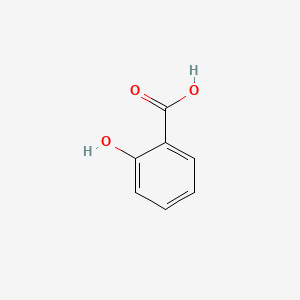
SA:2-Hydroxybenzoic acid
Active INCI: SALICYLIC ACID; CAS: 69-72-7; molecular formula: C7H6O3; molecular weight: 138.12 g/mol.
Skin care
Supports skin renewal and controlled exfoliation; care for open comedones and blemish-prone skin; formulations for clearer pores and smoother skin texture.
Scalp and hair care
Advanced salicylic acid delivery system
Scalp exfoliation, dandruff management, buildup removal, and improved surface comfort.
Molecular science / Formulation considerations
Solubility, ionization, and lipid affinity guide formulation design
Water solubility at 25°C
2.24 mg/mL
Aqueous phase
Lipid domain
Limited water solubility makes carrier selection central to aqueous formulation design.
pKa 2.9 · Acid/salicylate equilibrium; log Po/w 2.25 · Lipid affinity; saturated aqueous solution pH 2.4.
pH changes the ionization state; salicylates and the free acid are chemically distinct.
Delivery design should address molecular form and be supported by specific evidence.
Skin science / Corneocyte cohesion
Salicylic acid promotes shedding by reducing intercorneocyte cohesion
Normal human stratum corneum / 1980
Stratum corneum / Schematic
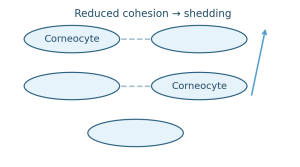
Promotes corneocyte shedding
Corneocyte
Corneocyte
Reduces cohesion between corneocytes
No effect on normal epidermal mitotic activity was detected. This study does not support a proliferation-based renewal claim.
Roberts DL, Marshall R, Marks R. Br J Dermatol. 1980;103(2):191–196. DOI: 10.1111/j.1365-2133.1980.tb06590.x.
Mechanistic and animal evidence / Sebocytes and rabbit ear acne model
Salicylic acid inhibited sebocyte lipogenesis and inflammatory pathways and reduced follicular dilation in a rabbit ear acne model
Human SEB-1 sebocytes / 50–100 μM salicylic acid
p-AMPK ↑ → SREBP-1 / FAS / ACC ↓; total lipid content decreased by 27.9% and 41.2% at 50 μM and 100 μM, respectively.
NF-κB signaling ↓; IL-1β, IL-6, IL-8, TNF-α, and OSM were measured after stimulation with heat-killed Propionibacterium acnes.
SREBP-1a and SREBP-1c transcripts decreased by approximately 40%; FAS and ACC decreased by 28.1% and 33.4%, respectively. Immunoblotting supported reductions in precursor and mature SREBP-1.
Rabbit ear acne model / Daily gel application for 3 weeks
| Salicylic acid gel | Baseline | Week 3 |
|---|---|---|
| 1% | 110.0 | 61.4 |
| 2% | 96.7 | 63.7 |
| Endpoint | Dilated follicles/cm² |
Histopathology and immunohistochemistry supported the cellular mechanisms. Across the reported groups and outcomes, IL-6, SREBP-1, NF-κB p65, and OSM protein levels decreased by approximately 53.7–81.3%.
These mechanistic and animal findings apply to the tested salicylic acid materials and doses. They cannot be directly extrapolated to untested finished NanoActive™ SA formulations.
Lu J et al. Experimental Dermatology. 2019;28(7):786–794. DOI: 10.1111/exd.13934. PMID: 30972839.
Animal evidence / 28-day study in normal mouse skin
Daily 0.5–5% supramolecular salicylic acid caused no obvious inflammatory or degenerative changes in normal mouse skin
Study design
C57BL/6 mice; vehicle or 0.5%, 1%, 2%, or 5% supramolecular salicylic acid hydrogel; once daily, 20 mg/cm²; histology on days 14 and 28; n = 3 per group per time point.
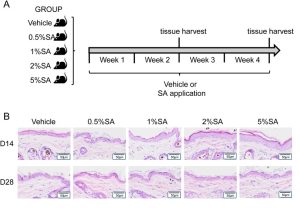
The original H&E images retain group labels, day 14/28 rows, and 50 μm scale bars.
Zhou C et al. Drug Des Devel Ther. 2023;17:1593–1609. Original Figure 1A–B. PMCID: PMC10228590.
Animal mechanisms / Barrier-related transcriptomics
Supramolecular salicylic acid upregulated genes associated with cornification, lipid lamellae, and cell junctions in mouse skin
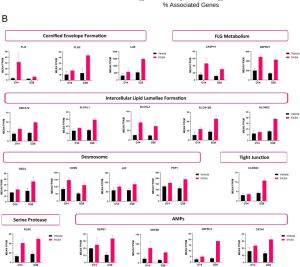
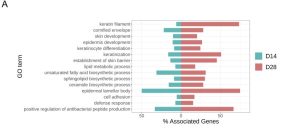
Original Figure 5A: barrier-related Gene Ontology (GO) terms on days 14 and 28.
In the 5% supramolecular salicylic acid group, expression increased for genes related to cornified envelope formation, filaggrin metabolism, intercellular lipid lamellae, desmosomes, tight junctions, and antimicrobial peptides. These are mouse transcriptomic findings, rather than evidence of clinical barrier benefits in humans.
Zhou C et al. Drug Des Devel Ther. 2023;17:1593–1609. Original Figure 5A–B. DOI: 10.2147/DDDT.S397541.
Human skin evidence / Vehicle-controlled study
Open comedones improved; closed comedones showed the same reduction as vehicle
0.5% salicylic acid / 12 weeks
Reduction from baseline at week 12 (%)
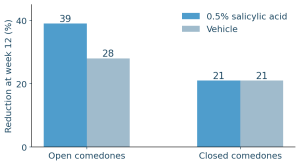
| Comedone type | Salicylic acid | Vehicle |
|---|---|---|
| Open comedones | 39% | 28% |
| Closed comedones | 21% | 21% |
39% vs 28%
Open-comedone reduction: salicylic acid versus vehicle; the authors reported a statistically significant difference.
21% = 21%
Closed-comedone reductions did not differ between groups, indicating that comedone type affects the outcome.
Test product: 0.5% salicylic acid in an alcohol–detergent vehicle. Values summarized from Liu H et al., Cochrane Database Syst Rev. 2020, Analysis 5.5; Shalita AR. Cutis. 1981. PMID: 6458457.
Human skin evidence / Multicenter randomized trial
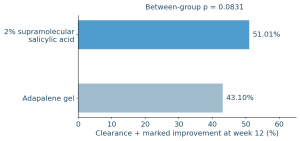
A 500-participant trial found no significant difference in overall improvement between 2% supramolecular salicylic acid and adapalene
Test: 2% supramolecular salicylic acid hydrogel; comparator: adapalene gel; randomized, evaluator-blind, parallel-controlled design.
n = 249 / 2% supramolecular salicylic acid; n = 251 / adapalene.
Clearance plus marked improvement at week 12
| Group | Clearance + marked improvement |
|---|---|
| 2% supramolecular salicylic acid | 51.01% |
| Adapalene gel | 43.10% |
Between-group p = 0.0831; no statistically significant difference.
Once daily for 16 weeks, as stated in the presentation; the overall improvement results shown here are from week 12.
Adverse event rates: 0.40% versus 0.80%; no statistically significant between-group difference.
Ye CX et al. J Cosmet Dermatol. 2024;23(6):2125–2134. DOI: 10.1111/jocd.16238. PMID: 38590107.
Human skin evidence / Original trial tables
Original tables from the 500-participant trial document lesion improvement and adverse events
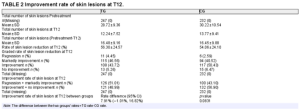
Table 2: lesion improvement at T12; TG = test group, CG = control group.

Table 3: adverse event summary; no serious adverse events occurred.
Ye CX et al. J Cosmet Dermatol. 2024;23(6):2125–2134. Original Tables 2 and 3. DOI: 10.1111/jocd.16238.
Human skin evidence / Standardized clinical photographs
Inflammatory acne visibly decreased on the forehead and cheeks in both groups
Trial overview
500 enrolled; 479 completed; 2% supramolecular salicylic acid once daily; adapalene comparator; multicenter, randomized, evaluator-blind trial.
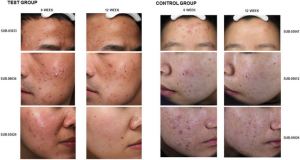
Photographs show individual responses. Randomized group analyses remain the main quantitative evidence.
Ye CX et al. J Cosmet Dermatol. 2024. Original Figure 2; 2% supramolecular salicylic acid hydrogel versus adapalene gel.
Human skin evidence / Skin color, TEWL, and hydration
Physiological measures changed over time, with no significant between-group differences
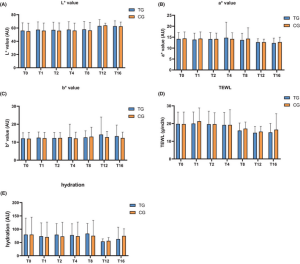
Interpreting the results
L* increased from baseline at several visits. TEWL decreased at T8, T12, and T16 in the supramolecular salicylic acid group. Hydration decreased at T1 in both groups. None of the physiological measures differed significantly between groups.
T16 was 4 weeks after product discontinuation.
Ye CX et al. J Cosmet Dermatol. 2024. Original Figure 3A–E: L*, a*, b*, TEWL, and hydration.
Human skin evidence / Original physiological data table
The original table records within-group physiological changes across all 7 visits
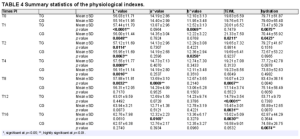
Within-group comparisons use baseline as the reference. The authors reported no significant between-group differences for any physiological measure.
Ye CX et al. J Cosmet Dermatol. 2024. Original Table 4: summary statistics for physiological measures.
Human skin evidence / Sebum, pores, and fine lines
Pore count differed significantly between groups at T1
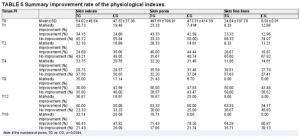
Original Table 5: summary of improvement rates for physiological measures.
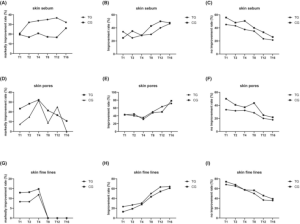
Original Figure 4: changes in sebum, pores, and fine lines over time.
The authors specifically identified a between-group difference in pore count at T1. This should not be described as lasting pore reduction.
Ye CX et al. J Cosmet Dermatol. 2024. Original Table 5 and Figure 4. DOI: 10.1111/jocd.16238.
Human skin evidence / Microbiome · 2% supramolecular salicylic acid for 8 weeks
Changes in facial microbial diversity accompanied improvements in lesion count and GAGS
30 participants with acne plus 10 non-acne controls; 2% supramolecular salicylic acid for 8 weeks.
| Outcome | Before treatment | After treatment |
|---|---|---|
| Lesion count | 39.67 ± 7.18 | 25.90 ± 8.40 |
| GAGS | 14.20 ± 2.71 | 10.37 ± 3.12 |
| p value | < 0.0001 | < 0.0001 |
Table 1 values reformatted for readability; BT = before treatment, AT = after treatment.
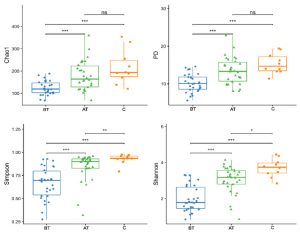
Bilal H et al. Pharmaceuticals. 2023;16(1):87. Table 1 and original Figure 1. PMCID: PMC9864713.
Human skin evidence / Microbial community structure
β-diversity tests found no significant difference between the post-treatment and control groups
Post-treatment versus control: ANOSIM: R = −0.028, p = 0.6; perMANOVA: R = 0.031, p = 0.257.
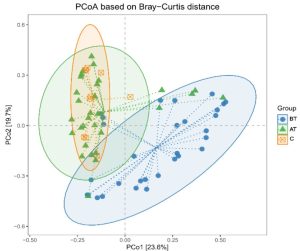
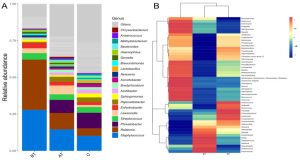
Original Figure 2: β-diversity. Original Figure 4: genus-level relative abundance and between-group comparisons.
Bilal H et al. Pharmaceuticals. 2023;16:87. Original Figures 2 and 4 and Table 2. DOI: 10.3390/ph16010087.
Human skin evidence / 21-day combination gel study
After 21 days of a multi-ingredient gel, forehead sebum decreased by 23.65% and IGA by 23.81%
n = 42; twice daily for 21 days; 2% salicylic acid + 2.9% glycolic acid + 2.5% lactic acid + niacinamide + three ceramides. Single-center prospective study; effects cannot be attributed to salicylic acid alone.
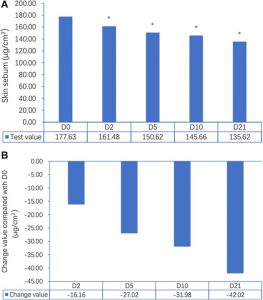
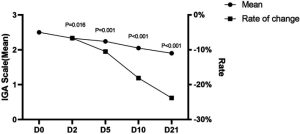
Liu Y et al. J Cosmet Dermatol. 2025;24(7):e70353. Original Figures 1 and 4. PMCID: PMC12274963.
Human skin evidence / Short-term forearm measures
Short-term forearm testing assessed hydration and TEWL recovery after tape stripping
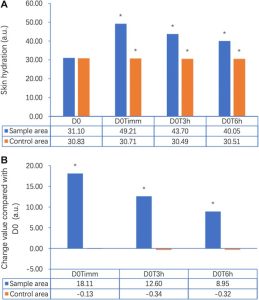
Hydration immediately and at 3 and 6 hours; sample and control areas.
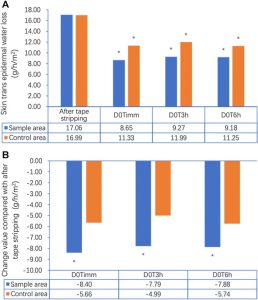
TEWL recovery after tape stripping; short-term forearm protocol.
Liu Y et al. J Cosmet Dermatol. 2025. Original Figures 2 and 3: hydration and TEWL after tape stripping.
Professional 30% peels / Clinical and barrier measures
GAGS and skin barrier measures improved after serial 30% supramolecular salicylic acid peels in 28 patients
Professional peels
n = 28; 30% supramolecular salicylic acid; once every 2 weeks for 2 months; GAGS, pH, sebum, TEWL, hydration, and red areas.
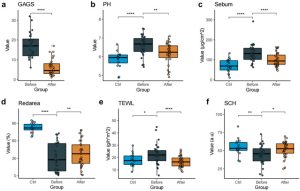
Post-peel burning/stinging: 25 patients; erythema: 3 patients. These data cannot be extrapolated to everyday leave-on cosmetics.
Shao X et al. Dermatol Ther (Heidelb). 2023;13:155–168. Original Figure 1. PMCID: PMC9823178.
Professional 30% peels / Perilesional immunohistochemistry
Post-peel perilesional biopsies showed lower inflammatory markers and higher caveolin-1
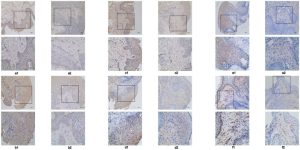
IL-1α ↓ · IL-6 ↓ · IL-17 ↓ · TGF-β ↓ · TLR2 ↓ · Caveolin-1 ↑
Shao X et al. Dermatol Ther (Heidelb). 2023;13:155–168. Original Figure 3. DOI: 10.1007/s13555-022-00844-5.
Professional 30% peels / Korean acne study
Serial 30% salicylic acid peels reduced inflammatory and non-inflammatory lesions in Korean patients
Korean patients · Fitzpatrick skin types III–IV
n = 35; single-blind, uncontrolled; 30% salicylic acid once every 2 weeks for 5 sessions; total lesions: 68.2 → 39 at week 12; non-inflammatory lesions: 43 → 28; inflammatory lesions: 25 → 11.
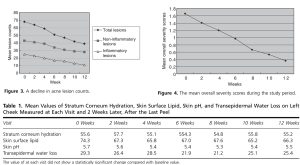
Acne grade decreased by 1.29 (p < 0.01). No significant barrier changes, persistent post-inflammatory hyperpigmentation, or scarring were observed. Original Table 1 prints “554.3” at week 6, a suspected source typographical error. Professional peel data do not support leave-on product claims.
No visit differed significantly from baseline. The week 6 hydration value “554.3” is retained as printed in the original table.
Lee HS, Kim IH. Dermatol Surg. 2003;29:1196–1199. Original Figures 3–4 and Table 1.
Professional 30% peels / Japanese comedonal acne study
Mean comedone count decreased by 75% after five 30% salicylic acid–PEG peels in Japanese patients
n = 16; comedone count: 39.3 → 9.2; once every 2 weeks for 5 sessions, 5 minutes each; blinded photographic assessment; no parallel control.
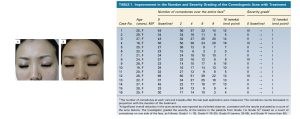
Severity: baseline II → grade I at week 12.
Original notes: comedones were counted at each visit and 2 weeks after the last peel; counts declined with treatment duration. A blinded observer reported an overall reduction in severity, consistent with lesion counts. Grades based on one side of the face: I (<10), II (10–25), III (severe, 25–50), IV (>50); thresholds retained as printed.
Hashimoto Y et al. Dermatol Surg. 2008;34:276–279. Original Figure 1 and Table 1. DOI: 10.1111/j.1524-4725.2007.34055.x.
From skin to scalp / A shared surface target
Retained corneocyte material links follicular plugging and scalp flaking
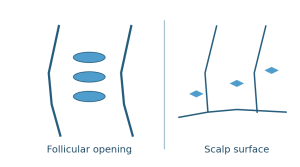
Skin / Follicular opening
Keratinous buildup at the follicular opening connects shedding biology with open-comedone and surface-texture care.
Scalp / Surface and contact time
Adherent flakes and surface buildup create another formulation setting: spreading through hair, rinsing, and routine maintenance.
Biological principles connect skin and scalp. Interpret leave-on and rinse-off evidence in the context of the specific product format.
Scalp evidence / Controlled studies
Flaking scores and corneocyte counts provide controlled evidence for scalp outcomes
1987
Double-blind, four-arm shampoo comparison
n = 48; supervised shampooing twice weekly for 5 weeks; clinical scaling scores plus shed corneocytes/cm².
| Comparison arms |
|---|
| 2% salicylic acid |
| 2% sulfur |
| Both actives combined |
| Vehicle |
The combination produced significantly greater and earlier reductions than either active alone or the vehicle.
2002
Randomized, single-blind comparison
n = 154; three times weekly for 4 weeks plus 2 weeks of follow-up. Test: 1.5% ciclopirox olamine + 3% salicylic acid. Comparator: 2% ketoconazole.
Both shampoos improved dandruff and scaling on days 29 and 43. In the seborrheic dermatitis subgroup, pruritus improved significantly only with the ciclopirox olamine–salicylic acid formula.
Leyden JJ et al. Cutis. 1987;39(6):557–561. PMID: 3301220. · Squire RA, Goode K. J Dermatolog Treat. 2002;13(2):51–60. PMID: 12060502.
Scalp evidence / 4-week shampoo study
Severe dandruff decreased from 28.4% to 3.2% after 4 weeks
n = 95 dermatologists; self-controlled assessment; 1% selenium disulfide + 0.9% salicylic acid shampoo; three times weekly for 4 weeks.
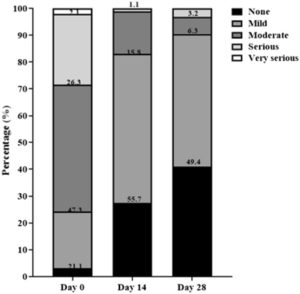
Original Figure 1 · Severity distribution
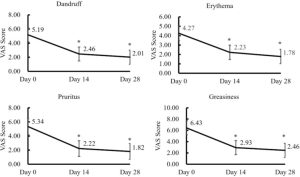
Original Figure 2 · Mean VAS scores ± SD
90.5%
Reported mild or no dandruff on day 28; all VAS scores improved (p < 0.01).
Chen X, Li J, Li Y, Wei A. Arch Dermatol Res. 2025;317(1):680. Figures 1–2. DOI: 10.1007/s00403-025-04165-3.
Scalp evidence / Day 0 to day 28 photographs
Two representative participants showed visible improvement in dandruff, erythema, and scalp lesions

Participant A · Day 0 (left) and day 28 (right)

Participant B · Day 0 (left) and day 28 (right)
95 dermatologists; self-controlled assessment; 1% selenium disulfide + 0.9% salicylic acid shampoo, three times weekly for 4 weeks. Photographs illustrate responses to a combination product.
Chen X et al. Arch Dermatol Res. 2025;317:680. Original Figures 3 and 4. PMCID: PMC11976785.
Scalp evidence / Two-step regimen
Mean dandruff score decreased by 55% after 4 weeks of combination scalp care
n = 20; prospective cohort; salicylic acid/piroctone olamine/zinc PCA pre-wash gel combined with a salicylic acid/piroctone olamine/antimicrobial peptide cleanser.
Baseline → Week 4
2.45 → 1.10
±0.50 ±0.30
Percentage reduction calculated from published mean scores; p < 0.01.
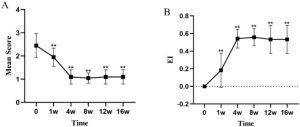
Original Figure 1: mean dandruff score (A) and efficacy index (B); error bars show SD. ** p < 0.01.
After 4 weeks of combination care, cleanser maintenance continued for 12 weeks. Ge L et al. J Cosmet Dermatol. 2025;24(1):e16742. Figure 1 and Table 3.
Scalp evidence / Surface comfort and greasiness
Pruritus and greasiness scores decreased alongside dandruff
Pruritus / Original Figure 2
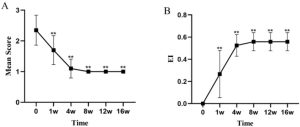
2.35 → 1.10
Baseline to week 4; p < 0.01. With continued maintenance, the score reached 1.00 from week 8 onward.
Greasiness / Original Figure 4
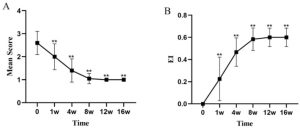
2.60 → 1.40
Baseline to week 4; p < 0.01. Perceived surface greasiness differs from sebum secretion rate.
The same 20-participant combination-care study; original figures retain means and SD. Ge L et al., 2025. Figures 2 and 4 and Table 3. DOI: 10.1111/jocd.16742.
Scalp evidence / Clinical and trichoscopic images
Clinical and trichoscopic images document improved surface cleanliness through week 16
Week 16 / Overall response
80%
Achieved marked overall clinical improvement (efficacy index ≥50%).
Weeks 0–4: pre-wash gel once weekly plus cleanser every 1–3 days. Weeks 4–16: cleanser maintenance.
All 20 participants completed the study; no adverse events were reported. Two dandruff recurrences occurred during weeks 12–16 and resolved after increasing cleanser frequency.
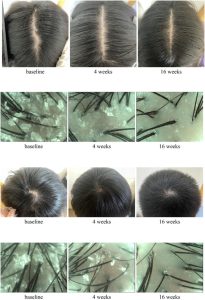
Original Figure 6
Combination regimen containing salicylic acid; images from two representative participants. Ge L et al. J Cosmet Dermatol. 2025;24(1):e16742. Figure 6 and Table 4.
Scalp evidence / Erythema and total symptom scores
The combination regimen sustained reductions in erythema and total symptom scores during maintenance
n = 20; salicylic acid/piroctone olamine pre-wash gel plus cleanser for 4 weeks, followed by cleanser maintenance for 12 weeks. At week 16, 80% achieved marked overall improvement.
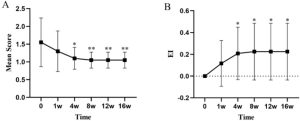
Figure 3: erythema score decreased from 1.55 at baseline to 1.10 at week 4 (p < 0.05).
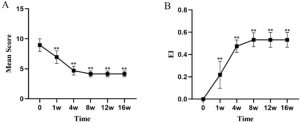
Figure 5: total symptom scores and efficacy index over 16 weeks.
Ge L et al. J Cosmet Dermatol. 2025;24(1):e16742. Original Figures 3 and 5 and Tables 3–4.
Scalp evidence / 5-participant supramolecular salicylic acid–zinc pyrithione pilot study
Dermoscopic findings and ASFS improved within 14 days in a small self-controlled scalp study
Test product and design
n = 5; 2% supramolecular salicylic acid + 0.8% zinc pyrithione; daily for 14 days; 3 scalp regions; D0, D7, and D14.
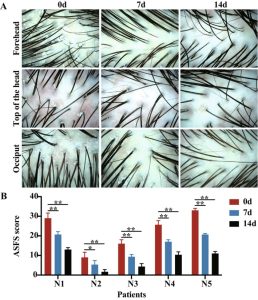
Original dermoscopic images and ASFS results. This exploratory study cannot separate the contributions of the two actives.
Wang Q et al. J Cosmet Dermatol. 2025;24:e16617. Original Figure 2. PMCID: PMC11743326.
Scalp evidence / Sebum, TEWL, pH, and hydration
The supramolecular salicylic acid–zinc pyrithione combination reduced scalp sebum and TEWL, with no significant hydration change
Example sites on the forehead
Sebum, day 0 → day 14: left forehead: 123.05 → 62.20 μg/cm²; right forehead: 103.29 → 54.08 μg/cm².
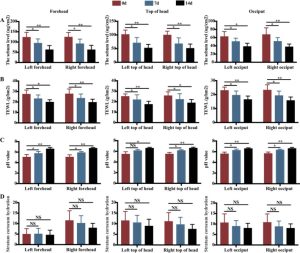
5 participants, multiple scalp regions. Hydration did not change significantly. Findings apply to the combined supramolecular salicylic acid–zinc pyrithione regimen.
Wang Q et al. J Cosmet Dermatol. 2025;24:e16617. Original Figure 3. DOI: 10.1111/jocd.16617.
Scalp evidence / Fungal spore counts
Fungal spore counts decreased in all 3 scalp regions during the 14-day pilot study
Original assay findings
Forehead, vertex, and occiput; days 0, 7, and 14; representative fluorescence images and quantitative fungal spore counts.
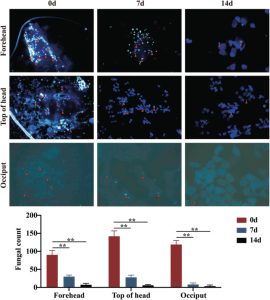
n = 5; combination supramolecular salicylic acid–zinc pyrithione product. Microbiological findings are preliminary and formulation-specific.
Wang Q et al. J Cosmet Dermatol. 2025;24:e16617. Original Figure 4. PMCID: PMC11743326.
Delivery science / Liposome design
Liposomal design addresses molecular location and the external-phase formula
Active molecule
Free salicylic acid
Limited water solubility; pH-dependent ionization; affinity for lipid domains; activity distinct from salicylates.
Formulation system
Bilayer: free-acid association and lipid compatibility. External aqueous phase: pH, rheology, and excipient compatibility. Conditions of use: release, deposition, and local exposure.
Phospholipid bilayer
Schematic of the liposomal formulation design space; not a particle-size or structural specification.
Each formulation requires its own performance testing.
Scientific basis: Bhalerao SS, Raje Harshal A. Drug Dev Ind Pharm. 2003; EP0616799A1, 1994.
Delivery evidence / Release and ex vivo porcine skin
Liposomal gel increased ex vivo permeation and skin retention compared with plain salicylic acid gel
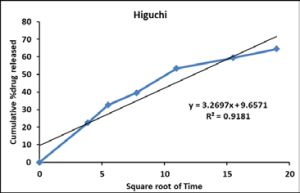
Higuchi release model: R² = 0.9181; the gel released 64.48% within 360 min.
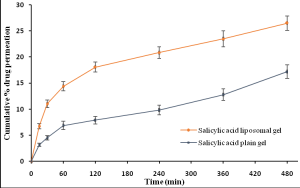
Porcine skin, 480 min: permeation 26.50% versus 17.20% with plain gel; mean ± SD, n = 3.
Skin retention: 10.90% with liposomal gel versus 5.30% with plain gel, approximately a 2-fold increase.
Chandwani S et al. Int J Appl Pharm. 2023;15(3):220–233. Foot-corn formulation study. Original Figures 16–17 and skin retention results.
Delivery evidence / Patent example and human tape stripping
A patent example combines free-acid liposomes with external-phase pH adjustment
Example 1 / Parts by weight
| Salicylic acid | 10.0 |
| Lecithin | 1.0 |
| Water | 83.0 |
| Arginine | 4.0 |
| Preservative combination + vitamin E acetate | 1.0 + 1.0 |
Process and testing
High-shear extrusion: 12,000 psi through 100 μm apertures. Dynamic light scattering: 200 nm; pH increased from 2.0 to 6.7 after arginine addition. Carboxyfluorescein labeling and freeze-fracture TEM supported vesicular structure.
Permeation protocol: volar human forearm; tape stripping plus HPLC; both liposomes and the 10% salicylic acid emulsion comparator were diluted 1:10 with polymethacrylate gel.
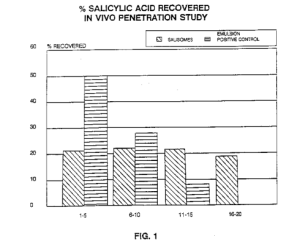
Original Figure 1 · Salicylic acid recovered from sequential skin tape strips
EP0616799A1. Cosmetic delivery system for salicylic acid and process for preparation of same. Published 1994. Example 1 and Figure 1.
Safety and regulatory context / SCCS Final Opinion
SCCS safety conclusions depend on product type, concentration, and exposure route
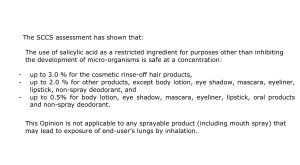
SCCS/1646/22 · Final Opinion
0.5% as a preservative; 3.0% in rinse-off hair products; 2.0% in other products, excluding specified categories; 0.5% in body lotions, eye shadow, mascara, eyeliner, lipstick, oral products, and non-spray deodorants. These concentrations include all uses; preservative use must not be added on top.
Not applicable to sprayable products that may expose the lungs. Salicylic acid is an eye irritant. Products for children under 3 years were not considered. Check current regulations in the target market.
SCCS/1646/22, Final Opinion, 2023, summary p. 4. Earlier restrictions: SCCS/1601/18, 2018; corrigendum 2019.
Formulation and applications / Development pathways
One delivery ingredient, two evidence-based product development pathways
Skin renewal and comedone care
Leave-on: pore-clearing serums, exfoliating toners, and texture-refining lotions. Rinse-off: advanced salicylic acid cleansers.
Relevant measures: open and closed comedones, standardized imaging, surface shedding, roughness, hydration, TEWL, and local tolerability.
Scalp exfoliation and dandruff care
Pre-wash: scalp exfoliating gels or buildup-removal treatments. Cleansing: dandruff-care shampoos. Leave-on: scalp renewal serums.
Relevant measures: adherent scalp flakes, corneocyte counts, pruritus, greasiness, erythema, trichoscopy, combability, and regimen-specific tolerability.
Finished-product salicylic acid (%) = ingredient use level (%) × confirmed salicylic acid fraction in the ingredient.
Confirm pH, rheology, assay, stability, preservation, and packaging. Free salicylic acid has approximately 0.2% water solubility at 20°C; clear aqueous systems require crystallization control (Merck 2019).
Ingredient use level is not the salicylic acid concentration. Translate leave-on and rinse-off evidence according to actual use conditions.
NANOACTIVE™ SA / Product characterization
NanoActive™ SA nanoencapsulated salicylic acid uses a phospholipid delivery system with particle size <30 nm
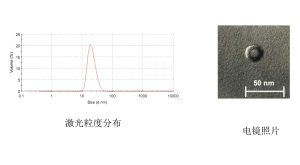
Left: laser particle-size distribution (x-axis: Size, d.nm; y-axis: Volume, %). Right: electron micrograph; scale bar 50 nm.
NANOACTIVE™ SA / D0–D28 product results
NanoActive™ SA nanoencapsulated salicylic acid: visible improvement in oily skin from D0 to D28
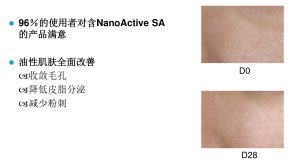
Text in the original image: 96% of users were satisfied with the product containing NanoActive SA. Reported oily-skin improvements include refined pores, reduced sebum secretion, and fewer comedones. Top photograph: D0; bottom: D28.
Evidence translation / Product performance
NanoActive™ SA combines salicylic acid science with product-specific performance
Salicylic acid science
Promotes corneocyte shedding; modulates sebocyte lipogenesis and inflammatory signaling; lesion, sebum, scalp, and dandruff outcomes from tested formulations; research on liposomal release and skin delivery.
NANOACTIVE™ SA product features
Phospholipid delivery system; particle size <30 nm; recommended ingredient use level: 1–5%; user satisfaction at D28: 96%; improvements in pores, sebum, and comedones.
Formulation and handling
Add at low temperature; avoid divalent/trivalent metal ions; store below 25°C protected from light; suitable for skin and scalp formulations.
NanoActive™ SA nanoencapsulated salicylic acid for skin renewal, oily skin care, and scalp clarity.