PuriActives® BioRetinal
BioRetinal / INCI: RETINAL
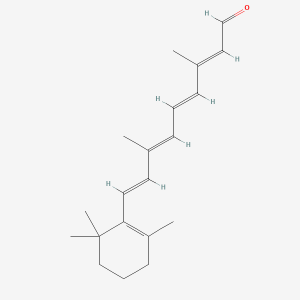
Retinaldehyde
C₂₀H₂₈O · 284.4 g/mol; the direct precursor of retinoic acid
Scientific and technical product information: skin, scalp, and formulation
Chemical structure source: PubChem CID 638015
PuriPharm Co. Ltd.
A defined retinoid identity for formulation innovation
PuriActives® BioRetinal combines biotechnological production with published research on topical retinaldehyde.
01
Product identity
PuriActives® BioRetinal
One enzymatic step to retinoic acid
INCI: Retinal · C₂₀H₂₈O · 284.4 g/mol
Retinaldehyde is immediately upstream of retinoic acid in cutaneous vitamin A metabolism, with a defined retinoid identity and direct topical research.
[16] PubChem, Retinal CID 638015 · [1] Zasada & Budzisz, 2019
PuriPharm Co. Ltd.
One molecule connects complementary lines of research
Direct retinaldehyde studies underpin the skin care evidence; related studies inform delivery and follicle biology.
Direct retinaldehyde evidence
Topical retinaldehyde studies
Human studies assess wrinkles, texture, hydration, pigmentation, and tolerability. In vitro and human microbiology studies also inform blemish-prone skin care.
Related research
Mechanistic and application research
RA/tretinoin studies help explain follicular responses; PRN and RSC studies explore stabilization and delivery.
Human studies: 0.05% and 0.1% topical formulas. In vitro studies: Propionibacterium acnes susceptibility. Delivery studies: niosomes and proretinal systems.
Every result applies to its tested retinoid, carrier, model, and regimen.
[3] Mukherjee et al., 2006 · [12] Everts, 2012
PuriPharm Co. Ltd.
Retinaldehyde is one enzymatic step from an active retinoid ligand
Cutaneous metabolism connects precursor identity with RAR/RXR-mediated gene transcription.
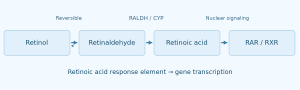
Preclinical validation
Topical 0.05% retinaldehyde increased tissue RA in mouse tail skin and produced retinoid biological responses. [2]
This metabolic position distinguishes retinaldehyde from retinol and retinoic acid. It does not justify exchanging efficacy conclusions or claiming a marketing potency multiplier.
[1] Zasada & Budzisz, 2019 · [2] Didierjean et al., 1996
PuriPharm Co. Ltd.
From nuclear signaling to measurable skin outcomes
Mechanistic research provides biological context; human studies assess efficacy.
Mechanistic context
↓
Keratinocyte differentiation and epidermal renewal
↓
Extracellular matrix homeostasis
Mechanistic value requires validation in a defined formula using appropriate measurements.
[1] Zasada & Budzisz, 2019 · [3] Mukherjee et al., 2006
PuriPharm Co. Ltd.
Topical retinaldehyde research spans more than two decades
Different study designs and formulas provide multidimensional evidence for skin care development.
1998
0.05% RAL, RA, and vehicle comparison
Profilometric assessment of wrinkles and roughness; follow-up to 44 weeks [4]
1999
0.05% RAL, 2 weeks
Significant reduction in viable P. acnes [5]
2018
40 women, 3 months
Texture, TEWL, hydration, and melanin index [6]
2024
32 women, 8 weeks
0.1% retinaldehyde combination serum, 3 nights per week [8]
2025
27 participants, 6 weeks
Anhydrous 0.1% retinaldehyde combination concentrate [9]
2026
56 women, 24 weeks
Blinded split-face study of two RAL formulas [10]
[4] Creidi 1998 · [6] Kwon 2018 · [9] Åkerström 2025 · [10] Deda 2026
PuriPharm Co. Ltd.
Different retinaldehyde formulas show visible wrinkle improvement
Instrumental studies link short-term imaging with longer-term wrinkle profiling.
Fine-line improvement at week 6
Cohort median; p<0.0001 [9]
12-week split-face study
Length −71.1%; area −79.9%; volume −81.25%
Median changes on the left forehead treated with the 0.1% RAL formula; respective p values: 0.018, 0.009, and 0.008. Different combination formulas were used on the two sides. [10]
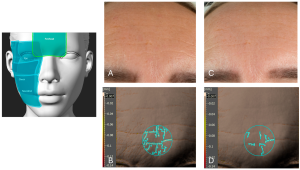
Representative forehead region at baseline and week 6, with corresponding 3D analysis. Original Figure 9; anhydrous 0.1% retinaldehyde combination formula. [9]
The image shows a representative region; its change is not the cohort median.
[9] Åkerström et al., 2025, Figs 2 & 9 · [10] Deda et al., 2026
PuriPharm Co. Ltd.
Biomechanical and ultrasound measures expand the aging-skin evidence
In a split-face retinaldehyde study, Cutometer R2 increased in multiple facial regions after 24 weeks.
R2 / Overall elasticity
R2 increased significantly in forehead, cheek, and chin regions after 24 weeks (N=52).
High-frequency ultrasound also showed increased dermal density in the assessed regions.
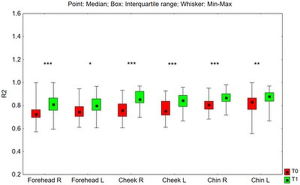
Original Figure 12. T0 = baseline, T1 = week 24; different retinaldehyde combination formulas were used on the two sides. [10]
[10] Deda et al., 2026, Fig 12
Figure key: point = median; box = interquartile range; whiskers = minimum–maximum; R/L = right/left.
PuriPharm Co. Ltd.
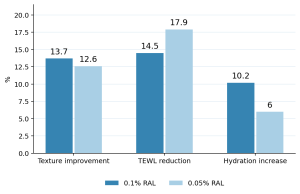
Both study concentrations improve texture, hydration, and TEWL
A randomized double-blind study compared 0.1% and 0.05% retinaldehyde creams over three months.
Change from baseline after 3 months (%)
|
|
|
|
|---|---|---|
|
|
|
|
|
|
|
|
|
|
|
|
Data from Kwon et al. [6]. Overall photoaging improvement was reported in 95% of both groups. There was no vehicle group, and between-concentration differences in the measures above were not significant.
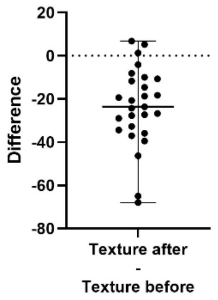
Texture improvement at week 6 in a separate study of an anhydrous 0.1% retinaldehyde combination formula [9]
[6] Kwon et al., 2018 · [9] Åkerström et al., 2025, Fig 4
PuriPharm Co. Ltd.
Retinaldehyde formulas show measurable pigmentation improvement
Melanin index and imaging findings are complementary across three independent clinical studies.
Pigmentation improvement at week 6
Cohort median; p<0.0001 [9]
Improvement in visible pigmentation
0.1% retinaldehyde + peptides/ceramides/lipids; 8 weeks [8]
Melanin index improvement after 3 months in the 0.1% RAL group [6]
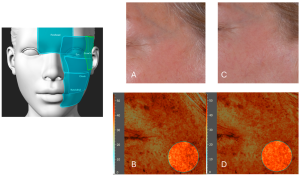
Representative pigmentation analysis at baseline and week 6. Original Figure 11; anhydrous 0.1% retinaldehyde combination formula. [9]
The image shows a representative regional change, presented separately from the cohort median.
[6] Kwon 2018 · [8] Konisky 2024 · [9] Åkerström 2025, Fig 11
PuriPharm Co. Ltd.
Antibacterial and comedonal-care findings broaden potential applications
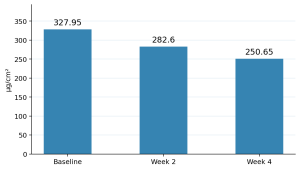
Direct P. acnes susceptibility testing complements a four-week study of retinaldehyde-loaded niosomes.
Minimum inhibitory concentration
|
|
|
|
|---|---|---|
|
|
|
|
|
|
|
|
|
|
|
|
Daily 0.05% retinaldehyde significantly reduced viable P. acnes after 2 weeks; the vehicle did not. MIC is a microbiological measure, not a formulation use level. [5]
Sebum level (μg/cm²)
|
|
|
|---|---|
|
|
|
|
|
|
|
|
|
0.05% retinaldehyde-loaded niosomal nanoemulsion, used daily for 4 weeks; n=23; p<0.05. Findings apply to the niosomal system studied. [7]
[5] Pechère et al., 1999 · [7] Kim et al., 2021
PuriPharm Co. Ltd.
Favorable tolerability supports regular, sustained use
Evidence includes a 44-week controlled trial, recent clinical formulas, and instrumental erythema assessment.
44 weeks
0.05% retinaldehyde was well tolerated; retinoic acid caused more local irritation and affected adherence. [4]
1 / 56
One participant reported skin irritation in the 24-week split-face retinaldehyde study. [10]
Patch testing
The tested 0.1% retinaldehyde combination serum showed no evidence of irritation or sensitization. [8]
p = 0.6664
Objective erythema did not change significantly at week 6 in the anhydrous 0.1% retinaldehyde study; mild adverse events were reported. [9]
Tolerability remains formula- and regimen-dependent. Several recent studies gradually increased application frequency.
[4] Creidi 1998 · [8] Konisky 2024 · [9] Åkerström 2025 · [10] Deda 2026
PuriPharm Co. Ltd.
The polyene structure makes stabilization a formulation priority
Covalent proretinal research quantifies the effects of light, oxygen, and carrier design.
40°C + sunlight + air
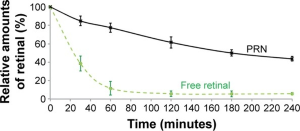
Relative degradation rate during the first hour: free retinaldehyde versus proretinal nanoparticles (PRN).
8 months / 25°C / protected from light
Free retinaldehyde: >90% degradation
PRN: <10% retinoid loss
Original Figure 3. PRN is a research chitosan–retinaldehyde system. Free retinaldehyde was solubilized in ethanol. These findings are not BioRetinal stability specifications. [11]
[11] Pisetpackdeekul et al., 2016, Fig 3
Original axes: relative retinal amount (%) and time (minutes); PRN = proretinal nanoparticles.
PuriPharm Co. Ltd.
Controlled release connects stability with skin performance
PRN illustrates sustained release from a covalent carrier at skin-relevant pH and changes in topical outcomes.
Release into artificial sebum
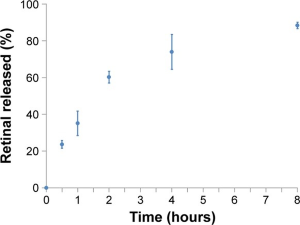
Original Figure 4. PRN was tested in artificial sebum at pH 5.0 and 4°C, protected from light, with sustained release measured for 8 hours. [11]
12-week split-face comparison
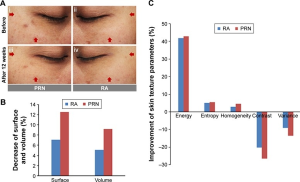
Original Figure 7. PRN hydrogel versus 0.025% RA hydrogel, twice daily; n=30. Surface parameter −12.5% versus −7.1%; volume parameter −9.2% versus −5.1%. [11]
[11] Pisetpackdeekul et al., 2016, Figs 4 & 7
Figure labels include retinal released (%), time (hours), surface/volume, and texture parameters: energy, entropy, homogeneity, contrast, and variance.
PuriPharm Co. Ltd.
Design around retention, compatibility, and delivery
The goal is to maintain retinaldehyde stability during manufacturing, storage, and consumer use.
01 · Carrier architecture
Assess solubilization, aqueous exposure, and retinaldehyde distribution in the intended format.
02 · Light and oxygen control
Assess formula and packaging exposure during processing, filling, and daily use.
03 · Compatibility and processing
Screen antioxidants, chelators, polymers, and other excipients in the actual system.
04 · Finished-formula validation
Track retinaldehyde content, degradation profile, appearance, and performance over time.
Evidence to establish
Retinaldehyde content; degradation products; packaging compatibility; microbiological quality; scalp/skin tolerability; application performance.
Potential formats: night serums, creams, and leave-on scalp concepts.
[9] Åkerström et al., 2025 · [11] Pisetpackdeekul et al., 2016
PuriPharm Co. Ltd.
A biologically grounded direction for scalp innovation
Retinoid metabolism participates in follicle biology. The opportunity requires rigorous translation, rather than borrowing hair-growth claims from other retinoids.
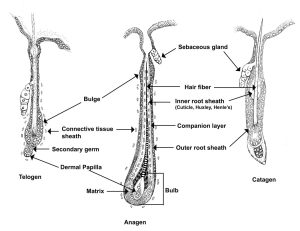
Follicular structure across the hair cycle. Original Figure 2, Everts 2012. [12]
Current evidence has not established hair-growth efficacy for BioRetinal.
Hair-cycle labels: telogen, anagen, and catagen. Anatomical labels include sebaceous gland, bulge, hair fiber, inner root sheath (cuticle, Huxley’s and Henle’s layers), companion layer, outer root sheath, connective tissue sheath, secondary germ, dermal papilla, matrix, and bulb.
PuriPharm Co. Ltd.
The pilosebaceous unit has its own retinoid metabolism
Retinaldehyde lies between retinol and RA in follicular signaling.
Local metabolic sequence
DHRS9 ALDH1A1 / 2 / 3
Regulated in space and time
RA-synthesizing enzymes, binding proteins, and receptors are distributed in follicular stem-cell-associated regions, with expression patterns changing across the hair cycle.
The biological goal is homeostasis, rather than maximum retinoid exposure.
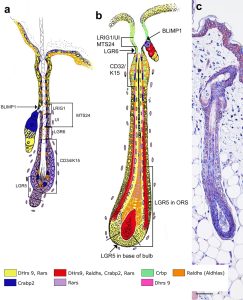
Original Figure 3. Components associated with follicular RA synthesis and reporter activity. [12]
[12] Everts, 2012, Fig 3
PuriPharm Co. Ltd.
RA/tretinoin research informs hypotheses for follicle biology
Test compound: retinoic acid/tretinoin. These results do not demonstrate retinaldehyde efficacy.
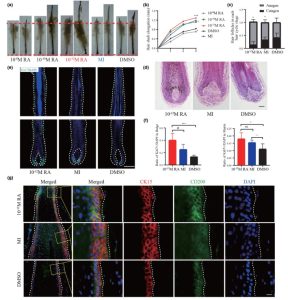
Original Figure 3. Human AGA follicle organ culture: RA concentration series, morphology, hair-cycle stage, and proliferation measures. [13]
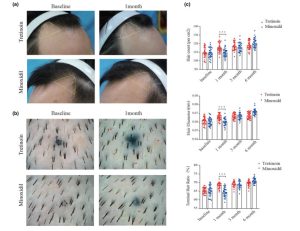
Original Figure 6. 0.025% tretinoin versus 5% minoxidil, twice daily; 30 participants per group. [13]
[13] Wen et al., 2025, Figs 3 & 6
PuriPharm Co. Ltd.
Follicular responses depend on dose, model, and retinoid
Different RA study findings support direct retinaldehyde research rather than efficacy extrapolation.
AGA follicle organ culture
10⁻¹² M RA
≈1.3× anagen proportion
In Wen’s study, hair-shaft elongation increased and anagen morphology was maintained versus DMSO. [13]
Human anagen VI scalp follicles
10⁻⁸ / 10⁻¹⁰ M ATRA
Approximately 80% catagen-like
In Foitzik’s study, approximately 30% of controls were catagen-like on day 6, and TGF-β2 was upregulated with ATRA treatment. [14]
Next evidence step: directly assess retinaldehyde scalp tolerability, exposure, and follicular responses under defined formulation conditions.
[13] Wen et al., 2025 · [14] Foitzik et al., 2005
PuriPharm Co. Ltd.
Follicular targeting provides a specific formulation research model
An ex vivo porcine ear study tracked retinaldehyde release from a succinyl chitosan particle system.
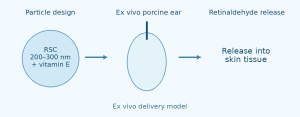
01 / Particle design
RSC, 200–300 nm + vitamin E
Retinaldehyde was covalently linked to succinyl chitosan, combining an imine bond, a matrix, and antioxidant protection. [15]
02 / Ex vivo skin
Porcine ear skin; follicular penetration; confocal fluorescence imaging.
03 / Retinaldehyde release
Release into skin tissue
The technical abstract reports that labeled particles entered follicles, followed by retinaldehyde release. [15]
Ex vivo delivery evidence only; it does not demonstrate hair growth in humans.
[15] Supmuang & Wanichwecharungruang, TechConnect 2012
PuriPharm Co. Ltd.
Skin care concepts focused on measurable outcomes
Each concept links consumer goals with formulation and evidence priorities.
01 · Night-time renewal
Fine lines, firmness, and long-term skin quality
Retinaldehyde retention; gradual-use regimen; imaging and Cutometer assessment.
Serum or cream
02 · Texture and skin tone
Smoothness, hydration, and visible pigmentation
Barrier support; compatibility; Antera/melanin index assessment.
Targeted leave-on care
03 · Blemish-prone skin care
Comedonal appearance and excess surface oil
Delivery selection; sebum and lesion counts; tolerability.
Lightweight leave-on formula
Development principle: validate the complete formula and regimen, beyond ingredient identity.
[5] Pechère 1999 · [6] Kwon 2018 · [9] Åkerström 2025 · [10] Deda 2026
PuriPharm Co. Ltd.
Translate follicle biology into a rigorous scalp development plan
A leave-on scalp serum is a research concept requiring defined formulation, tolerability, and efficacy milestones.
Concept / Leave-on scalp serum
A lightweight, targeted scalp care format
Design for retinaldehyde retention, scalp comfort, and controlled deposition. Treat follicular delivery as a research variable rather than an established product feature.
Development stages
01 Formulation
Retinaldehyde content, degradation profile, packaging compatibility, and deposition.
02 Tolerability
Scalp redness, itching, dryness, and participant comfort.
03 Exploratory efficacy
Phototrichogram assessment: hair count, density, diameter, and anagen proportion.
04 Translational validation
Define the comparator, regimen, and duration before developing claims.
Initial goal: a stable, well-tolerated scalp formula for controlled efficacy research.
[12] Everts 2012 · [13] Wen 2025 · [15] Supmuang 2012
PuriPharm Co. Ltd.
BioRetinal connects ingredient identity with evidence-based development
Core value for international skin care and scalp innovation teams.
01 · Biotechnological production
A defined product feature without unsupported process or certification claims.
02 · Direct precursor of RA
Immediately upstream of retinoic acid, requiring one enzymatic conversion.
03 · Extensive skin research
Human studies address wrinkles, texture, skin tone, blemish-prone skin care, and tolerability.
04 · A rigorous innovation pathway
Formulation-first development, with scalp research grounded in follicle biology.
[1] Zasada & Budzisz 2019 · [6] Kwon 2018 · [10] Deda 2026 · [12] Everts 2012
PuriPharm Co. Ltd.
References / Mechanisms and skin evidence
Reference numbers match the in-text citations. Original figure numbers and study conditions appear in the adjacent captions.
[1] Zasada M, Budzisz E. Retinoids: active molecules influencing skin structure formation in cosmetic and dermatological treatments. Adv Dermatol Allergol. 2019;36:392–397. DOI: 10.5114/ada.2019.87443.
[2] Didierjean L, Carraux P, Grand D, et al. Topical retinaldehyde increases skin content of retinoic acid and exerts biologic activity in mouse skin. J Invest Dermatol. 1996;107:714–719. DOI: 10.1111/1523-1747.ep12365603. PMID: 8875955.
[3] Mukherjee S, Date A, Patravale V, Korting HC, Roeder A, Weindl G. Retinoids in the treatment of skin aging: an overview of clinical efficacy and safety. Clin Interv Aging. 2006;1:327–348. DOI: 10.2147/CIIA.2006.1.4.327.
[4] Creidi P, Vienne MP, Ochonisky S, et al. Profilometric evaluation of photodamage after topical retinaldehyde and retinoic acid treatment. J Am Acad Dermatol. 1998;39:960–965. DOI: 10.1016/S0190-9622(98)70270-1. PMID: 9843009.
[5] Pechère M, Pechère JC, Siegenthaler G, Germanier L, Saurat JH. Antibacterial activity of retinaldehyde against Propionibacterium acnes. Dermatology. 1999;199 Suppl 1:33–36. DOI: 10.1159/000051375. PMID: 10473957.
[6] Kwon HS, Lee JH, Kim GM, Bae JM. Efficacy and safety of retinaldehyde 0.1% and 0.05% creams used to treat photoaged skin: a randomized double-blind controlled trial. J Cosmet Dermatol. 2018;17:471–476. DOI: 10.1111/jocd.12551. PMID: 29663701.
[7] Kim J, Kim J, Lee YI, Suk J, Lee D, Lee JH. A pilot study evaluating the efficacy and safety of retinaldehyde-loaded niosomes against mild-to-moderate acne. J Cosmet Dermatol. 2021;20:3586–3592. DOI: 10.1111/jocd.14478. PMID: 34587353.
[8] Konisky H, Bowe WP, Yang P, Kobets K. The Clinical Efficacy and Tolerability of a Novel Retinaldehyde Serum with Firming Peptides to Improve Skin Texture and Signs of Photoaging. J Drugs Dermatol. 2024;23:992–997. DOI: 10.36849/JDD.8058R1. PMID: 39496127.
DOIs, PMIDs, and source links from the presentation are provided for verification.
PuriPharm Co. Ltd.
References / Formulation, scalp, and chemical identity
Reference numbers match the in-text citations. Original figure numbers and study conditions appear in the adjacent captions.
[9] Åkerström U, Gaudicheau C, Locret B, Gillbro JM. Efficacy and Safety of a Novel Anhydrous 0.1% Retinal-Based Concentrate with Hydrophilic Actives for Photoaged Skin: A Six-Week Prospective Study. Cosmetics. 2025;12:235. DOI: 10.3390/cosmetics12060235.
[10] Deda A, Odrzywołek W, Lebiedowska A, et al. Comparative Evaluation of Topical Stabilized Retinaldehyde 0.1% vs. 0.05% on Skin Biophysical and Biomechanical Parameters. Skin Res Technol. 2026;32:e70326. DOI: 10.1111/srt.70326. PMID: 41729119.
[11] Pisetpackdeekul P, Supmuang P, Pan-In P, et al. Proretinal nanoparticles: stability, release, efficacy, and irritation. Int J Nanomedicine. 2016;11:3277–3286. DOI: 10.2147/IJN.S111748. PMID: 27499622.
[12] Everts HB. Endogenous retinoids in the hair follicle and sebaceous gland. Biochim Biophys Acta. 2012;1821:222–229. DOI: 10.1016/j.bbalip.2011.08.017. PMID: 21914489.
[13] Wen L, Fan Z, Huang W, et al. Retinoic acid drives hair follicle stem cell activation via Wnt/β-catenin signalling in androgenetic alopecia. J Eur Acad Dermatol Venereol. 2025;39:189–201. DOI: 10.1111/jdv.20000. PMID: 38629345.
[14] Foitzik K, Spexard T, Nakamura M, Halsner U, Paus R. Towards dissecting the pathogenesis of retinoid-induced hair loss: all-trans retinoic acid induces premature hair follicle regression (catagen) by upregulation of TGF-β2 in the dermal papilla. J Invest Dermatol. 2005;124:1119–1126.
[15] Supmuang P, Wanichwecharungruang S. Triple protection delivery system for retinaldehyde: preparation, skin penetration and controlled release at the hair follicles. TechConnect Briefs. 2012;3:130–133. ISBN: 978-1-4665-6276-9.
[16] PubChem. Retinal, CID 638015. Molecular formula C₂₀H₂₈O; molecular weight 284.4 g/mol; official 2D chemical structure. https://pubchem.ncbi.nlm.nih.gov/compound/638015.
PuriPharm Co. Ltd. · service@puripharm.com · www.puriactives.com
DOIs, PMIDs, and source links from the presentation are provided for verification.
PuriPharm Co. Ltd.