PuriActives® SPG
PuriPharm Co. Ltd.
Schizophyllan: Two Grades, Physicochemical Properties and Care Applications
Two grades, triple-helix rheology, and evidence for antioxidant, repair and oral-care applications
Two grades · Original research figures · Measured data · Application value
Marketing and technical presentation / 2026
STRUCTURE → FUNCTION

β-(1→3) backboneβ-(1→6) side groups · Triple helix in water
INCI: SCHIZOPHYLLANBrand: PuriActives® SPG
Overview
PuriActives® SPG: Product Highlights
Two molecular-weight grades supported by structural, antioxidant, repair and oral-care evidence
A versatile polysaccharide platform for skincare and oral-care development
|
|
|
|
|
|---|---|---|---|
|
|
|
|
|
|
|
|
|
|
|
|
|
|
|
|
|
|
|
|
PuriActives® SPG combines grade flexibility, evidence across experimental models and broad application potential.
Original research figures, experimental conditions and references are retained throughout.
Two Grades and Physicochemical Properties
SPG: Identity, Sources and Product Value
PuriActives® SPG is a schizophyllan ingredient with a defined structure, controlled specifications and comprehensive characterization.
Biological sources
Polysaccharides can be obtained from Schizophyllum commune fruiting bodies or submerged fermentation. Strain, medium and isolation process jointly determine product quality.
Schizophyllan (SPG)
The classical structure is a β-(1→3)-D-glucan backbone with one β-(1→6)-glucose side group on every third backbone glucose.Characterization of the backbone, branching and conformation establishes product identity.
Fungal extract
Fungal extracts contain polysaccharides, proteins, small molecules and other cellular components.PuriActives® SPG focuses on defined SPG identity, composition and molecular-weight characterization.
Defined strains, fermentation and purification processes support specification control and formulation development.
Kuttel et al., Biophys J, 2007, PMC1896245;He et al., Front Pharmacol, 2025, DOI:10.3389/fphar.2025.1562839
PuriActives® SPG: Two Product Grades
The same schizophyllan backbone is used to create two distinct grades through molecular-weight control.
Shared structure: β-(1→3) backbone with one β-(1→6)-glucose side group per three backbone residues
High-molecular-weight grade
High-MW SPG: Structure and material performance
-
Long chains and triple-helical conformation provide structural performance. -
Focus: viscosity, shear thinning, gelation and film formation. -
Suitable for thickening, gel and film-forming systems.
Upgraded low-molecular-weight grade
Low-MW SPG: Chain length and biological response
-
A distinct upgraded grade produced through molecular-weight control. -
Characterize degree of polymerization, distribution, conformation and receptor response. -
Suitable for low-viscosity systems and chain-length-oriented product design.
The two grades allow formulators to tailor rheology, texture and biological-response studies.
The two grades emphasize structural rheology and formulation flexibility, respectively, allowing selection for different products.
Original Structure Figure: Backbone and Branching
An excerpt from Figure 1a of a 2021 structural review compares linkages in linear glucans and schizophyllan.
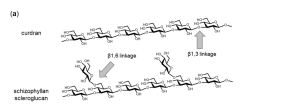
Original English labels retained: curdlan has a linear backbone; schizophyllan/scleroglucan shows a β1,3 backbone with β1,6 side chains.
Backbone
β-(1→3) glycosidic bonds form the glucose backbone.
Branching
One monosaccharide side group is attached per three SPG backbone residues.
Structural parameters
Backbone length, branch spacing and side chains jointly influence higher-order structure.
Manabe & Yamaguchi, Int J Mol Sci, 2021, 22:1578, Figure 1a, DOI:10.3390/ijms22041578 (CC BY 4.0)
Repeating Unit: Backbone Structure and Water-Facing Side Groups
Structural schematic redrawn from Kuttel et al., Figure 1
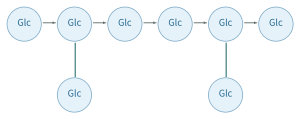
β-(1→3)-D-glucan backbone
One β-(1→6)-glucose side group is attached to every third backbone glucose.
Interpreting the structure
-
Three backbones form a rigid triple helix through interchain hydrogen bonds. -
Side groups face outward and interact with water. -
Side-group hydration promotes dispersion and dissolution in water. -
These structural features support thickening, gelation and film formation.
Kuttel et al., Explicit-Solvent Molecular Dynamics Simulations of the Polysaccharide Schizophyllan in Water, PMC1896245
Triple Helix and Hydration: Cooperative Interchain Rigidity
Redrawn from Kuttel et al., Figure 1. Persistence length is a structural parameter discussed in the molecular-simulation study.
Outer Glc side groups interact with water; interchain hydrogen bonds maintain the triple helix.
Persistence length: 150–200 nm
A rigid triple helix in water supports high viscosity and characteristic rheological behavior.
Triple-helix stability up to 120 °C
The aqueous triple helix is reported as stable up to 120 °C. The reversible state transition at 7 °C is a separate conformational process.
Formulation value
Triple-helix rigidity and hydration support thickening, gelation and film formation.
Schematic based on Kuttel et al., 2007
Kuttel et al., Biophys J, 2007, PMC1896245. For triple-helix stability and transition temperatures, see the experimental literature reviewed in that paper.
Solution Conformation: Effects of Temperature, Solvent and Concentration
Temperature, solvent and concentration provide practical ways to control SPG conformation.
In water: Ordered triple helix
Interchain hydrogen bonds maintain a rigid triple helix.The reversible state transition at 7 °C and the high-temperature stability range provide distinct windows for conformational control.
Heat and solvent: Conformational rearrangement
The aqueous triple helix remains stable at temperatures up to 120 °C.Denaturation–renaturation can alter aggregation and rheology.
Cooling and polyols: Gelation
Cooling the SPG/sorbitol system produces a thermoreversible gel accompanied by a triple-helix II→I transition.
Formulation value: Dissolution temperature, solvent composition, concentration and renaturation history jointly control molecular conformation and product texture.
Kuttel et al., 2007;Fang & Nishinari, 2004, DOI:10.1002/bip.10514;Fang et al., PMID:15211499
Power-Law Behavior and Shear Thinning
A 1% SPG solution behaves as a non-Newtonian, pseudoplastic fluid.
η = K γ̇ⁿ⁻¹
n < 1: shear thinningK: consistency index
1% dried SPG sample
21.05 mPa·sShear rate: 27.05 s⁻¹168 h sample: Mw = 5.54 × 10⁵ Da
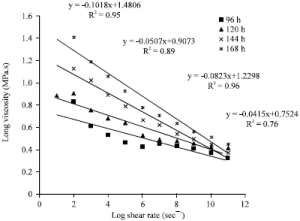
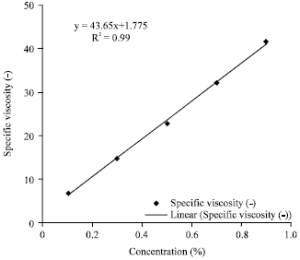
Original Figure 3: Viscosity versus shear rate for 1% SPG. Figure 4: The slide caption calls this reduced viscosity versus concentration, while the original graph axis is labeled Specific viscosity. These are different terms.
Kumar & Singhal, Am J Food Technol, 2011, Figures 3–4, DOI:10.3923/ajft.2011.781.789
Fermentation Rheology: From Near-Newtonian Flow to Shear Thinning
Biomass, SPG accumulation and molecular weight jointly change the flow behavior of the fermentation broth.
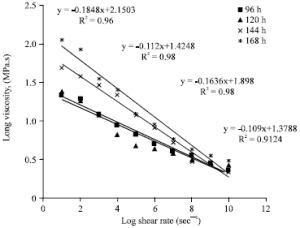
Original Figure 1: viscosity versus shear rate at 96, 120, 144 and 168 h
Original Table 2: Power-law parameters
|
|
|
|
|---|---|---|
|
|
|
|
|
|
|
|
|
|
|
|
|
|
|
|
|
|
|
|
|
|
|
|
Rheological value
As fermentation proceeds, n decreases and K increases, indicating stronger shear thinning.The gradual transition at 72–96 h links SPG accumulation with flow behavior.
Kumar & Singhal, 2011, Figure 1 and Table 2, DOI:10.3923/ajft.2011.781.789
Weak Gels and Thermoreversible SPG/Sorbitol Gels
Solutions, weak gels and thermoreversible gels correspond to different structural conditions.
Denatured–renatured SPG: Concentration dependence
|
|
|
|---|---|
|
|
|
|
|
|
|
|
|
SPG/sorbitol system
Cooling → thermoreversible gelCooling drives the triple-helix II→I transition and gel formation.The SPG/sorbitol ratio, molecular weight and thermal history jointly control gel strength and reversible texture.
Formulation value: Solutions, weak gels and thermoreversible gels offer texture options for serums, masks and gel-based care products.
Fang et al., 2004, PMID:15211499;Fang & Nishinari, 2004, DOI:10.1002/bip.10514
High-MW Grade: Triple Helix and Solution Rheology
Long-chain higher-order structure connects molecular conformation with formulation performance.
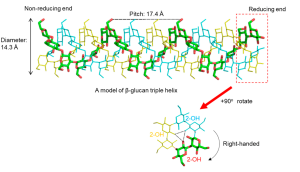
Original Figure 2: Right-handed triple-helix model, pitch and interchain 2-OH hydrogen bonds
Long-chain higher-order structure
Long-chain β-glucans can form triple helices. Schizophyllan adopts a semiflexible rod-like conformation.
Material performance
Molecular rigidity and interchain interactions provide a structural basis for high viscosity, shear thinning and gelation.
Key specification criteria
Record molecular-weight distribution, conformation, rheological curves and sample-preparation history together.
At molecular weights above 50,000 Da, the triple helix forms an ordered conformation associated with high viscosity.
Manabe & Yamaguchi, 2021, Figure 2;Kuttel et al., 2007;Kumar & Singhal, 2011
Upgraded Low-MW Grade: Rebalancing Chain Length and Conformation
Molecular-weight control creates a distinct low-MW grade and shifts the focus of characterization and evaluation.
High-MW long chains
Prominent triple-helix and rheological properties
Controlled molecular-weight adjustment
Changes in degree of polymerization and distribution
Upgraded low-MW grade
Chain length, conformation and application flexibility
What is retained?
-
Chemical features of the β-(1→3) backbone. -
Structural features of β-(1→6) branching. -
Confirmation by FTIR, NMR and related structural methods is required.
What changes?
-
Degree of polymerization and molecular-weight distribution. -
Triple-helix proportion, morphology and solution viscosity. -
Controlled degradation jointly affects chain length and chemical structure.
Application focus
-
Receptor recognition and cellular responses. -
Antioxidant activity, repair and formulation stability. -
Low-viscosity systems and chain-length-oriented product design.
The upgraded low-MW grade combines β-glucan structural features with tailored chain length, conformation and distribution to expand formulation options.
Manabe & Yamaguchi, 2021;He et al., 2025
Differences in Molecular Weight, Strain and Preparation
Molecular weight, strain and preparation history jointly shape conformation, viscosity and biological responses.
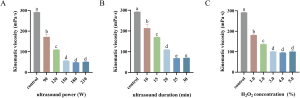
Original Figure 1: Effects of ultrasonic power, duration and H₂O₂ concentration on kinematic viscosity; N = 3
|
|
|
|---|---|
|
|
|
|
|
|
|
|
|
|
|
|
Strain and composition differences
The fermentation product of S. commune 5.43 is a heteropolysaccharide with a glucose:mannitol:galactose:fucose molar ratio of 86:8:5:1.
Molecular-weight range in the literature
Reported natural SPG molecular weights span 100–6,000 kDa. Measurement methods and post-processing define the resulting distribution.
He et al., 2025, Figure 1, DOI:10.3389/fphar.2025.1562839;Kuttel et al., 2007;Gou et al., 2023
Degradation Alters the Triple Helix and Morphology While Retaining Some Sugar-Structure Features
Controlled degradation jointly adjusts molecular weight, triple helices, morphology and solution behavior.
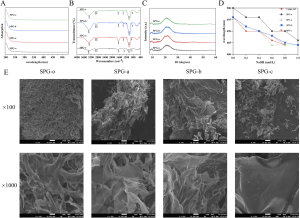
Original Figure 4: UV-Vis, FTIR, XRD, Congo red and SEM
Reading the figure
-
FTIR: Pyranose and β-glycosidic-bond features are retained. -
Congo red: Degraded samples show disruption of triple-helical conformation. -
SEM: Morphology shifts from fibrous to sheet-like.
Process-control value
Redissolution, ethanol reprecipitation and freeze–thaw treatment can be combined with molecular-weight adjustment to control purity, branching, solubility and viscosity.
He et al., 2025, Figure 4, DOI:10.3389/fphar.2025.1562839;Jamshidian et al., 2017, DOI:10.1016/j.ijbiomac.2017.06.110
Low-MW Characterization: GPC and MALDI-TOF
Original GPC and MALDI-TOF spectra show the molecular-weight distribution and oligosaccharide mass series.
GPC: Relative molecular-weight distribution
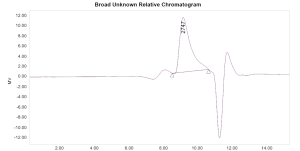
Original GPC chromatogram with retention-time axis and peak shape retained
GPC results: Mn 1777 Da; Mw 2420 Da; MP 2747 Da; Đ 1.361456Defined standards, column systems and detection conditions are required to report distributions and statistical parameters.
MALDI-TOF: Ion-peak series
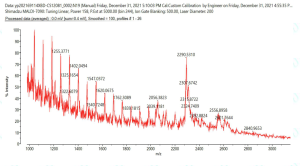
Original MALDI-TOF spectrum: Glucan degradation product A
Ion series at m/z 1000–3000 characterize oligosaccharide fragments. MALDI-TOF complements GPC by providing detailed mass-series information.
Complementary GPC and MALDI-TOF characterization supports low-MW SPG specification design.
Chain Length and Receptor Recognition: Structure-Driven Biological Responses
Dectin-1 binding depends on chain length. Branching and higher-order structure also matter.
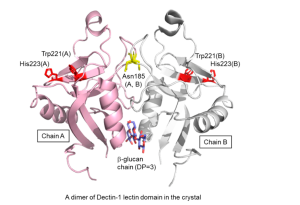
Original Figure 3: A DP = 3 trisaccharide captured in a crystal of dimeric Dectin-1 lectin domains illustrates the structural basis of receptor recognition.
10–11 sugar residues
Shortest chain length with detectable binding in glycan microarrays
DP 6: Weak binding
Short-chain response in NMR interaction studies
DP 16: Moderate binding
Increasing chain length is associated with secondary-structure formation.
Average DP 25: Stronger binding
Laminarin shows stronger binding; recognition occurs in the middle of the chain rather than at its ends.
Dectin-1 recognition integrates chain length, branching and higher-order conformation, informing SPG specification design.
Manabe & Yamaguchi, 2021, Figure 3;Palma et al., JBC, 2006;Hanashima et al., Glycoconj J, 2014
Formulation Selection: Balancing Molecular Weight, Viscosity and Conformation
Select high- or low-MW SPG according to target texture, conformation and application performance.
|
|
|
|
|
|---|---|---|---|
|
|
|
|
|
|
|
|
|
|
|
|
|
|
|
|
|
|
|
|
Formulation-characterization panel
Appearance and dispersibility + molecular weight/distribution + viscosity–shear curves + pH/ions/polyols + concentration in the target model
Based on Kumar & Singhal, 2011; Fang et al., 2004; He et al., 2025; Jamshidian et al., 2017
Skincare Applications
Skincare Evidence: Antioxidant Activity and Repair Across Models
Chemical, cellular, animal and formulation evidence links mechanisms with product development.
|
|
|
|
|
|---|---|---|---|
|
|
|
|
|
|
|
|
|
|
|
|
|
|
|
|
|
|
|
|
The two SPG grades combine evidence on antioxidant activity, cell protection and tissue repair to support skincare development.
Gou et al., 2023, DOI:10.1016/j.ijbiomac.2023.124504;He et al., 2025;Lei et al., 2025, DOI:10.1016/j.ijbiomac.2025.145816
NTU-1: High-Yield Fermentation and Efficacy Across Models
Controlled fermentation provides high SPG productivity and material for efficacy studies across models.
5 L fermenter: Process conditions
|
|
|
|---|---|
|
|
|
|
|
|
|
|
|
|
|
|
Fermentation results
7 days → 5 daysSPG yield: 21.3 g/L, combining a shorter fermentation cycle with high productivity
Efficacy evaluation across models
Chemical antioxidant assays: Best tested concentration, 2.0 mg/mLL929: UVB photodamage model, 20 mJ/cm²B16F10: Melanin-synthesis assay
NTU-1 combines high-yield fermentation, antioxidant activity and evidence from skin-related cell models.
Gou et al., Int J Biol Macromol, 2023, PMID:37080406, DOI:10.1016/j.ijbiomac.2023.124504
NTU-1 and Photoaging: The L929 UVB Cell Model
SPG at 1 mg/mL increases viability after UVB exposure and modulates ROS, MDA and SOD.
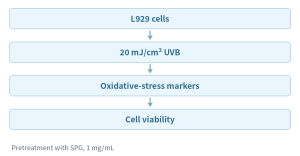
Cell viability
+23.5%Increase versus the control; the experiment used 1 mg/mL SPG pretreatment and a UVB injury model.
Oxidative stress
Reduced ROSAt 1 mg/mL, MDA decreased and SOD activity increased.
Skincare application value
Cell studies support antioxidant and photodamage-care applications.The combined responses of viability, ROS, MDA and SOD provide a mechanistic basis for protective skincare formulations.
Experimental workflow and data based on Gou et al., 2023
Gou et al., 2023, PMID:37080406, DOI:10.1016/j.ijbiomac.2023.124504. Experimental workflow and summary data reproduced from the source presentation.
NTU-1 in B16F10 Cells: Melanin-Related Skin-Tone Care
B16F10 cell findings demonstrate SPG activity relevant to skin-tone care.
Experimental model
B16F10 melanoma cellsSPG showed inhibitory activity related to melanin synthesis in B16F10 cells.This model provides a direct cellular assessment for skin-tone-care ingredients.
Observations
SPG showed inhibition related to melanin synthesis in the B16F10 cell model.These findings complement the NTU-1 antioxidant and UVB-protection data.
Skin-tone-care value
-
Melanin-synthesis-related inhibition in B16F10 cells. -
Complementary antioxidant and cell-protection evidence. -
Potential use in products targeting an even, brighter-looking skin tone.
PuriActives® SPG offers a polysaccharide option for skin-tone care, antioxidant and skin-conditioning products.
Gou et al., 2023, PMID:37080406, DOI:10.1016/j.ijbiomac.2023.124504. Based on the abstract and verifiable excerpts cited in the presentation.
Chemical Radical Scavenging by Degraded SPG
Degraded samples generally outperformed undegraded SPG-o. N = 3; values are mean ± SD.
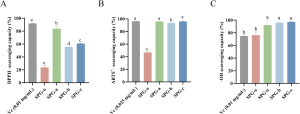
Original Figure 5: DPPH, ABTS⁺· and ·OH scavenging. Different letters indicate p < 0.05.
DPPH
SPG-a: 83.76 ± 3.68%SPG-b: 55.43 ± 0.55%; SPG-c: 60.55 ± 0.77%SPG-o: 20.37 ± 7.57%
ABTS⁺·
SPG-a: 95.79 ± 0.19%; SPG-b: 93.30 ± 0.67%SPG-c: 95.91 ± 0.58%SPG-o: 46.67 ± 0.85%
·OH
SPG-a: 92.00 ± 7.27%; SPG-b: 95.94 ± 1.83%SPG-c: 97.01 ± 1.09%; SPG-o: 76.26 ± 5.00%
Three complementary chemical assays demonstrate broad radical-scavenging activity and support positioning as an antioxidant ingredient.
He et al., 2025, Figure 5, DOI:10.3389/fphar.2025.1562839. Vc is the positive control.
BJ/HaCaT Proliferation: Cell-Type Differences Across Molecular Weights
CCK-8, 24 h; untreated control normalized to 100%; N = 3
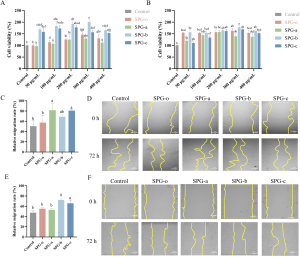
Original Figure 6A/B: 50–400 μg/mL; highlighted values are at 300 μg/mL.
BJ fibroblasts
SPG-b: 200.42% ± 11.00%300 μg/mL, 24 h
HaCaT keratinocytes
SPG-b: 177.62% ± 9.16%300 μg/mL, 24 h
Data reference: +53.69% and +14.59% in the abstract are relative to SPG-o. Values in the figure use the untreated control = 100%.
Additional EdU evidence: SPG-b, 50.90% ± 1.26%; SPG-c, 51.06% ± 0.88%, supporting DNA-synthesis activity.
He et al., 2025, Figures 6–7, DOI:10.3389/fphar.2025.1562839
Scratch Migration: Different Leading Samples in BJ and HaCaT Cells
The results text and figure legend report 300 μg/mL for 48 h; N = 3.
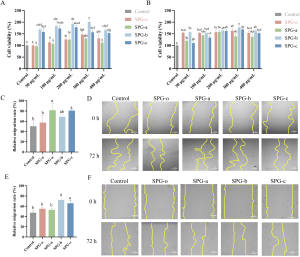
BJ: Significant effects with SPG-a/c
Untreated: 50.34 ± 10.51%a: 81.54 ± 13.78%c: 80.70 ± 1.92%
HaCaT: Significant effects with SPG-b/c
Untreated: 47.46 ± 3.75%b: 72.24 ± 6.67%c: 65.81 ± 6.20%
Results text and figure legend: 300 μg/mL, 48 h. Original microscopy panels are retained.
He et al., 2025, Figure 6C–F, DOI:10.3389/fphar.2025.1562839
Zebrafish Caudal-Fin Regeneration: Repair Evidence in an Animal Model
3.125 mg/mL, 72 h, N = 15; regenerated area reached 110.49% with SPG-c.
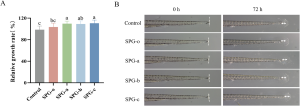
Regenerated area/rate, as reported in the original study
Untreated: 98.46 ± 6.91%SPG-o: 103.52 ± 7.18%SPG-a: 109.71 ± 4.81%SPG-b: 109.04 ± 5.79%SPG-c: 110.49 ± 5.94%
SPG-c increased the value by 6.97% relative to SPG-o.All SPG groups exceeded the untreated control (p < 0.05).
Repair application value
Animal regeneration data complement cell-proliferation and migration results, providing evidence across models for skincare development.
He et al., 2025, Figure 8, DOI:10.3389/fphar.2025.1562839
Full-Thickness Mouse Skin Wounds: 96.65% Healing at Day 18 with 4 mg/mL
SPG at 4 mg/mL achieved 96.65% closure at day 18 in a full-thickness mouse wound model.
Male BALB/c mice, 8 weeks old, 18–22 g
Circular full-thickness dorsal skin wounds, 8 mm; 3 mice per group
|
|
|
|---|---|
|
|
|
|
|
|
|
|
|
Changed every 3 days; continuous observation

Efficacy result reported in the patent
4 mg/mL: 96.65%Wound-healing rate at day 18; positive control: 3M transparent dressing
Animal wound-closure data provide tissue-level evidence for SPG repair applications and formulation development.
Lei et al., 2025, PMID:40628325, DOI:10.1016/j.ijbiomac.2025.145816;CN119874951B
Skincare Conclusions: Antioxidant and Repair Evidence Across Models
Chemical, cellular and animal studies together support skincare applications.
Evidence across experimental levels
-
DPPH, ABTS⁺· and ·OH assays show broad radical-scavenging activity. -
L929, BJ and HaCaT models show protection, proliferation and migration effects. -
B16F10 findings support melanin-related skin-tone-care activity. -
Zebrafish and mouse studies show tissue regeneration and wound closure.
Marketing value
-
Two grades meet different texture and application-design needs. -
Three complementary assays support antioxidant activity. -
Multiple models provide cell-protection and repair evidence. -
Potential applications include skin-tone care, antioxidant and daily repair products.
The two SPG grades combine formulation flexibility with evidence on antioxidant activity, cell protection and tissue repair to support skincare development.
Based on Gou et al., 2023; He et al., 2025; Lei et al., 2025. Experimental models and original data are presented in the NTU-1 through mouse-wound sections above (source slides 20–27).
Oral Care
HGF Study Design: Viability, Proliferation and Migration
Human gingival fibroblasts; 0.1–10 mg/mL; n = 3
Experimental workflow

Defined observation windows
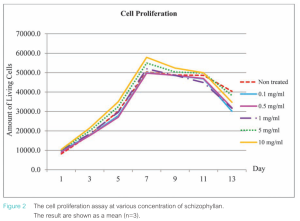
Between-group comparison at day 7 identifies proliferation differences. Figure 2 shows proliferation curves through day 13.
|
|
|
|---|---|
|
|
|
|
|
|
|
|
|
|
|
|
|
|
|
|
|
|
Mean ± SD, n = 3; P > 0.05.
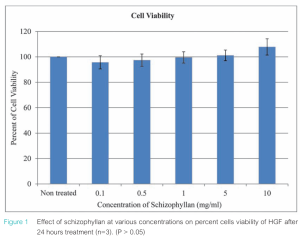
Mala, Sacharoen & Surarit, M Dent J, 2017, Table 1 and Figure 1;he02.tci-thaijo.org/index.php/mdentjournal/article/view/180061
HGF Results: Dose Differences in Day-7 Proliferation and 24-h Migration
At 5 and 10 mg/mL, 24-h scratch migration was significantly higher than the control.
Day-7 proliferation: 5.7 × 10⁴ cells/well at 10 mg/mL
|
|
|
|---|---|
|
|
|
|
|
|
|
|
|
|
|
|
|
|
|
|
|
|
Mean ± SD, n = 3; overall P < 0.05. Values sharing a letter are not significantly different (P > 0.05).
24-h migration: Control, 120 ± 5 cells/mm²
|
|
|
|---|---|
|
|
|
|
|
|
|
|
|
|
|
|
|
|
|
|
|
|
Mean ± SD, n = 3; overall P < 0.05. Values sharing a letter are not significantly different (P > 0.05).
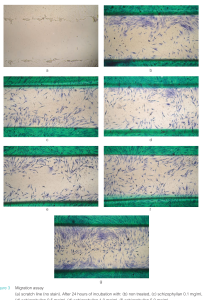
Dose-dependent HGF proliferation and migration findings support the potential of SPG in oral and gingival care products.
Mala et al., 2017, Tables 2–3 and Figures 2–3; n = 3. Statistical grouping letters and P values follow the original paper.
Periodontal-Pathogen LPS/IL-10: A Macrophage Signaling Pathway
SPG/Dectin-1 enhances LPS-induced IL-10 expression in J774.1 macrophages through coordinated signaling.
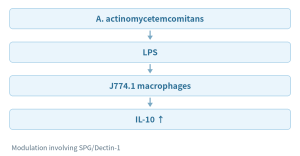
Signaling events
-
Prolonged NF-κB nuclear translocation. -
Phosphorylation of Syk, MSK1 and CREB. -
Enhanced LPS-induced IL-10 expression.
Oral-care application value
-
IL-10-related mechanisms support oral-care ingredient development. -
Dectin-1, Syk, MSK1 and CREB define the signaling pathway. -
HGF proliferation and migration evidence further supports gingival-care applications.
PuriActives® SPG combines fibroblast and macrophage evidence to support oral and gingival care product development.
Thongsiri et al., Carbohydr Polym, 2021, PMID:33278951, DOI:10.1016/j.carbpol.2020.117285
References
Additional References and Analytical Methods
Structural biology, receptor recognition and complementary low-MW characterization
Structure and receptor recognition
1. Manabe N, Yamaguchi Y. 3D Structural Insights into β-Glucans and Their Binding Proteins. Int J Mol Sci. 2021;22:1578. DOI:10.3390/ijms22041578.2. Palma AS et al. Ligands for the β-glucan receptor, Dectin-1, assigned using designer microarrays. J Biol Chem. 2006;281:5771–5779.3. Hanashima S et al. NMR study of short β(1–3)-glucans provides insights into the structure and interaction with Dectin-1. Glycoconj J. 2014;31:199–207.4. Adams EL et al. Differential high-affinity interaction of Dectin-1 with natural or synthetic glucans. J Pharmacol Exp Ther. 2008;325:115–123.
Analytical characterization: GPC and MALDI-TOF
5. Schilan3000 GPC molecular-weight data, 2021-09-28, Waters RI; Mn 1777 Da, Mw 2420 Da.6. Test report XBD-CS-2021120581, sample “Glucan degradation product A,” MALDI-7090, 2022-01-07.7. Botaride Sclero3000P comprehensive materials, pp. 9–11, technical data on low-MW β-glucan.
GPC provides molecular-weight distributions and statistical averages. MALDI-TOF resolves oligosaccharide ion series. Combining them supports robust low-MW characterization and specification development.
Complementary GPC and MALDI-TOF characterization supports low-MW SPG specification design.
Summary
PuriActives® SPG: Two Grades, Multiple Applications
Triple-helix rheology, low-MW flexibility and evidence for skincare and oral care
High-MW SPG provides triple-helical structure and rheological properties, while low-MW SPG offers chain-length flexibility. Evidence on antioxidant activity, cell protection, tissue repair and oral care supports product development across applications.
Structure and rheology1. Kuttel et al. Explicit-Solvent Molecular Dynamics Simulations of the Polysaccharide Schizophyllan in Water. Biophys J, 2007. PMC1896245.2. Kumar & Singhal. Rheological properties of schizophyllan. Am J Food Technol, 2011. DOI: 10.3923/ajft.2011.781.789.3. Fang & Nishinari. Gelation of schizophyllan/sorbitol. 2004. DOI: 10.1002/bip.10514.4. Fang et al. Rheology of denatured–renatured SPG. 2004. PMID: 15211499.5. Zhong et al. 2013. DOI: 10.1016/j.ijbiomac.2013.08.015.6. Jamshidian et al. 2017. DOI: 10.1016/j.ijbiomac.2017.06.110.
Care applications7. Gou et al. NTU-1 fermentation, UVB and melanin studies. Int J Biol Macromol, 2023. DOI: 10.1016/j.ijbiomac.2023.124504.8. He et al. Degraded SPG: antioxidant, cells and zebrafish. Front Pharmacol, 2025. DOI: 10.3389/fphar.2025.1562839.9. Lei et al. Non-homopolymeric SPG in wound healing. 2025. DOI: 10.1016/j.ijbiomac.2025.145816; CN119874951B.10. Mala et al. HGF proliferation and migration. M Dent J, 2017.11. Thongsiri et al. SPG/Dectin-1 and IL-10. 2021. DOI: 10.1016/j.carbpol.2020.117285.12. “Evaluation of the Moisturizing Efficacy of Schizophyllan” [Chinese title translated]. Journal of Chinese Institute of Food Science and Technology, 2015, 15:223–228 (bibliographic information only).
High MW: Structure and texture. Low MW: Formulation flexibility. Evidence: Skincare and oral-care innovation.
See the preceding reference section for structure, receptor and molecular-weight characterization. Original paper figures include He 2025, Kumar 2011 and Mala 2017.