01 · PuriActives® Supra Series
From difficult-to-use actives to formulation-ready performance.
PuriPharm Co., Ltd. Cosmetic Active Ingredients. Technical Presentation.
02 · Why Supramolecular Technology: Active Value and Formulation Challenges
High-value ingredients with biological activity or efficacy potential can still face 11 common challenges in real cosmetic formulations.
Solubility and dispersion: insufficient water solubility, difficult dispersion, crystallization or precipitation, and uneven distribution.
Stability: limited oxidative stability, limited light stability, and pH sensitivity.
Compatibility and application: limited formulation compatibility, dependence on organic solvents, difficult development, and incomplete translation of molecular activity into finished-product performance.
Core conclusion: scientific value becomes product value when an active can be incorporated successfully, remain stable, distribute uniformly, and perform effectively.
03 · Supramolecular Chemistry: Recognition, Organization, and Cooperation
Conventional chemistry examines how atoms form molecules through covalent bonds. Supramolecular chemistry examines how molecules recognize, bind, arrange, and cooperate through reversible noncovalent interactions to form higher-order organized systems.
Definition: the science of ordered molecular assemblies formed through noncovalent interactions.
Key interactions: hydrogen bonding, electrostatic and hydrophobic interactions, van der Waals forces, π–π interactions, host–guest interactions, molecular recognition, and metal-ion coordination.
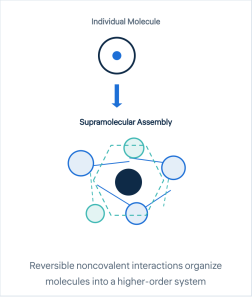
Individual molecules organize into supramolecular assemblies through reversible noncovalent interactions.
Sources: Lehn J.-M. Supramolecular Chemistry. Science 1993, 260, 1762–1763. DOI: 10.1126/science.8511582; Supramolecular Chemistry—Scope and Perspectives (Nobel Lecture). Angew. Chem. Int. Ed. 1988, 27, 89–112.
04 · Understanding the System: Optimizing the Molecular Environment
Conventional active performance depends on the aqueous and oil phases, pH, salts, temperature, and other ingredients. Functional components in a supramolecular system create a cooperative molecular environment around the active.
The presentation compares this to a molecular team supporting an active facing formulation challenges.
Conventional pathway: an isolated active encounters an unfavorable environment and solubility, stability, and compatibility problems.
Supramolecular pathway: the active and functional supporting components form an organized system through noncovalent interactions, creating an environment better suited to formulation.

05 · System Formation: From Separate Components to a Dynamic Network
An active, functional supporting components, and an aqueous phase or specific formulation environment organize into a dynamic supramolecular network through reversible noncovalent interactions.
These include hydrogen bonding, electrostatic interactions, hydrophobic association, molecular recognition, and coordination. The reversible, dynamic, cooperative network creates a functional molecular environment.
A supramolecular system does not necessarily create a new covalent chemical substance. Its function arises from component organization, interactions, and cooperative behavior.

06 · Conventional Actives and Supramolecular Systems
Conventional actives primarily rely on individual molecules. Performance depends strongly on solvent conditions, with potential solubility and dispersion problems. Stability and compatibility require separate solutions, while actives and supporting systems remain relatively independent.
Supramolecular systems combine functional components and tailor the molecular environment. They can support compatibility and uniform distribution, reduce some application barriers, and provide complementary functions, with emphasis on finished-product performance.
Purposeful organization offers the possibility of synergistic value greater than the sum of its parts. This describes a platform design objective rather than verified synergy for every product.
07 · From Formulation Challenges to Solutions
The table maps formulation challenges to molecular strategies and practical value for formulators. Development starts from a formulation problem and uses molecular strategies to create actionable formulation value.
| Formulation challenge | Supramolecular strategy | Formulation value |
|---|---|---|
| Insufficient water solubility | Create a hydrophilic molecular environment | Easier incorporation into water-based systems |
| Crystallization or precipitation | Intermolecular interactions and organized assembly | Improved dispersion and storage performance |
| Insufficient stability | Create a supportive microenvironment | Improved formulation robustness |
| Limited system compatibility | A cooperative multicomponent molecular system | Greater formulation flexibility |
| Uneven distribution | Improve molecular-level dispersion | More uniform active distribution |
| Limited active functionality | Combine with functional supporting components | Multidimensional formulation value |
08 · Supra Series: A Platform for Real Formulations
PuriActives® Supra Series comprises multifunctional supramolecular active systems. Each combines a high-value cosmetic active with designed functional supporting components according to its molecular properties. Noncovalent interactions create a cooperative environment intended to improve ease of use, compatibility, and overall functional value.
The platform can expand to different actives.
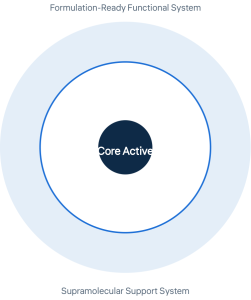
Three layers: the core active, a supramolecular support system, and a formulation-ready functional system.
09 · Development Purpose: Bridging Scientific Potential and Commercial Formulations
A molecule with scientific potential is not automatically a formulation-ready commercial cosmetic ingredient.
01 Improve the practical value of high-value actives.
02 Make difficult actives easier to formulate.
03 Improve use in water-based systems.
04 Support stability and uniform distribution.
05 Reduce development barriers.
06 Create multifunctional cooperative systems through supporting components.
07 Translate scientific potential into commercially feasible ingredients.
08 Bring active concepts closer to finished-product development.
10 · Core Objective: Connecting Molecular Potential and Real Performance
To make high-value active ingredients easier to use and more effective in real cosmetic formulations through supramolecular organization.
The pathway connects molecular potential, supramolecular organization, formulation performance, and perceptible product value.

11 · Four Development Principles
01 Formulation readiness: turn difficult actives into convenient ingredient systems.
02 Molecular compatibility: create a suitable physicochemical environment.
03 Synergistic functionality: combine complementary functions of the core active and supporting components.
04 Real formulation performance: consider experimental molecular activity alongside the actual state of use in finished cosmetics.
Supra applies supramolecular science to real formulation needs.
12 · Typical Architecture of a Supra System
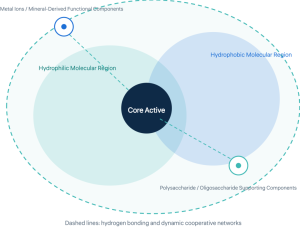
A system may include a core active, metal ions or mineral-derived functional components, polysaccharide or oligosaccharide supporting components, and hydrophilic and hydrophobic regions.
Hydrogen-bond networks, electrostatic interactions, and coordination contribute to a dynamic cooperative supramolecular network. Dashed lines illustrate hydrogen bonding and dynamic cooperation.
The diagram presents the platform’s general design logic. Specific components and organization depend on the core active’s physicochemical properties and intended use.
13 · Representative Products
S1 PuriActives® SupraFerulix™: a supramolecular ferulic acid system. Ferulic acid offers antioxidant and photoaging-care potential but faces solubility, stability, and compatibility challenges in aqueous formulations.
S2 PuriActives® SupraSalix: a supramolecular salicylic acid system. Salicylic acid supports pore cleansing, exfoliation, and oily/acne-prone skin care, with limitations in water solubility and pH compatibility.
S3 PuriActives® SupraHDA™: a supramolecular 10-HDA system. This characteristic royal-jelly-related functional molecule has skin and scalp care potential but presents practical formulation challenges.
S4 PuriActives® SupraCaffix™: a supramolecular caffeic acid system. Caffeic acid offers polyphenol antioxidant value, with aqueous solubility, oxidative stability, and compatibility requiring optimization.
Sources: Srinivasan et al. 2007; Saija et al. 2000; Arif 2015; Zhang et al. 2022; Sugiyama et al. 2012; Yang et al. 2018. Original bibliographic details appear in the final section.
14 · Supramolecular Organization and Conventional Delivery
Supramolecular technology is defined by purposeful molecular organization and functional cooperation through reversible noncovalent interactions. Its definition does not depend on nanoscale size or physical encapsulation.
It can combine with liposomes, nanodelivery, and other technologies, with a distinct design rationale. The table summarizes the main features.
| Technology | Main features |
|---|---|
| Solubilization | Primarily improves dissolution or dispersion in a solvent. |
| Microcapsules / encapsulation | Primarily encloses actives within physical wall materials. |
| Liposomes | Primarily carries actives in lipid bilayers or vesicles. |
| Nanodelivery | Typically focuses on particle size, surface area, dispersion, and delivery performance. |
| Supramolecular technology | Organizes molecules into cooperative systems through reversible noncovalent interactions. |
15 · Value for Formulators: Practical Molecular Science
Ease of use: easier incorporation, reduced reliance on strong solvents, and support for water-based development.
Formulation performance: supports uniform distribution, design flexibility, and formats including serums, gels, and lotions.
Development value: opportunities for multifunctional concepts, simpler development steps, new scalp-serum and cleansing/conditioning applications, and translation of high-value molecules into commercial products.
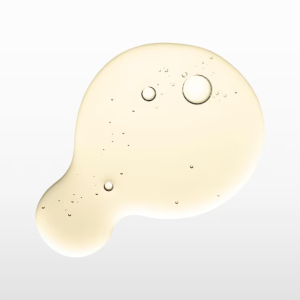
Advanced molecular science made practical for formulators. The image illustrates development across serum, gel, and lotion formats.
16 · Skin, Hair, and Scalp Care Directions
Skin care: antioxidant care, aging and photoaging care, skin brightening, oily/acne-prone skin care, exfoliation, soothing, barrier support, sensitive-skin formulations, protection from external stressors, serums, and functional lotions.
Hair and scalp care: scalp sebum management, soothing, antioxidant care, microenvironment management, pollution protection, scalp serums, functional shampoos and conditioners, and comprehensive hair/scalp care.
Specific directions for each Supra product should follow its core active and actual test data.
17 · Key Questions, Answered
Q1 What is supramolecular technology? It purposefully organizes molecules into cooperative functional systems through noncovalent interactions such as hydrogen bonding, electrostatic and hydrophobic interactions, and molecular recognition, creating a suitable environment for actives.
Q2 Why develop Supra Series? To address limitations in solubility, stability, dispersion, compatibility, and practical use, bridging molecular potential and real formulation performance.
18 · Molecular Organization. Formulation Freedom. Active Performance.
Building the molecular environment where actives perform better.
PuriPharm Co., Ltd.
Selected references below retain the bibliographic information supplied in the presentation.
Lehn J.-M. Science 1993, 260, 1762–1763. DOI: 10.1126/science.8511582
Lehn J.-M. Angew. Chem. Int. Ed. 1988, 27, 89–112. DOI: 10.1002/anie.198800891
Cram D. J. Angew. Chem. Int. Ed. 1988, 27, 1009–1020.
Pedersen C. J. Angew. Chem. Int. Ed. 1988, 27, 1021–1027.
Lehn J.-M. Proc. Natl. Acad. Sci. USA 2002, 99, 4763–4768.
Lehn J.-M. Chem. Soc. Rev. 2007, 36, 151–160. DOI: 10.1039/b616752g
Aida T., Meijer E. W., Stupp S. I. Science 2012, 335, 813–817.
Webber M. J., Langer R. Chem. Soc. Rev. 2017, 46, 6600–6620.
Srinivasan M. et al. J. Clin. Biochem. Nutr. 2007, 40, 92–100.
Saija A. et al. Int. J. Pharm. 2000, 199, 39–47.
Arif T. Clin. Cosmet. Investig. Dermatol. 2015, 8, 455–461. DOI: 10.2147/CCID.S84765
Zhang L. et al. J. Cosmet. Dermatol. 2022, 21, 3398–3405.
Sugiyama T. et al. Endocr. Metab. Immune Disord. Drug Targets 2012.
Yang Y.-C. et al. BMC Complement. Altern. Med. 2018, 18.