01 · PuriActives® Supra-Allantoin
Beyond soothing: from skin barrier care to skin and scalp microbiome balance.
PuriActives® Supramolecular Care System. PuriPharm Co. Ltd.
02 · Contents: From Molecule to Application
03 · Product Concept: From Soothing to Integrated Care
PuriActives® Supra-Allantoin combines Zinc PCA, Allantoin, Xyloglucan, and Alpha-Glucan Oligosaccharide. The presentation describes an integrated supramolecular care system in which four components cooperate within a hydrophilic network to address sebum management, soothing and recovery, flexible film formation, and microbiome balance across skin, scalp, and hair care.
Purify: Zinc PCA for sebum and scalp environment management.
Soothe: Allantoin for soothing and recovery.
Protect: Xyloglucan for a flexible film and barrier interface.
Balance: Alpha-Glucan Oligosaccharide for microbiome balance.
One active system addresses oiliness, irritation, barrier stress, and microbial balance in sensitive oily skin and scalp.
Source: PuriPharm public supramolecular product platform, puriactives.com (platform narrative).
Source link from the presentation: https://www.puriactives.com/en/?p=1281
04 · Supra-Architecture: Four Components, One Integrated System
Zinc PCA (INCI: Zinc PCA): sebum balance, freshness, and scalp environment management. Functional Zn²⁺ ions and the skin-compatible PCA carrier form a small functional node.
Allantoin (INCI: Allantoin): soothing, recovery, and support for stressed skin. This polar ureide molecule forms the soothing and recovery core.
Xyloglucan (INCI: Xyloglucan): flexible film formation, a biomimetic interface, and support for skin cell recovery. A hydroxyl-rich polysaccharide backbone creates a flexible hydrophilic network.
Alpha-Glucan Oligosaccharide (INCI: Alpha-Glucan Oligosaccharide; α-GOS): prebiotic microbiome balance and barrier support. These short-chain sugars can be selectively utilized by skin commensals.
Sources: Allantoin—Araújo et al. 2010; Xyloglucan—Nie & Deters 2013; α-GOS—Duan et al. 2021; Zinc PCA—public international supplier technical information. Full references appear in the final section.
Source link from the presentation: https://ajiaminoscience.eu/personalcare/produit/ajidew-zn-100/
05 · Supra-Architecture: Dynamic Multipoint Interactions
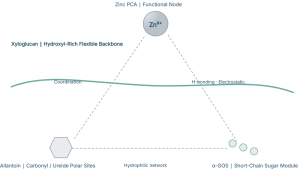
The presentation proposes a dynamic hydrophilic network in which Zn²⁺/Zinc PCA functional nodes interact with Allantoin polar sites and polysaccharide hydroxyl groups through coordination, hydrogen bonding, electrostatic interactions, and hydrophilic associations.
Structural modules comprise Zinc PCA functional nodes, a hydroxyl-rich flexible Xyloglucan backbone, Allantoin carbonyl/ureide polar sites, and an α-GOS short-chain sugar ecological module. The architecture integrates four care functions in one system.
06 · Molecular Mechanisms: Four Complementary Functions
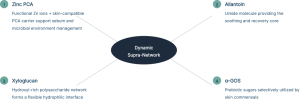
Zinc PCA: functional zinc ions and the skin-compatible PCA carrier support sebum and microbial environment management.
Allantoin: a ureide molecule provides the soothing and recovery core.
Xyloglucan: a dense hydroxyl-rich polysaccharide network creates a flexible hydrophilic interface.
α-GOS: prebiotic sugars can be selectively utilized by skin commensals.
Small molecules deliver activity, polysaccharides organize the interface, and prebiotic sugars extend care into the microbial ecosystem. A dynamic supramolecular network forms the center.
Sources: Zinc PCA sebum, freshness, and dandruff-care applications—public international supplier information; XG film formation—Kochumalayil et al. 2010, DOI: 10.1039/C0JM00367K.
Source link from the presentation: https://ajiaminoscience.eu/personalcare/produit/ajidew-zn-100/
07 · From Cell Recovery to Barrier Homeostasis
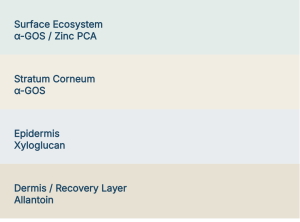
Surface ecosystem (α-GOS/Zinc PCA): an ingredient-level human α-GOS study reported improved Simpson index in the low-diversity group, with trends toward increased S. epidermidis and decreased S. aureus.
Stratum corneum (α-GOS): patent ex vivo/cellular experiments observed changes in the barrier-associated proteins filaggrin and involucrin (NL2037619A).
Epidermis (Xyloglucan): in vitro work supports proliferation and migration of human keratinocytes and fibroblasts, involving pro-proliferative signaling (Nie & Deters 2013).
Dermis/recovery layer (Allantoin): an animal open-wound model suggested inflammatory modulation, fibroblast proliferation, and extracellular matrix (ECM) synthesis (Araújo 2010; preclinical evidence).
Repair the tissue interface, support the barrier, and rebalance the ecosystem. The layer diagram illustrates mechanisms and does not establish product delivery depth.
Sources: Duan 2021, 10.5107/sccj.55.176; NL2037619A; Nie & Deters 2013, 10.1155/2013/359756; Araújo 2010, 10.1590/S0102-86502010000500014.
Source link from the presentation: https://doi.org/10.1590/S0102-86502010000500014
08 · Skin Benefits: Sensitive, Oily, and Barrier-Stressed Skin
Calm without heaviness. Balance without stripping. Protect beyond the surface.
Soothing and recovery: Allantoin + Xyloglucan combine a soothing core with a biomimetic interface to support stressed skin recovery.
Shine and sebum balance: Zinc PCA supports management of visible sebum and a fresh feel.
Barrier and moisture environment: Xyloglucan + α-GOS combine flexible hydrophilic film formation and prebiotic support.
Microbiome balance: α-GOS + Zinc PCA integrate prebiotic microbial management with sebum environment management.
Applications: sensitive oily skin serums, post-procedure/post-exfoliation care concepts, sebum-balancing soothing lotions, complementary care for acne-prone skin, and fresh-feeling men’s care.
Source: a case series of 11 participants using a Zinc PCA-containing facial cream reported improvement in all participants after 8 weeks (Piquero-Casals et al. 2020). This is evidence from a multi-ingredient formulation.
Source link from the presentation: https://pubmed.ncbi.nlm.nih.gov/32574015/
09 · Scalp Is Skin: Extending Barrier and Microbiome Science
Oil balance, scalp comfort, the microbiome, and hair surface care.
Zinc PCA: freshness and use in dandruff-care formulations. Allantoin: soothing and sensitive scalp care concepts. α-GOS: microbiome-friendly scalp care concepts. Xyloglucan: flexible film formation and deposition-interface concepts for hair care.
Formats: sebum-balancing shampoos, scalp serums, complementary dandruff-care products, sensitive scalp cleansing and conditioning, oily-root sprays, and leave-on scalp care.
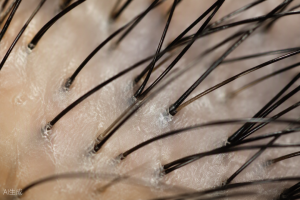
Image: illustrative macro photography of scalp and hair roots.
Source: a prospective cohort of 20 participants reported improvement with a salicylic acid/piroctone olamine/Zinc PCA scalp regimen (PMID 39778065, 2025). These results relate to a multi-ingredient regimen.
Source link from the presentation: https://pubmed.ncbi.nlm.nih.gov/39778065/
10 · Evidence Architecture: Clarifying Evidence Strength
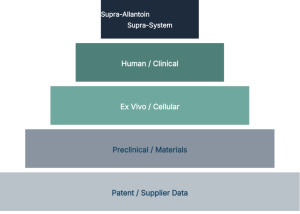
The presentation organizes its system narrative using human, ex vivo, cellular, materials, and patent evidence. The diagram lists, from top to bottom, the Supra-Allantoin system, human/clinical evidence, ex vivo/cellular evidence, preclinical/materials evidence, and patent/supplier data.
Human/clinical: facial flora research on α-GOS and multi-ingredient facial/scalp formulations containing Zinc PCA.
Ex vivo/cellular: α-GOS-associated filaggrin/involucrin findings and XG skin cell proliferation/migration.
Preclinical/materials: Allantoin animal wound models and XG film properties.
Patent/supplier: allantoin–metal complexes and public Zinc PCA technical data.
Communication follows the evidence and its limits. Ingredient, combination-formulation, patent, and materials studies do not establish direct human efficacy of the complete Supra-Allantoin system. Details follow in the next three sections and references.
Source link from the presentation: https://www.jstage.jst.go.jp/article/sccj/55/2/55_176/_article/-char/en
11 · Human α-GOS Evidence: Two-Week Microbiome Observations
Study design: an α-GOS-containing gel was applied to the whole face twice daily for 2 weeks. Wet-swab sampling and DNA metagenomic analysis assessed facial flora.
Result 1: microbial diversity improved in the group with a low initial Simpson Index (SI). C. acnes abundance moved toward a more appropriate level in that group.
Result 2: the overall population showed trends toward increased S. epidermidis and decreased S. aureus.
Prebiotic care supports ecological balance. This is ingredient-level human evidence for α-GOS, and trend findings retain the source wording.
Source: Duan Z, Yokota M, Eda Y. The Effect of Alpha-Glucan Oligosaccharide on Facial Skin Flora. J Soc Cosmet Chem Jpn. 2021;55(2):176–181. DOI: 10.5107/sccj.55.176.
Source link from the presentation: https://www.jstage.jst.go.jp/article/sccj/55/2/55_176/_article/-char/en
12 · Recovery Evidence: Allantoin and a Biomimetic Polysaccharide Interface
Allantoin (preclinical animal model): histological findings in the open-wound model of Araújo et al. 2010 involved inflammatory modulation, fibroblast proliferation, and ECM synthesis, providing a preclinical basis for soothing and recovery mechanisms.
Xyloglucan (human skin cells in vitro): Nie & Deters 2013 reported that tamarind Xyloglucan promoted proliferation, cell-cycle progression, and migration, involving pro-proliferative signaling.
Materials research by Kochumalayil et al. 2010 showed that water-cast XG films combined stiffness, strength, and ductile toughness, supporting a flexible biomimetic protective interface.
A soothing core and a biomimetic interface supporting recovery.
Sources: Araújo, Acta Cir Bras. 2010;25(5):460–466, 10.1590/S0102-86502010000500014; Nie & Deters, 10.1155/2013/359756; Kochumalayil, 10.1039/C0JM00367K.
Source link from the presentation: https://doi.org/10.1590/S0102-86502010000500014
13 · Zinc PCA: Sebum and Scalp Balance
Public supplier information describes reduction of excess visible sebum, freshness of skin and hair, mild antimicrobial activity against yeasts and molds, and use in dandruff-care shampoo formulations.
Patent support: technical data on 5α-reductase and MIC support the sebum-management rationale (CN107126379B).
Clinical context from a combination cream: 11 patients with mild-to-moderate facial seborrheic dermatitis used a multi-ingredient Zinc PCA-containing cream for 8 weeks. All improved: 81.8% received an excellent rating and 18.1% a good rating, with 0 recorded adverse reactions. Percentages are retained exactly as supplied.
Sources: public international supplier Zinc PCA information; Piquero-Casals J et al. J Drugs Dermatol. 2020;19(6), DOI: 10.36849/JDD.2020.5121; CN107126379B.
Source link from the presentation: https://ajiaminoscience.eu/personalcare/produit/ajidew-zn-100/
Source link from the presentation: https://patents.google.com/patent/CN107126379B/en
14 · Formulation Guide: Multiple Skin & Scalp Formats
Five-point addition gradient: 0.5%, 1%, 2%, 3%, and 5%. Evaluate clarity, viscosity, pH, electrolyte stability, centrifugation/thermal cycling, and performance. The presentation recommends 1–3%, with up to 5% for enhanced formulations.
Processing: preferably add to the aqueous phase or at a later stage. Evaluate the effects of pH, strong chelators, anionic surfactants, and electrolytes on Zn²⁺ and the supramolecular network.
Sources: NL2037619A (α-GOS barrier proteins and formulation-range context); JP6995791B2 (XG cleansing/conditioning formats); WO2014027120A2 (XG hair deposition).
Source link from the presentation: https://patents.google.com/patent/NL2037619A/en
| Format | Application |
|---|---|
| Soothing sebum-balancing serum | Daily care for sensitive oily skin |
| Gel cream / lotion | Sebum balance, soothing, and moisturization |
| Mask | Intensive soothing care |
| Scalp serum | Scalp barrier and microbiome |
| Shampoo | Fresh-feeling sebum-balancing cleansing system |
| Scalp spray | Leave-on scalp care |
15 · Regulatory & Safety Readiness: Established Ingredient Foundations
China: the PuriPharm ingredient database records XYLOGLUCAN in the 2025 and 2021 Inventory of Existing Cosmetic Ingredients, with a highest historical leave-on use level of 1.989%.
USA: the presentation cites 21 CFR §347.10 for Allantoin as an OTC skin protectant at 0.5–2%. Its history of topical use and CIR safety assessment provide an established foundation.
International: public α-GOS supplier information addresses use in the EU, USA, China, and Japan and COSMOS-related natural-origin information.
The presentation positions all four components as established cosmetic ingredients for global development. These regulatory/database statements reproduce the supplied presentation and do not imply approval or certification of this complex or finished products. They have not been independently updated for this conversion.
Sources: PuriPharm Xyloglucan database; 21 CFR §347.10; Becker et al. 2010, CIR Allantoin safety assessment; public international α-GOS supplier information.
Source link from the presentation: https://www.puriactives.com/db/public/index.php/materials/detail/22408
Source link from the presentation: https://www.ecfr.gov/current/title-21/chapter-I/subchapter-D/part-347/subpart-B/section-347.10
Source link from the presentation: https://www.solabia.com/cosmetics/product/bioecolia/
16 · Market Positioning: From Soothing to Integrated Balance
A supramolecular care system built around Allantoin.
Traditional Allantoin solutions: a single soothing position, established recovery care with a limited mechanism narrative, and substantial similarity between offerings.
Supra-Allantoin positioning: soothing/recovery and sebum balance, flexible film formation and microbiome care, and dual skin/scalp applications.
Four-in-One architecture: an integrated four-component supramolecular system.
Mechanism chain: a three-layer narrative from molecule to microbiome.
Dual applications: one active story for skin and scalp care.
Expandable evidence framework: literature, patents, human, cellular, and materials evidence.
17 · Application Markets: Formulations with Multiple Care Functions
Functional sensitive-skin brands: sensitive oily skin serums, soothing masks, and barrier care concepts.
Oily/acne-prone skin brands: sebum-balancing recovery lotions and complementary acne care products.
Professional scalp care brands: oily scalp serums, sebum-balancing shampoos, complementary dandruff-care products, and leave-on scalp sprays.
International ODM/OEM innovation centers: platform development of multiple formats across skin and scalp formulation libraries.
Target contexts: sensitive/oily skin, barrier stress, and scalp imbalance. One active story spans facial, scalp, and hair-care innovation.
Image: illustrative photography of a translucent serum texture.
18 · Communication System
Primary: Calm. Balance. Protect.
Alternatives: Beyond Soothing. From Molecule to Microbiome. One Supra-System. Skin & Scalp in Balance. Four Components. One Intelligent Interface.
19 · Scientific Evidence Sources: Six Core Evidence Streams
Six evidence dimensions address the human microbiome, skin cells, recovery mechanisms, clinical contexts, supramolecular chemistry, and barrier proteins. Original slide references in the table are retained for evidence navigation.
| Evidence dimension | Professional source | Supporting content |
|---|---|---|
| ① Human microbiome | Duan et al. 2021, J Soc Cosmet Chem Jpn. DOI: 10.5107/sccj.55.176 | α-GOS: human flora changes over 2 weeks (slide 11) |
| ② Skin cells | Nie & Deters 2013. DOI: 10.1155/2013/359756 | Xyloglucan: human skin cell proliferation and migration (slide 12) |
| ③ Recovery mechanisms | Araújo et al. 2010, Acta Cir Bras. DOI: 10.1590/S0102-86502010000500014 | Allantoin: inflammatory modulation / fibroblasts / ECM (slide 12) |
| ④ Clinical use contexts | Piquero-Casals et al. 2020, J Drugs Dermatol. DOI: 10.36849/JDD.2020.5121 | Zinc PCA-containing facial care: improvement over 8 weeks (slide 13) |
| ⑤ Supramolecular chemistry | WO1995026194A1 (allantoin–metal complexes) | Precedent for allantoin–zinc coordination structures (slide 5) |
| ⑥ Barrier proteins | NL2037619A (filaggrin / involucrin ex vivo) | α-GOS: barrier-associated protein support (slide 7) |
20 · Scientific References & Patents
The following retains the full journal, human study, patent, supplier, and platform references from the presentation. Source hyperlinks are retained from the presentation. No additional URLs have been invented.
Source link from the presentation: https://doi.org/10.1590/S0102-86502010000500014
Source link from the presentation: https://doi.org/10.1155/2013/359756
Source link from the presentation: https://doi.org/10.1039/C0JM00367K
Source link from the presentation: https://doi.org/10.1016/j.ijbiomac.2018.10.078
Source link from the presentation: https://www.jstage.jst.go.jp/article/sccj/55/2/55_176/_article/-char/en
Source link from the presentation: https://pubmed.ncbi.nlm.nih.gov/32574015/
Source link from the presentation: https://pubmed.ncbi.nlm.nih.gov/39778065/
Source link from the presentation: https://www.cir-safety.org/ingredient/allantoin
Source link from the presentation: https://patents.google.com/patent/WO1995026194A1/en
Source link from the presentation: https://patents.google.com/patent/NL2037619A/en
JOURNALS & HUMAN STUDIES
Araújo LU, Grabe-Guimarães A, Mosqueira VCF, et al. Profile of wound healing process induced by allantoin. Acta Cir Bras. 2010;25(5):460–466. DOI: 10.1590/S0102-86502010000500014
Nie W, Deters AM. Tamarind seed xyloglucans promote proliferation and migration of human skin cells. Dermatol Res Pract. 2013:359756. DOI: 10.1155/2013/359756
Kochumalayil J, Sehaqui H, Zhou Q, Berglund LA. Tamarind seed xyloglucan — a thermostable high-performance biopolymer. J Mater Chem. 2010;20:4321–4327. DOI: 10.1039/C0JM00367K
Picone P, et al. Biocompatibility, hemocompatibility and antimicrobial properties of xyloglucan-based hydrogel film. Int J Biol Macromol. 2019;121:784–795. DOI: 10.1016/j.ijbiomac.2018.10.078
Duan Z, Yokota M, Eda Y. The effect of alpha-glucan oligosaccharide on facial skin flora. J Soc Cosmet Chem Jpn. 2021;55(2):176–181. DOI: 10.5107/sccj.55.176
Piquero-Casals J, et al. Non-steroidal topical therapy for facial seborrheic dermatitis. J Drugs Dermatol. 2020;19(6). DOI: 10.36849/JDD.2020.5121 (combination-formulation context evidence)
A cohort clinical study on topical salicylic acid / piroctone olamine / Zinc PCA regimens in scalp seborrheic dermatitis. J Cosmet Dermatol. 2025. PMID 39778065 (combination-formulation context evidence)
Becker LC, et al. Final report of the safety assessment of allantoin and its related complexes. Int J Toxicol. 2010. DOI: 10.1177/1091581810362805
PATENTS
WO1995026194A1 Allantoin-metal complexes for skin and hair (1995)
NL2037619A Active ingredients capable of increasing skin barrier-associated protein differentiation
CN107126379B Oil-control acne-removing composition and application thereof
WO2014027120A2 Cosmetic and household care compositions (2014)
JP6995791B2 Xyloglucan-containing gel composition
SUPPLIER & PLATFORM DATA
Zinc PCA technical product information — public international supplier technical information
Alpha-Glucan Oligosaccharide technical information — public international supplier technical information
PuriActives® public supramolecular platform information — puriactives.com (platform narrative)
XYLOGLUCAN Xyloglucan ingredient information — PuriPharm ingredient database;21 CFR §347.10