01 · PuriActives® RhamnoCalm™: Rhamnose-Rich Soothing Polysaccharide
A rhamnose-rich biofunctional polysaccharide linking glycobiology with skin and scalp soothing. Recognizing cellular signals for targeted soothing.
Key active: Biosaccharide Gum-2. A functional cosmetic active based on glycobiological cell recognition.
PuriPharm Co. Ltd. (浦瑞生物医药技术有限公司).
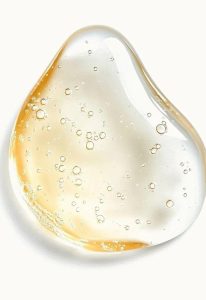
02 · Product at a Glance: Biotechnology in the Language of Skin
Trade name: PuriActives® RhamnoCalm™. Key active: Biosaccharide Gum-2.
Category: a biotechnology-derived functional polysaccharide active for soothing cosmetic formulations.
Positioning: sensitive skin soothing, rapid redness reduction, anti-irritant care, neuro-comfort, inflammatory signal modulation, support for tolerance of potent actives, healthy aging, and scalp soothing and stress management.
Central idea: rhamnose-rich polysaccharides interact with biological recognition mechanisms in keratinocytes to soothe stressed skin and scalp and support lasting resilience. Rhamnose-powered biological soothing.
Image: illustrative textures for serums, gels, and creams.
03 · Why Skin Becomes Sensitive: The Biological Pathway of Discomfort
Before redness becomes visible, daily stressors can already trigger alarm signals in epidermal cells.
Stressors include UV and pollution, surfactant cleansing, retinol and exfoliating acids, chemical hair coloring or perming, heat, friction and shaving, dryness and barrier stress, and lifestyle or urban stress.
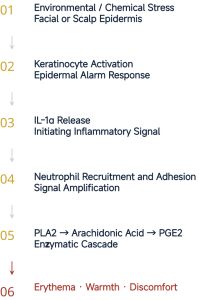
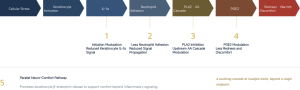
Pathway: environmental and chemical stress on facial or scalp epidermis → keratinocyte activation → IL-1α release and initiation of inflammation → neutrophil recruitment and adhesion → the PLA2, arachidonic acid, and PGE2 cascade → erythema, warmth, and visible discomfort.
04 · Key Active: A Rhamnose-Rich Branched Biosaccharide
Biosaccharide Gum-2 is a biotechnology-derived extracellular polysaccharide produced through modern fermentation, with a branched structure rich in rhamnose residues.
Its biofunctional concept centers on skin–glycan interactions, with sugar units recognized at the keratinocyte surface.
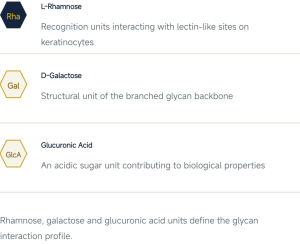
L-rhamnose (Rha): a recognition unit interacting with lectin-like carbohydrate recognition sites.
D-galactose (Gal): a structural unit of the branched glycan backbone.
Glucuronic acid (GlcA): an acidic sugar unit contributing to the glycan’s biological properties.
These related sugar units together define the interaction profile. The branched structure is schematic, with darker units indicating rhamnose-rich recognition motifs.

05 · Glycobiological Cell Recognition
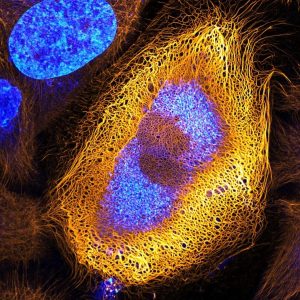
Human keratinocytes have membrane-associated lectins and carbohydrate recognition systems that can interact with rhamnose-containing glycans.
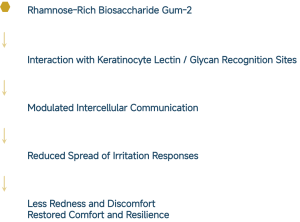
Rhamnose-rich Biosaccharide Gum-2 → interaction with cell-surface lectin/carbohydrate recognition sites → modulation of intercellular communication → reduced spread of irritation responses → less redness and discomfort, with restored comfort and resilience.
This is a recognition-based glycobiological concept, not a pharmacological receptor claim.
Image: fluorescence microscopy of human skin cells.
06 · Rhamnose–Keratinocyte Communication
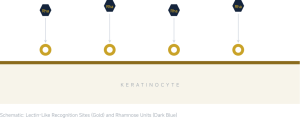
Cell affinity encoded in glycans: the schematic shows rhamnose-containing units in dark blue interacting with lectin-like carbohydrate recognition sites in gold.
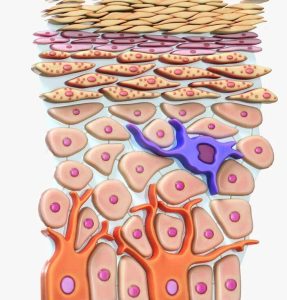
Image: a 3D model of epidermal keratinocyte layers.
Scientific basis: Condaminet et al., Experimental Cell Research, 1997, supports the basis for recognition of α-L-rhamnosyl structures by surface lectins on keratinocytes. DOI: 10.1006/excr.1997.3518. [1]
07 · Inflammatory Signal Network: Five Intervention Points
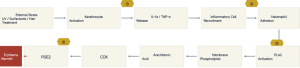
External stress (UV, surfactants, coloring or perming) → keratinocyte activation → IL-1α/TNF-α release → inflammatory cell recruitment → neutrophil adhesion → PLA2 activation → membrane phospholipid and arachidonic acid pathways → COX → PGE2 → erythema and warmth.
Five intervention points: modulate the initiating IL-1α signal, reduce neutrophil adhesion, inhibit PLA2 activity, modulate PGE2 signaling, and promote β-endorphin release for neuro-comfort.
Signals amplify from external stress to visible redness, and RhamnoCalm™ is positioned for soothing at several nodes.
08 · Multi-Target Soothing: Five Mechanisms
Main pathway: cellular stress → keratinocyte activation → IL-1α → neutrophil adhesion → the PLA2/arachidonic acid cascade → PGE2 → erythema, warmth, and discomfort.
1. Modulate initiation by reducing keratinocyte IL-1α signaling.
2. Reduce neutrophil adhesion and further signal propagation.
3. Inhibit PLA2 to modulate the arachidonic acid cascade upstream.
4. Modulate PGE2 to help reduce redness, warmth, and discomfort.
5. A parallel neuro-comfort pathway promotes keratinocyte β-endorphin release to support comfort beyond inflammatory signaling.
The concept covers a cascade at multiple levels rather than a single inflammatory endpoint.
09 · In Vitro Reference Data: IL-1α
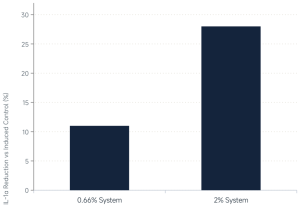
Model: reconstructed human epidermis stimulated with 0.025% tretinoin cream.
The rhamnose-rich polysaccharide reference system reduced induced IL-1α by approximately 11% at 0.66% and 28% at 2%.
This relates to modulation of sensitivity signals at the onset of inflammation.
Source: in vitro reference research on rhamnose-rich Biosaccharide Gum-2. In vitro data do not represent clinical efficacy of finished products.
10 · In Vitro Reference Data: Neutrophil Adhesion
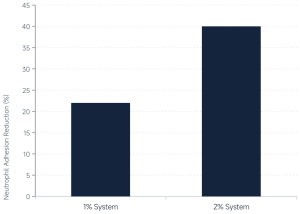
Keratinocytes were stimulated with LPS, then fluorescence-labeled human neutrophils were added to measure adhesion.
The reference system reduced adhesion by approximately 22% at 1% and 40% at 2%. Reduced adhesion can help limit continued inflammatory signal propagation.
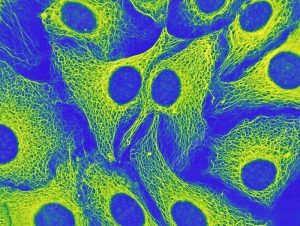
Image: a reference light microscopy image of keratinocytes.
Source: in vitro reference research on rhamnose-rich Biosaccharide Gum-2.
11 · In Vitro Reference Data: Upstream PLA2 Modulation
Phospholipase A2 (PLA2) is a key upstream enzyme in the arachidonic acid inflammatory cascade: cell membrane phospholipids → PLA2 → arachidonic acid → COX → PGE2 → visible erythema, warmth, and discomfort.
At approximately 0.5%, the reference system reduced PLA2 activity by about 38%–40%, with relatively stable inhibition over the 0.5%–2% test range.
RhamnoCalm™ is positioned for upstream intervention in the visible redness cascade.
Source: reference in vitro enzyme research on rhamnose-rich Biosaccharide Gum-2.

12 · In Vitro Reference Data: PGE2
Prostaglandin E2 (PGE2) is an important mediator of skin erythema, warmth, irritation, and inflammatory discomfort.
Model A, human neutrophils: a 1% reference system reduced PGE2 synthesis by approximately 32%.
Model B, keratinocytes: another reference system at a higher test concentration reported a maximum decrease of approximately 69% in PGE2 release.
These are independent models and must not be combined into a single dose–response curve. Modulation occurs at several levels from enzymes to mediators.
Source: in vitro reference research on rhamnose-rich Biosaccharide Gum-2.
13 · Neuro-Comfort: β-Endorphin Release
Keratinocytes participate in the skin’s neuroimmune and endocrine network. Rhamnose-rich polysaccharide signaling promotes β-endorphin release, which is associated with comfort and modulation of pain signaling.
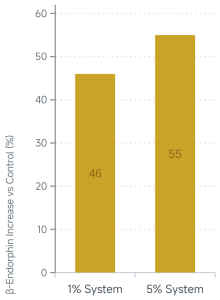
Reference data after 36 hours of in vitro keratinocyte culture: release increased approximately 46% with the 1% system and 55% with the 5% system. The presentation reports statistical significance without a specific p-value.
Conceptual pathway: keratinocytes → β-endorphin release → greater comfort and fewer discomfort signals.
Patent WO2004078789A1 describes rhamnose-containing branched polysaccharides with high keratinocyte affinity that can promote β-endorphin release, together with cosmetic compositions and uses. [4]

14 · Human Reference Data: Redness Reduction at 2 Hours
UV-induced erythema reference study: 20 volunteers, UV-induced redness on the back, and a cream containing 5% of the test system compared with placebo.
Instrumental measurement of the a* erythema parameter at 2 hours showed an average decrease of approximately 44% in visible redness among the relevant participants.
Source: a human reference study of rhamnose-rich Biosaccharide Gum-2, not direct clinical data for a finished product.
15 · Sensitive and Active Skin Care: Soothing and Tolerance Support
The IL-1α study in tretinoin-stimulated reconstructed epidermis provides a formulation rationale for pairing rhamnose-rich soothing polysaccharides with potent actives. The source positions the product to preserve active performance while improving irritation, tightness, redness, and overall comfort.
Concepts include retinol/retinal, AHA/BHA/PHA exfoliation, high-concentration vitamin C, brightening actives, acne-prone skin care, and soothing cosmetics after irritating care procedures.
Other opportunities include post-sun, post-shave and depilation aftercare, daily redness care, compromised barriers, and sensitive skin care. Comfort is part of formulation strategy.
Image: soothing care after sun exposure and UV stress.

16 · Healthy Aging: Soothing and Skin Resilience
Inflammation, cellular senescence, ECM damage, and skin aging are interconnected.
Rhamnose research: in vitro and in vivo evidence relates to epidermal and dermal benefits, collagen IV, and procollagen I. Pageon et al., 2019, doi:10.1111/ics.12523. [2]
Rhamnose-rich oligosaccharide/polysaccharide research: these materials can counter increases in the senescence marker SA-β-gal induced by advanced glycation end products (AGEs) in human skin fibroblasts. Ravelojaona et al., 2009, doi:10.1016/j.archger.2007.12.004. [3]
Patent WO2006037813A1 concerns saccharide compounds with repeated rhamnose-rich motifs and cosmetic anti-aging uses. [5]
Attribution boundary: free rhamnose research must be distinguished from Biosaccharide Gum-2 product data. Free sugar results are not measurements of RhamnoCalm™.
17 · From Face to Scalp: Scalp Is Skin
The scalp and facial skin share keratinocytes, epidermal barriers, inflammatory responses, and sensory systems.
Stressors include frequent washing, strong surfactants, coloring, bleaching, perming, oxidants, hot blow-drying, UV, pollution, dryness, friction, and styling residue.
Common concerns include tightness, redness, dryness, irritation, sensitivity, and discomfort.
Pathway: external stress → scalp keratinocyte stress → IL-1α/PLA2/PGE2 → discomfort and erythema. The positioning is based on glycobiological cell recognition. Patent WO2004078789A1 supports cosmetic applications on covering tissues including skin and scalp. [4]

18 · Sensitive Scalp Care Solutions
Sensitive scalp shampoo: reduce discomfort during cleansing.
Scalp soothing serum/spray: for dry, tight, or reactive scalp.
Post-color/post-bleach care: for scalp after oxidative coloring or bleaching.
Post-perm care: support comfort after chemical hair treatment.
Oil-control plus comfort: for pollution, heat, and lifestyle stress.
After-sun scalp care: for scalp after UV exposure.
Men’s scalp care: for areas prone to friction-related discomfort.
Positioning includes scalp soothing, redness support, comfort after coloring or perming, stress-responsive care, and barrier-conscious hair care, without hair-growth or hair-loss prevention claims.
19 · Application Map: Skin and Hair Care
Sensitive skin: soothing serums, lotions, creams, and sprays.
Potent anti-aging care: retinol, retinal, and acid products.
Post-sun care: gels, lotions, and recovery sprays.
Redness-prone skin: redness care serums, soothing masks, and barrier care.
Healthy aging: anti-aging serums and creams.
Baby/child and gentle care: subject to product positioning and regulatory requirements.
Acne-prone skin: oil-control serums and soothing support in acne-care formulas.
After-shave/depilation care: soothing products.
From daily serums to post-color or post-perm scalp care, one glycan technology supports multiple comfort concepts.
20 · Formulation Guide: Technical Parameters
The full parameters appear below. They are based on the supplied technical information for a system equivalent in active strength to a 2.5% Biosaccharide Gum-2 reference solution.
If the commercial product has a different active content, recalculate the recommended addition level accordingly. This fermentation-derived functional polysaccharide is positioned in the source for performance at low addition levels.
| Parameter | Recommendation |
|---|---|
| Recommended addition level | 3%–5% (for a system equivalent in active strength to a 2.5% Biosaccharide Gum-2 reference solution) |
| Solubility | Water · Propylene glycol · Glycerin |
| Recommended formulation pH | Approximately 4–8 |
| Thermal stability | Up to approximately 80 °C |
| Processing | Preferably add during cooling below 45 °C. Reference information also permits addition to the aqueous phase at higher temperatures. |
21 · Formulation Concepts: Complementary Combinations
RhamnoCalm™ + panthenol: soothing and hydration.
+ allantoin: multi-pathway soothing.
+ ectoin: protection against environmental stress.
+ niacinamide: soothing and barrier care.
+ Zinc PCA: oil control and comfort for acne-prone skin or scalp.
+ ceramides: barrier resilience.
+ retinoids: potent anti-aging care with a tolerable experience, with further opportunities in PAD/salicylic acid systems.
These are complementary formulation concepts. Unvalidated combinations do not support synergy claims.
22 · Why RhamnoCalm™: Cell Recognition and Multi-Target Soothing
Quantitative reference results: approximately 44% less visible redness at 2 hours (UV human model), 40% lower neutrophil adhesion (in vitro, 2% system), 28% lower induced IL-1α (reconstructed epidermis, 2%), approximately 40% lower PLA2 activity (in vitro, 0.5%), and 46% more β-endorphin release (keratinocytes, 1%).
Key positioning: rhamnose–keratinocyte recognition, multi-target soothing involving IL-1α, adhesion, PLA2, and PGE2, β-endorphin-related neuro-comfort, rapid visible redness reduction, and modulation at several cascade nodes.
Applications include sensitive or stressed skin, retinoid/acid/active formulations, skin and scalp care, healthy aging, and biotechnology-derived rhamnose-rich glycans.
All figures are reference data for Biosaccharide Gum-2 systems. The corresponding chapters specify the models and conditions.
23 · Scientific References and Data Notes
1. Condaminet B. et al. Ultraviolet rays induced expression of lectins on the surface of a squamous carcinoma keratinocyte cell line. Experimental Cell Research. 1997;232(2):216–224. DOI: 10.1006/excr.1997.3518.
2. Pageon H. et al. Potentially beneficial effects of rhamnose on skin ageing: an in vitro and in vivo study. International Journal of Cosmetic Science. 2019;41(3):213–220. DOI: 10.1111/ics.12523.
3. Ravelojaona V., Robert A.M., Robert L. Expression of senescence-associated beta-galactosidase by human skin fibroblasts, effect of advanced glycation end-products and fucose or rhamnose-rich polysaccharides. Archives of Gerontology and Geriatrics. 2009;48(2):151–154. DOI: 10.1016/j.archger.2007.12.004.
4. WO2004078789A1 — Novel agent for stimulating the release of beta-endorphins, cosmetic and/or dermatological compositions containing same and uses thereof.
5. WO2006037813A1 — Cosmetic composition comprising a saccharide compound having a repeated rhamnose-rich motif and its cosmetic use for skin anti-aging activity.
Quantitative efficacy figures are reference data for rhamnose-rich Biosaccharide Gum-2 systems in the supplied technical information. Conditions are specified in each section. In vitro data do not represent clinical efficacy of finished products.
PuriActives® and RhamnoCalm™ are trademarks of PuriPharm Co. Ltd. This material introduces cosmetic ingredients and makes no medicinal claims.
www.puriactives.com