01 · NanoActive™ RP: Retinyl Propionate Nanoliposomes
A precision-delivered vitamin A active for advanced skin and scalp renewal. A smarter route to retinoid performance.
Powered by PURISOME® FlexVes™ Liposome Technology.
PuriPharm Co. Ltd. (浦瑞生物医药技术有限公司).
02 · Why Retinyl Propionate?
Retinyl esters differ in their skin metabolic profiles. Retinyl propionate (RP) shows a distinctive profile in human skin models and should not be viewed simply as a lower-activity substitute for retinol.
The table compares RP, retinol, and retinyl palmitate by type, metabolism, and biological activity.
Source: Bjerke et al., 2021, doi:10.1111/exd.14219. [1]
| Dimension | Retinyl Propionate | Retinol | Retinyl Palmitate |
|---|---|---|---|
| Type | Short-chain retinyl ester | Vitamin A alcohol | Long-chain storage ester |
| Entry into the vitamin A pathway | Yes | Yes | Requires further mobilization |
| Human skin penetration evidence | Relatively strong [1] | Relatively strong | Lower in the comparative model |
| Metabolic profile | Preferential conversion to retinol | Further oxidation or re-esterification | More oriented toward storage |
| RAR-related biological activity | Direct experimental support [1] | Classic retinoid activity | Weaker in the comparative study |
| HA-related activity | Direct experimental support [1] | Present | Weaker in the comparative model |
03 · Meet the Molecule: A Vitamin A Ester for Metabolic Activation
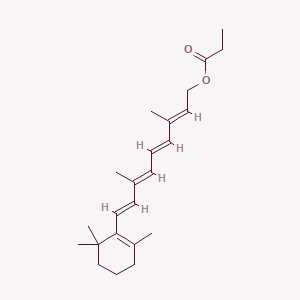
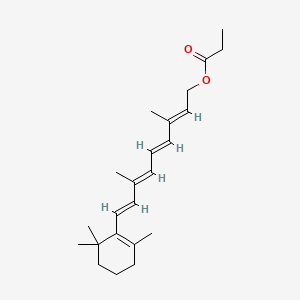
INCI name: RETINYL PROPIONATE. CAS: 7069-42-3, subject to official product documentation.
Chemical structure: an ester derivative formed from retinol and propionic acid. It is a retinyl ester, also described as a vitamin A ester.
Physicochemical profile: a lipophilic vitamin A derivative with a conjugated polyene structure, sensitivity to light, oxidation, and environmental conditions, and suitability for lipid environments, encapsulation, and nanoliposomal delivery design.
Source of the 2D chemical structure: PubChem. Listed in the PuriPharm raw material database as RETINYL PROPIONATE.
04 · From Ester to Signal
Schematic skin pathway: retinyl propionate → esterase hydrolysis → retinol → retinol dehydrogenase → retinaldehyde → retinaldehyde dehydrogenase → retinoic acid → RAR/RXR nuclear receptors → retinoic acid response elements (RAREs) and retinoid-responsive gene expression.
Downstream areas include epidermal renewal, differentiation, extracellular matrix (ECM) remodeling, hyaluronic acid (HA) biology, and skin quality.
RP undergoes stepwise activation through endogenous skin enzymes rather than binding directly to receptors. NanoActive™ RP builds on this metabolic mechanism.
Sources: Bjerke et al., 2021, and classic retinoid metabolism literature. [1]

Schematic retinoid metabolism in skin
05 · Direct RP Evidence: A Unique Profile in Human Skin Models
A 2021 study in Experimental Dermatology systematically compared RP, retinol, and retinyl palmitate in ex vivo human skin and keratinocyte models, assessing penetration, metabolism, and receptor-related biological activity.
Skin penetration: RP and retinol both showed appreciable penetration, while retinyl palmitate showed less.
Metabolism: after reaching viable epidermal and dermal regions, RP was primarily converted to retinol, entering the core vitamin A pathway.
RARα-related activity: RP showed relatively strong receptor-related activity in the experimental model, linking it to retinoid signaling.
HA-related activity: keratinocyte models showed significant activity related to HA synthesis. This retinyl ester exhibits behavior closely connected with the core retinoid pathway.
Source: Bjerke et al., 2021. [1]
06 · The Core Switch of Renewal: From Activation to Gene Expression
Classic signaling pathway: retinoic acid → RAR/RXR heterodimeric nuclear receptors → RAREs → gene transcription. RAR/RXR is a key step through which retinoid signals influence nuclear gene expression.
Downstream skin effects involve epidermal renewal, keratinocyte differentiation, skin structure, ECM support, collagen homeostasis, pigmentation uniformity, HA biology, smoothness, firmness, and elasticity.
Evidence boundary: this section describes classic retinoid-class mechanisms to explain the pathway. Clinical results for retinoic acid are not directly attributed to NanoActive™ RP.
Sources: classic retinoid signaling literature and Fisher et al., Nature, 1996. [8]
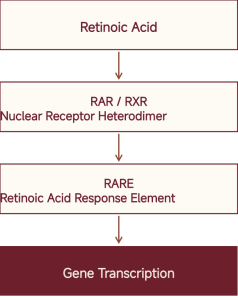
Nuclear receptor signaling and gene transcription
07 · The Retinoid Spectrum: Efficacy, Daily Use, and Formulation Engineering
The schematic places retinyl esters, retinol, retinal, and retinoic acid on a spectrum, with formulation flexibility and daily-use potential at one end and closer proximity to direct receptor activity at the other. RP is identified within this framework.
Activation by design: endogenous skin enzymes activate the molecule step by step.
Delivery by design: PURISOME® FlexVes™ flexible liposomes provide engineered protection, contact, and release.
Metabolic activation × precision delivery.

Retinoid spectrum and RP positioning schematic
08 · Endogenous Hydration: Connecting Renewal with HA Biology
RP → retinoid signaling → increased HA-related synthesis → a more favorable hydration state. Relevant skin qualities include plumpness, smoothness, softness, the appearance of fine lines, and resilience.
The concept links renewal with the skin’s own hydration network and extends retinoid care to skin quality and hydration management.
Dual hydration formulation concept: combine NanoActive™ RP with HA, polyglutamic acid (PGA), β-glucan, or ceramides to connect externally supplied hydration with endogenous HA biology.
Evidence boundary: HA synthesis-related activity comes from direct RP experiments. These ingredient combinations are formulation concepts, and synergy requires corresponding combination data.
Source: Bjerke et al., 2021. [1]
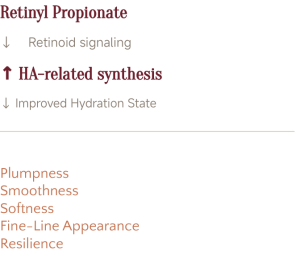
Retinoid signaling and HA-related biology
09 · Collagen and ECM: Epidermal Renewal and Dermal Structure
Schematic pathway: UV exposure / aging → increased AP-1 transcription factor activation → increased matrix metalloproteinases (MMPs) → increased collagen breakdown → wrinkles and loss of firmness.
Retinoid signaling can support collagen formation and regulate matrix degradation at several levels, helping maintain dermal structure. Relevant care areas include fine lines, wrinkles, firmness, elasticity, smoothness, and the appearance of photoaging.
Image: thick human skin section stained with H&E, showing the epidermis, dermis, and hypodermis. Source: Blue Histology, University of Western Australia.
Evidence boundary: this is retinoid-class mechanistic evidence, not a human trial of RP itself.
Sources: Fisher et al., 1996, and Griffiths et al., 1993. [8,9]
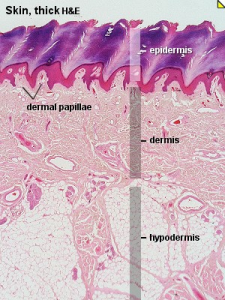
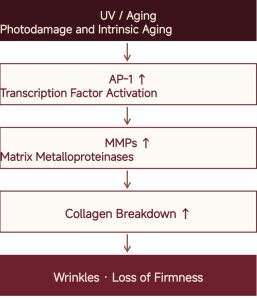
Photodamage, collagen breakdown, and firmness pathway
10 · Three Decades of RP Research
1998: a clinicopathological study of RP cream in photoaged skin. Green et al., Clin Exp Dermatol, 23(4):162–167. [2]
2010: a randomized controlled comparison of a multi-active RP-containing skin care regimen and a 0.02% tretinoin regimen. Fu et al., Br J Dermatol, 162(3):647–654. [4]
2017: a 16-week randomized double-blind human study of RP plus climbazole. Hawkins et al., Int J Cosmet Sci, 39(6):589–599. [3]
2021: human skin models elucidated RP penetration, metabolism, RARα activity, and HA-related bioactivity. Bjerke et al., Exp Dermatol, 30(2):226–236. [1]
2023 onward: new delivery systems and retinoid combination studies continue to emerge. [6,7]
The molecule determines potential, while delivery influences how that potential is realized.
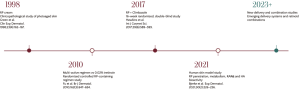
RP research timeline
11 · Human Study: Wrinkles, Pigmentation, and Tolerability over 16 Weeks
A 2017 study assessed an RP plus climbazole formulation. It was not a clinical trial of NanoActive™ RP.
Design: 45 healthy women aged 40–70 years with moderate facial photodamage, 16 weeks, randomized and double-blind split-face comparison, 0.1% retinol as the comparator, and RP plus climbazole as the test system.
More than 50% of participants showed improvement in deep wrinkles in the crow’s feet area after 5 weeks. Observed improvements included photoaging appearance, deep wrinkles, nasolabial texture, and hyperpigmentation, with relatively low irritation.
Data boundary: these results apply to the complete combination system, not RP alone, and are not clinical data for NanoActive™ RP.
Source: Hawkins et al., 2017, doi:10.1111/ics.12412. [3]
12 · The Delivery Problem: Six Challenges for Free Retinoids
Light: the conjugated polyene structure is light-sensitive, and activity can decline under exposure.
Oxygen: oxidative conditions complicate formulation and shelf-life management.
Water compatibility: high lipophilicity limits use in water-based systems.
Distribution: uniform dispersion in complex formulations can be difficult.
Local exposure: high local exposure may increase irritation and limit daily use.
Active availability: protection during shelf life and use is needed to preserve functional value.
Retinoid product design requires both molecular selection and delivery engineering.
13 · PURISOME® FlexVes™: A Microenvironment for Sensitive Retinoids
Schematic structure: an aqueous core, a phospholipid bilayer, lipophilic RP embedded in hydrophobic regions, and a flexible vesicle membrane.
Protect: the phospholipid microenvironment helps shield sensitive retinoids from light, oxygen, and complex formulation conditions.
Deliver: phospholipid structures with affinity for stratum corneum lipids support contact between the active and the skin interface.
Control: vesicle structures support gradual release and smoother local exposure.
Formulate: poorly dispersible lipophilic RP becomes a delivery-engineered active suitable for modern formulations.
The NanoActive™ range is supported by the PURISOME® platform. The official technology name is PURISOME® FlexVes™ Liposome Technology.
Image: an example of liposome morphology under TEM/cryo-TEM, sourced from Springer Nature Experiments.
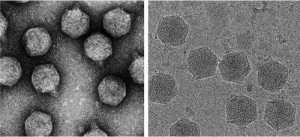
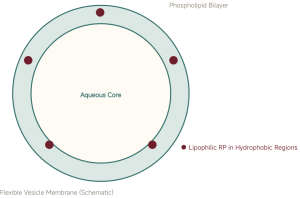
Flexible liposome structure schematic
14 · From Molecule to System: Free versus Delivery-Engineered Active
RP + PURISOME® FlexVes™ = NanoActive™ RP.
Free RP: lipophilic, exposed to the environment, conventionally dispersed, passively delivered, and subject to local concentration fluctuations.
NanoActive™ RP: vesicle-associated, phospholipid-protected, designed for improved dispersion, skin-affinitive delivery, and controlled release.
The microenvironment is engineered around molecular stability, contact, release, and formulation use.
15 · Skin Efficacy Platform: Multiple Dimensions of Renewal
Renew the epidermis, support skin structure, and refine skin quality.
Eight care areas: the appearance of fine lines, wrinkles, firmness, the appearance of elasticity, texture, dullness and uneven tone, HA-related hydration biology, and the appearance of photoaging.
16 · Barrier-Conscious Retinoids: Efficacy, Control, and Comfort
Conventional high-intensity approach: high concentrations → greater irritation → intermittent use → difficulty maintaining a routine.
Modern design approach: an effective molecule + protective delivery + gradual release + a barrier-conscious formula to support consistent long-term care.
NanoActive™ RP concepts include introductory and long-term retinoid care, anti-aging concepts for sensitive skin, daily retinoid routines, skin longevity, preventive aging, and barrier-conscious anti-aging.
Communication focuses on comfort, controlled-release design, barrier-conscious formulation, and long-term care.
17 · Formulation Inspiration Matrix: Multiple Paths to Anti-Aging
NanoActive™ RP + niacinamide: barrier, tone, and anti-aging concepts.
+ peptides: collagen and firmness concepts.
+ HA: retinoid renewal with hydration and plumpness.
+ ceramides: renewal and barrier management.
+ ectoin / β-glucan: retinoid performance with soothing protection.
+ antioxidants: photoaging and urban anti-aging care.
These are formulation inspirations. Research has explored RP combined with niacinamide and other actives, but NanoActive™ RP has not thereby been clinically validated for these synergies.
Sources: Lam et al., 2021, and Wang et al., 2023. [5,6]
18 · From Skin to Scalp: Continuously Renewing Skin
The scalp is retinoid-responsive skin, providing a research rationale for extending facial renewal concepts to scalp care.
Shared features include keratinocytes, epidermal differentiation, barrier structures, sebaceous glands, inflammatory and oxidative stress, and retinoid-responsive signaling.
A distinctive feature is the high density of hair follicles, which creates a specialized epithelial microenvironment.
The source pathway is retinoic acid signaling → epidermal renewal and differentiation → follicular epithelial microenvironment → scalp condition → healthy, resilient, vital-looking hair.
Image: an illustrative macro view of the human scalp and hair roots.
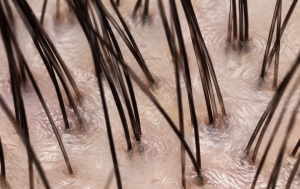
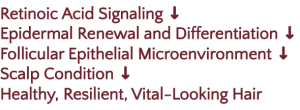
Conceptual pathway for retinoid scalp care
19 · Retinoids and Follicle Science: Retinoic Acid Signaling
Hair follicles are retinoid-responsive miniature organs.
Development: cutaneous retinoic acid levels participate in follicle development and downgrowth. Okano et al., 2012. [10]
Stem cells: research suggests that RA can participate in hair follicle stem cell activation through Wnt/β-catenin-related mechanisms. Wen et al., J Eur Acad Dermatol Venereol. [11]
Metabolism: retinoid research also indicates effects on local follicular enzyme activity. Sharma et al., 2019. [12]
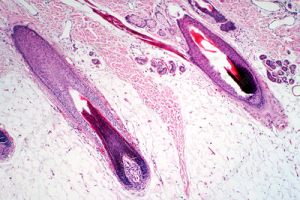
Image: a light micrograph of human scalp and hair follicles. Source: Science Photo Library.
Evidence boundary: these are follicular mechanisms involving retinoids or retinoic acid, not evidence supporting a hair-loss treatment claim for NanoActive™ RP.
Commercial care concepts include scalp renewal, the hair-root environment, follicular microenvironment care, scalp rejuvenation, resilient hair, and hair vitality.
20 · Scalp and Hair Platform: From Scalp Condition to Hair Vitality
Renew the scalp to support hair vitality. Positioning includes resilience, fullness, healthy shine, root vitality, a youthful scalp, and anti-aging hair care.
Scalp renewal: support normal epidermal renewal and balanced keratinization.
Scalp condition: maintain a smooth, healthy, balanced scalp surface.
Follicular environment: use retinoid-responsive follicle biology as a basis for premium hair-root care concepts.
Hair vitality: a healthy scalp is an important foundation for healthy hair.
Scalpification positioning extends facial retinoid science to scalp epidermal and follicular microenvironment care.
21 · Applications: Modern Skin and Scalp Formulations
Skin care: anti-aging serums, overnight renewal serums, retinoid creams, anti-aging eye care, firming lotions, fine-line serums, tone care serums, barrier-conscious retinoid products, and skin longevity products.
Scalp and hair care: scalp renewal serums, overnight scalp serums, premium scalp tonics, hair-root serums, anti-aging hair care, leave-in scalp lotions, scalp serum sprays, and premium volumizing care.
NanoActive™ RP transforms a lipophilic vitamin A ester into a delivery-engineered ingredient for a wider range of modern product formats.
Image: an illustrative formulation laboratory.

22 · Market Context: Skin Longevity and Scalpification
Skin longevity: maintaining skin quality over time.
Preventive aging: earlier care with consistent long-term retinoid routines.
Precision delivery: delivery technology as part of active ingredient differentiation.
Barrier-conscious retinoids: design efficacy and comfort together.
Scalpification: extend facial skin care technologies to scalp and hair care.
Evidence-driven beauty: develop ingredients supported by mechanisms, publications, and data.
NanoActive™ RP = retinoid science × delivery engineering × skin and scalp longevity.
23 · Why NanoActive™ RP? Molecular Potential and Delivery Performance
Metabolically activated vitamin A: RP has a distinctive skin metabolic profile.
Direct RP scientific evidence: human skin models and human studies provide a research foundation, with attribution distinguished between RP alone and combination systems.
PURISOME® precision delivery: flexible phospholipid vesicles provide protection, delivery, and release design.
Multi-dimensional skin renewal: wrinkles, texture, firmness, tone, hydration, and photoaging care.
New scalp-care opportunities: extend retinoid science to scalp rejuvenation and follicular microenvironment care.
The molecule determines potential, while delivery influences performance.
24 · A Smarter Route to Retinoid Performance
NanoActive™ RP, retinyl propionate nanoliposomes. A smarter route to retinoid performance and more precise renewal.
Metabolic activation × precision liposomal delivery × skin and scalp renewal.
Powered by PURISOME® FlexVes™ Liposome Technology.
PuriPharm Co. Ltd. (浦瑞生物医药技术有限公司).
25 · Selected References and Evidence Classification
[1] Bjerke DL, Li R, Price JM, et al. The vitamin A ester retinyl propionate has a unique metabolic profile and higher retinoid-related bioactivity over retinol and retinyl palmitate in human skin models. Experimental Dermatology. 2021;30(2):226–236. doi:10.1111/exd.14219.
[2] Green C, Orchard G, Cerio R, Hawk JL. A clinicopathological study of the effects of topical retinyl propionate cream in skin photoageing. Clinical and Experimental Dermatology. 1998;23(4):162–167.
[3] Hawkins S, Adamus J, Chiang CY, et al. Retinyl propionate and climbazole combination demonstrates clinical improvement to the appearance of hyperpigmentation and deep wrinkling with minimal irritation. International Journal of Cosmetic Science. 2017;39(6):589–599. doi:10.1111/ics.12412.
[4] Fu JJJ, Hillebrand GG, Raleigh P, et al. A randomized, controlled comparative study of the wrinkle reduction benefits of a cosmetic niacinamide/peptide/retinyl propionate product regimen vs. a prescription 0.02% tretinoin product regimen. British Journal of Dermatology. 2010;162(3):647–654.
[5] Lam ECS, Li R, Rodrigues MR, et al. Enhanced retinoid response by a combination of the vitamin A ester retinyl propionate with niacinamide and a flavonoid containing Ceratonia siliqua extract in retinoid responsive in vitro models. International Journal of Cosmetic Science. 2021;43(1):102–106.
[6] Wang Q, Hu F, Hu X, et al. The synergistic effect of retinyl propionate and hydroxypinacolone retinoate on skin aging. Journal of Cosmetic Dermatology. 2023;22(7):2040–2049.
[7] Bai D, Hu F, Xu H, et al. High Stability and Low Irritation of Retinol Propionate and Hydroxypinacolone Retinoate Supramolecular Nanoparticles with Effective Anti-Wrinkle Efficacy. Pharmaceutics. 2023;15(3):731.
[8] Fisher GJ, Datta SC, Talwar HS, et al. Molecular basis of sun-induced premature skin ageing and retinoid antagonism. Nature. 1996;379:335–339.
[9] Griffiths CEM, Russman AN, Majmudar G, et al. Restoration of collagen formation in photodamaged human skin by tretinoin. New England Journal of Medicine. 1993;329:530–535.
[10] Okano J, Levy C, Lichti U, et al. Cutaneous retinoic acid levels determine hair follicle development and downgrowth. Journal of Biological Chemistry. 2012;287(47):39304–39315. doi:10.1074/jbc.M112.397273.
[11] Wen L, Fan Z, Huang W, et al. Retinoic acid drives hair follicle stem cell activation via Wnt/β-catenin signalling in androgenetic alopecia. Journal of the European Academy of Dermatology and Venereology.
[12] Sharma A, Goren A, Dhurat R, et al. Tretinoin enhances minoxidil response in androgenetic alopecia patients by upregulating follicular sulfotransferase enzymes. Dermatologic Therapy. 2019;32(3):e12915.
[13] Mezei M, Gulasekharam V. Liposomes — a selective drug delivery system for the topical route of administration: lotion dosage form. Life Sciences. 1980;26(18):1473–1477.
[14] Cevc G, Blume G. Lipid vesicles penetrate into intact skin owing to the transdermal osmotic gradients and hydration force. Biochimica et Biophysica Acta. 1992;1104(1):226–232.
Evidence classification: [1] and [2] provide direct RP evidence. [3] and [4] report human data for RP-containing combinations. [5]–[7] concern RP combinations or delivery systems. [8]–[12] provide retinoid-class mechanistic evidence. [13] and [14] are classic liposomal delivery publications.
PuriPharm Co. Ltd. 浦瑞生物医药技术有限公司 · PURISOME® FlexVes™ Liposome Technology