01 · PuriActives® NanoCalmin: Product Presentation
Multi-pathway soothing science for skin and scalp. A product presentation focused on sensitive skin and scalp care.
Key ingredient: Hydroxyphenyl Propamidobenzoic Acid.
“Skin Calm. Scalp Calm. One Multi-Pathway Solution.”
PuriPharm Co. Ltd. (浦瑞生物医药技术有限公司).
02 · Beyond Anti-Irritant: Multi-Pathway Soothing Science
NanoCalmin’s five core pathways involve histamine, mast cells, the substance P–NK1R neurogenic itch axis, inflammatory cytokine cascades, and oxidative stress.
Five core claims: anti-itch soothing, redness reduction, suppression of histamine-related responses, anti-inflammatory soothing, and antioxidant defense.
Applications span skin care, body care, scalp care, and hair care, with one multi-pathway solution for skin and scalp.
Sources: Schmaus et al., 2007, and Lotts et al., 2017. [1,3]
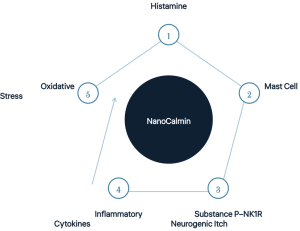
Five core soothing pathways
03 · Product Identity: Nature-Inspired Molecular Precision
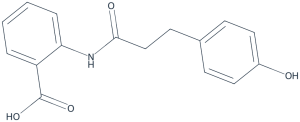
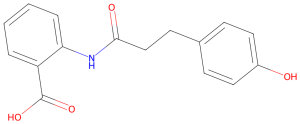
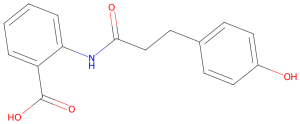
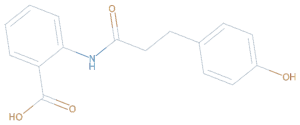
Core INCI: Hydroxyphenyl Propamidobenzoic Acid. Research name: Dihydroavenanthramide D (DHAvD). Molecular weight: 285.3.
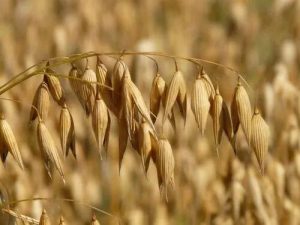
This molecularly defined synthetic analogue is inspired by the structure of naturally occurring oat avenanthramides.
Product attributes: a defined molecular composition and traceable structure, identifiable efficacy targets supported by published mechanisms, high batch consistency and controllable quality, suitability for modern skin and scalp care formulations, and anti-irritant, anti-itch, anti-redness, anti-inflammatory, and antioxidant properties.
Oat-inspired avenanthramide science. Source: Sur et al., 2008. [4]
04 · The Problem: Sensitive Skin Is More Than Histamine
Itch involves a cascade of neural, immune, and inflammatory events.
The source schematic presents environmental or chemical stimuli (friction, dryness, pollution) → keratinocytes → substance P release → NK1R activation → mast cell degranulation → itch, redness, and irritation. Histamine and inflammatory mediators are released, while ROS and oxidative stress further amplify the inflammatory cascade.
Skin itch is a complex process involving nerves, immune responses, mast cells, and inflammatory mediators. NanoCalmin is positioned for multi-pathway intervention.
Sources: Lotts et al., 2017, and Sur et al., 2008. [3,4]
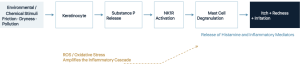
Neural, immune, and inflammatory cascade schematic
05 · Mechanism 1: Targeting the SP–NK1R Neuroimmune Itch Axis
The source pathway is substance P / neurokinin A (SP / NKA) → NK1R → Ca²⁺ signaling → mast cell degranulation → itch and inflammation.
Research on DHAvD reports interaction with the neurokinin-1 receptor (NK1R), reduced SP/NKA-mediated intracellular Ca²⁺ signaling, inhibition of SP-induced mast cell degranulation, and reduced IL-6-related inflammatory responses in keratinocytes and macrophages.
This supports upstream intervention in the neurogenic itch cascade. Source: Lotts et al., 2017, doi:10.1111/exd.13265. [3]
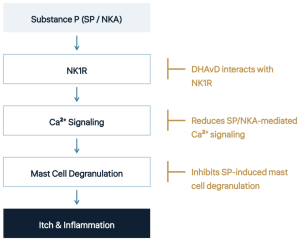
DHAvD and the SP–NK1R-related mechanism schematic
06 · Mechanism 2: Dose-Dependent Histamine Control
After substance P stimulation, net histamine release from mast cells decreased with increasing DHAvD concentration.
Original chart data: 0.5, 5, 50, 250, and 500 ppm correspond to 87%, 74%, 60%, 33%, and 19% of control release, respectively. At 500 ppm, net release was approximately 19% of control.
The vertical axis shows histamine release as a percentage of control. Lower values indicate less release. Across 0.5–500 ppm, the source describes a clear and reproducible dose–response relationship.
Source: Schmaus et al., 2007. [1]
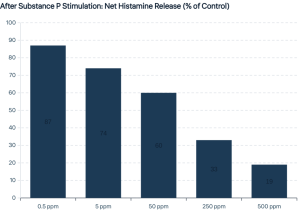
Net histamine release (% of control)
07 · Human Efficacy: Comfort in a Histamine Challenge Model
Study design: a double-blind human skin prick study using histamine HCl to induce itch and erythema, 10 subjects, a single application of 500 ppm DHAvD, 180 minutes of follow-up, and a 0–6 scoring scale.
Compared with placebo and untreated areas, the 500 ppm DHAvD formulation reduced erythema faster and significantly lowered itch scores, with p < 0.05.
The two charts present itch and erythema scores, retaining the source curves and data. They are illustrative redrawings based on Figure 5 of the original publication and should not be treated as precise experimental measurements.
Source: Schmaus et al., 2007. [1]
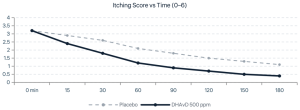
Itch scores over time; illustrative redrawing
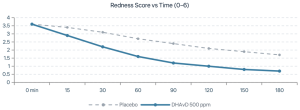
Redness scores over time; illustrative redrawing
08 · Antioxidant Activity: Defense Beyond Soothing
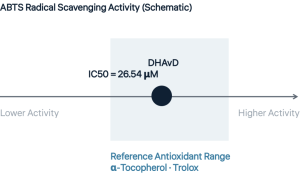
ABTS radical scavenging assay: DHAvD had an IC50 of 26.54 μM, equivalent to 7.57 μg/mL.
The source cites a paper reporting radical scavenging activity in a range similar to that of reference antioxidants such as α-tocopherol and Trolox.
The schematic compares lower to higher scavenging activity and places DHAvD near the reference antioxidant range. It does not provide precise numerical values for the reference antioxidants. Calm inflammation and defend against oxidative stress.
Application opportunities include care for environmental irritation, sensitivity associated with photoaging, support for tolerance of active ingredients, sensitive scalp care, and everyday urban skin stress.
Source: Schmaus et al., 2007. [1]
Schematic comparison of ABTS radical scavenging activity
09 · Stability: A Broad pH Range for Formulation Development
Study conditions: 500 ppm DHAvD over 24 weeks at pH 3, 5, 7, 9, and 12 and temperatures of 5, 25, and 40°C. The complete stability matrix appears below.
Only slight degradation was observed at pH 3 and 12 after 24 weeks, while the molecule remained stable at pH 5–9.
These data support formulation development from acidic skin care to shaving products and high-pH hair bleaching or coloring applications.
Note: these are published stability data for the DHAvD molecule. The final recommended range for commercial NanoCalmin follows PuriPharm’s product documentation.
Source: Schmaus et al., 2007. [1]
| Temperature / pH | 3 | 5 | 7 | 9 | 12 |
|---|---|---|---|---|---|
| 5 °C | Slight degradation | Stable | Stable | Stable | Slight degradation |
| 25 °C | Slight degradation | Stable | Stable | Stable | Slight degradation |
| 40 °C | Slight degradation | Stable | Stable | Stable | Slight degradation |
10 · Skin Delivery: Why Skin Availability Matters
In a study of specific vehicles, DHAvD in the viable epidermis and dermis at 300 minutes accounted for approximately 12% of the applied dose with a conventional vehicle and 41% with an optimized BuG/PeG vehicle.
Adding the BuG/PeG system increased DHAvD release approximately 2–4-fold within 30 minutes and increased the amount in viable skin layers approximately twofold.
Four linked stages influence efficacy: solubilization → release → skin availability → biological response. This chain is the scientific basis of NanoCalmin’s delivery design concept.
Data note: the 12%, 41%, and 2–4-fold figures come from published studies of specific BuG/PeG vehicle or diol systems. They illustrate the value of delivery design and are not measurements of NanoCalmin itself.
Source: Heuschkel et al., 2008, doi:10.1016/j.ejpb.2008.04.005. [2]
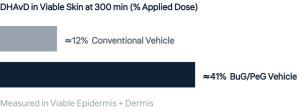
Published results for specific vehicles, not measurements of NanoCalmin
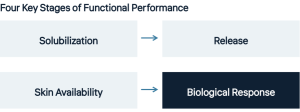
Solubilization, release, skin availability, and biological response
11 · NanoCalmin Technology: A Formulation-Ready Delivery Concept
Design chain: the active molecule DHAvD → solubilization and encapsulation in a nano/phospholipid carrier → uniform dispersion compatible with aqueous and emulsified systems → contact and functional performance on skin or scalp.
Hydroxyphenyl Propamidobenzoic Acid presents solubility and delivery challenges in aqueous applications. NanoCalmin uses delivery and solubilization design to improve suitability for cosmetic formulations.
Key benefits: easier dispersion and use, greater active availability within the formulation, support for skin contact and functional performance, and suitability for different sensory profiles and dosage forms.
NanoCalmin-specific particle size, encapsulation efficiency, and other technical parameters must follow PuriPharm’s official test data and product documentation. The image illustrates texture design for multiple formulation formats.
Source: PuriPharm NanoCalmin product information.
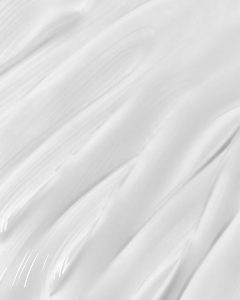

NanoCalmin delivery design concept
12 · Skin Applications: Interrupting the Itch–Scratch Cycle
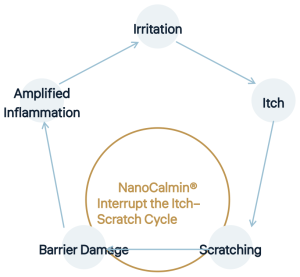
The source cycle is irritation → itch → scratching → barrier damage → amplified inflammation. NanoCalmin is positioned to help interrupt this cycle.
Five application groups: soothing serums for sensitive skin, barrier care creams, soothing alongside acids and retinoids, post-sun/post-shave/depilation aftercare, and body care for dry and itchy skin.
The concept extends soothing care from redness management to multiple neural, immune, and oxidative stress pathways.
Source: PuriPharm NanoCalmin application concepts.
Itch–scratch cycle schematic
13 · Application Data: A 4-Week Study in Dry and Itchy Skin
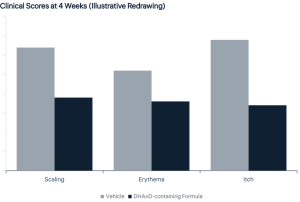
A 4-week double-blind crossover study enrolled 40 subjects aged 35–80 years with pronounced dryness and itch. A system containing 2% of the relevant commercial DHAvD formulation was compared with vehicle, assessing scaling, erythema, and itch.
Results: scaling improved significantly versus vehicle (p < 0.041), erythema improved, and itch decreased markedly. The source describes clear downward trends in erythema and itch.
The chart is an illustrative redrawing of 4-week clinical scores, retaining the original presentation’s values and groups.
Attribution note: this is an application study of a commercial combination formula containing DHAvD and provides formulation-level evidence. “2% commercial formula” does not mean 2% pure Hydroxyphenyl Propamidobenzoic Acid.
Source: supplied technical dossier.
Clinical scores at 4 weeks; illustrative redrawing
14 · Scalp Care: Comfort Beyond Dandruff Control
Consumer-perceivable scalp concerns include itch, redness, tightness, and irritation. Conventional dandruff care focuses on microorganisms and flakes, while comfort care addresses everyday scalp discomfort.
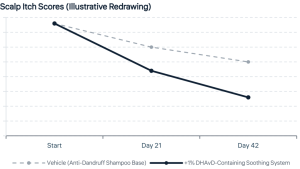
The original chart compares an anti-dandruff shampoo vehicle with a system containing 1% of a DHAvD-containing soothing ingredient on days 0, 21, and 42. The added-system group showed larger decreases in itch scores at days 21 and 42. The chart is an illustrative redrawing.
Anti-dandruff plus anti-itch positioning connects flake control with greater scalp comfort.
Note: the test formulation also contained climbazole. NanoCalmin is positioned for complementary itch relief and soothing, without claims of direct antifungal or anti-dandruff action.
Source: scalp application study data in the supplied technical dossier.

Scalp itch scores; illustrative redrawing
15 · Application Matrix: Scalp and Hair Care Opportunities
One active supports multiple scalp and hair care opportunities. The table retains all eight original cells and their functional positioning.
Core benefits: anti-itch, anti-redness, anti-irritation, and antioxidant activity.
Source: PuriPharm NanoCalmin application matrix.
| Anti-Dandruff ShampooAnti-Itch · Anti-Irritation | Sensitive Scalp ShampooAnti-Redness · Anti-Itch | Scalp Soothing SerumAnti-Itch · Anti-Redness | Hair Color / Bleach AftercareAnti-Irritation · Antioxidant |
| Anti-Itch Scalp TonicAnti-Itch | Men’s Scalp CareAnti-Itch · Anti-Irritation | Shaving / Beard CareAnti-Redness · Anti-Irritation | Skin + ScalpOne Active, Two Application AreasNanoCalmin |
16 · Supporting Evidence: Reconstructed Human Epidermis
A 2014 in vitro study assessed IL-1α in a reconstructed human epidermis (RHE) model. Inflammatory stimulation increased IL-1α release, while a DHAvD-containing complex reduced release, with an illustrated inhibition level of approximately 90%. Treated tissue showed approximately 35% higher cell viability than untreated tissue.
Attribution note: the study assessed a combination formulation containing DHAvD. It illustrates potential within soothing complexes, and its results cannot be attributed entirely to pure DHAvD alone.
This formulation-level evidence supports the development rationale for combination systems incorporating NanoCalmin.
Source: de Yzaguirre et al., 2014, doi:10.4236/jcdsa.2014.45040. [5]
17 · Patents and Applications: Itch-Relief Systems in a European Patent
Patent number: EP 1893161 B1. Title: “Mixtures Comprising Anthranilic Acid Amides and Cooling Agents as Cosmetic and Pharmaceutical Compositions for Alleviating Itching.”
Applications described include after-shave balms, shaving foams, wipes, and various topical care systems using low addition levels for itch relief, redness reduction, and anti-irritant care.
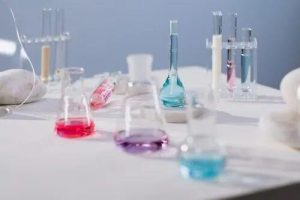
The patent number, title, and technical applications are presented as formulation development references for NanoCalmin. Images include an application photograph and the DHAvD molecular structure.
Source: EP 1893161 B1. [6]
18 · Formulation Guide: NanoCalmin
Recommended dosage: 0.1–5%. Recommended working pH: 3–8. Processing: add at approximately 45°C or below. Storage: keep cool and protect from light. Compatibility: common skin, body, and scalp care systems.
Dosage forms: essences/serums, creams/lotions, gels, masks, body lotions, shampoos, scalp serums, scalp tonics, after-shave care, and post-color care.
All parameters must follow PuriPharm’s latest TDS or SPEC.
Source: PuriPharm NanoCalmin TDS, latest version.
19 · Value Summary: One Molecule, Multiple Pathways, Skin and Scalp
Five value areas: rapid comfort for itch and redness, dose-dependent histamine release suppression, modulation of the SP–NK1R neuroimmune itch axis, antioxidant defense, and applications from sensitive skin to sensitive scalp.
“Calm More Than Skin.” NanoCalmin: multi-pathway soothing science for skin and scalp.
PuriPharm Co. Ltd. (浦瑞生物医药技术有限公司).
20 · References: Core Publications and Patent
1. Schmaus G, Herrmann M, Joppe H, Lange S, Koch O, Pillai R, Röding J. Dihydroavenanthramide D for Anti-irritant and Anti-itch. Cosmetics & Toiletries. 2007;122(11):55–64.
2. Heuschkel S, Wohlrab J, Schmaus G, Neubert RHH. Modulation of Dihydroavenanthramide D release and skin penetration by 1,2-alkanediols. European Journal of Pharmaceutics and Biopharmaceutics. 2008;70:239–247. doi:10.1016/j.ejpb.2008.04.005.
3. Lotts T, Agelopoulos K, Phan NQ, et al. Dihydroavenanthramide D inhibits mast cell degranulation and exhibits anti-inflammatory effects through the activation of neurokinin-1 receptor. Experimental Dermatology. 2017;26(8):739–742. doi:10.1111/exd.13265.
4. Sur R, Nigam A, Grote D, Liebel F, Southall MD. Avenanthramides, polyphenols from oats, exhibit anti-inflammatory and anti-itch activity. Archives of Dermatological Research. 2008;300:569–574. doi:10.1007/s00403-008-0858-x.
5. de Yzaguirre MM, Bacchini G, Luna EG, Vila-Martínez E. Anti-Inflammatory Efficacy of Product Containing “Skin Calm Complex” in Vitro Reconstructed Epidermis. Journal of Cosmetics, Dermatological Sciences and Applications. 2014;4:309–315. doi:10.4236/jcdsa.2014.45040.
6. EP 1893161 B1. Mixtures Comprising Anthranilic Acid Amides and Cooling Agents as Cosmetic and Pharmaceutical Compositions for Alleviating Itching.
PuriPharm Co. Ltd. · NanoCalmin