PuriActives® BioCalmin: Dihydroavenanthramide D
Precision active ingredient. Multi-pathway soothing for skin and scalp, inspired by oat science.
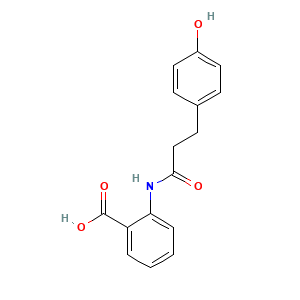
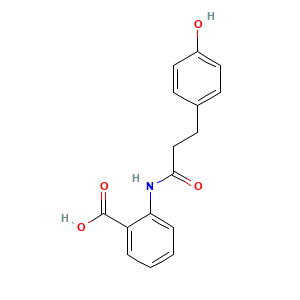
INCI: HYDROXYPHENYL PROPAMIDOBENZOIC ACID. Active molecule: Dihydroavenanthramide D (DHAvD).
PuriPharm Co. Ltd. (浦瑞生物医药技术有限公司).

Executive Summary: One Molecule, Multiple Soothing Pathways
PuriActives® BioCalmin supports soothing through multiple pathways, from histamine release to oxidative stress.
Six functional dimensions: rapid itch relief, redness reduction, suppression of histamine-related responses, irritation protection, modulation of inflammatory responses, and antioxidant defense.
Applications span both skin and scalp care.
Molecular Origin: From Oat Science to Molecular Precision
Oats have long been used to soothe dry, irritated, and itchy skin. Naturally occurring oat avenanthramides are among their characteristic active components.
Development pathway: natural oat avenanthramides → structure-inspired molecular optimization → the synthetic analogue dihydroavenanthramide D (DHAvD) → standardized manufacturing → PuriActives® BioCalmin.
BioCalmin is a molecularly defined synthetic analogue inspired by the structure and soothing mechanisms of natural oat avenanthramides. The presentation highlights stability, defined activity, identifiable targets, and quantifiable efficacy.
Molecular weight: approximately 285.3. Four attributes: nature-inspired design, a defined molecular structure, reproducible efficacy, and formulation versatility. Defined active molecule. Precision efficacy. Scientific evidence.

Skin Biology: The Biology Behind Itch and Redness
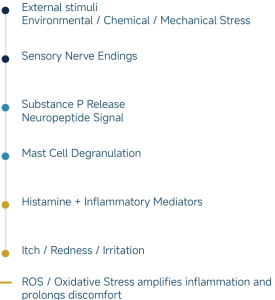
Itch and redness in sensitive skin involve a cascade linking neural signals, immune responses, and inflammatory mediators.
External stimuli (environmental, chemical, or mechanical stress) → sensory nerve endings → substance P release → mast cell degranulation → release of histamine and inflammatory mediators → itch, redness, and irritation.
Reactive oxygen species (ROS) and oxidative stress can amplify inflammation and prolong discomfort. Itch involves neural signaling, immune mediators, and oxidative stress, so intervention at a single target may not cover the full cascade.
BioCalmin is positioned for intervention at several levels, including substance P-related neural signaling, histamine-related immune responses, and ROS-related oxidative stress.
Core Mechanism: Targeting Histamine Release in the Itch Cascade
Stress → sensory nerves → substance P signaling → mast cells → histamine release → itch, redness, and irritation. BioCalmin targets the substance P–mast cell–histamine step.
Research shows that DHAvD can inhibit substance P-induced histamine release from mast cells, providing an upstream biological basis for itch relief, redness reduction, and anti-irritant activity. [1]

In Vitro Evidence: Dose-Dependent Histamine Control
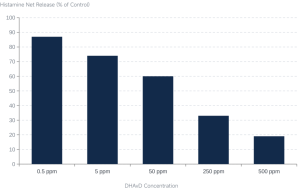
In the mast cell model, substance P-induced net histamine release decreased as DHAvD concentration increased. The presentation describes biological activity at low concentrations.
Chart data (DHAvD concentration / net histamine release as a percentage of control): 0.5 ppm / 87%, 5 ppm / 74%, 50 ppm / 60%, 250 ppm / 33%, and 500 ppm / 19%.
At 500 ppm, net release was approximately 19% of control. The vertical axis shows net histamine release (% of control), and the horizontal axis shows DHAvD concentration. Values represent remaining release, rather than percentage inhibition. [1]
Human Evidence: Itch Relief in a Histamine Skin Prick Model
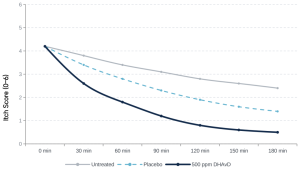
Study design: double-blind, 10 subjects, histamine HCl at 10 mg/mL, 500 ppm DHAvD as the test active, a single application, 180 minutes of observation, and an itch score scale of 0–6.
Itch scores declined faster in the 500 ppm DHAvD area, with p < 0.05 versus placebo and untreated areas. The chart compares untreated skin, placebo, and 500 ppm DHAvD at 0, 30, 60, 90, 120, 150, and 180 minutes.
The curves were redrawn from the DHAvD-related curves in Figure 5 of the cited publication and illustrate trends only. [1]
Human Evidence: Visible Redness Reduction
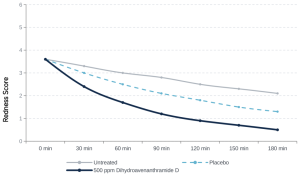
In the same histamine skin prick study, erythema scores decreased faster in the area treated with 500 ppm DHAvD. Itch and erythema scores declined faster than in placebo and untreated areas, with p < 0.05. The presentation summarizes the benefits as itch relief, redness reduction, and improved comfort.
The chart compares untreated skin, placebo, and 500 ppm DHAvD over 0–180 minutes. Erythema curves were redrawn from the same human study and illustrate trends only. [1]
Antioxidant Defense: The ABTS Radical Scavenging Assay
DHAvD had an IC50 of 26.54 μM (7.57 μg/mL) in the ABTS radical scavenging assay. Reference antioxidants were α-tocopherol (vitamin E) and Trolox, a water-soluble vitamin E analogue.
DHAvD demonstrated good radical scavenging activity in an ABTS assay alongside these reference antioxidants, supporting antioxidant defense in addition to soothing. [1]
Potential application contexts include urban environmental irritation, sensitivity after light exposure, pollution stress, formulations with potent actives, sensitive scalp care, and scalp stress after coloring or perming. Calm the skin and defend against oxidative stress.
Multi-Pathway Soothing: Multiple Levels of Inflammation Control
Pathway 1: substance P → mast cells → histamine. This neuroimmune itch cascade is associated with itch and redness.
Pathway 2: environmental stress → ROS → an inflammatory cascade. Oxidative stress can amplify inflammation, providing a rationale for antioxidant defense.
Pathway 3: keratinocyte stress → cytokine signaling → skin discomfort.
A soothing complex containing DHAvD has shown anti-inflammatory evidence in reconstructed human epidermis. The multi-pathway rationale combines molecular mechanisms with formulation synergy. One molecule, intervention at multiple levels: calm signals, protect against stress, and restore comfort.
In Vitro Evidence: Reconstructed Human Epidermis
Test system: reconstructed human epidermis in an inflammatory injury model, treated with a soothing formulation containing DHAvD plus a botanical complex. Endpoints were IL-1α release and tissue cell viability.
After inflammatory stimulation, the DHAvD-containing complex showed approximately 90% inhibition of IL-1α release and a 35% increase in tissue cell viability versus untreated tissue. The presentation cites this as tissue-level evidence for DHAvD-containing soothing formulations.
Attribution note: these results concern a DHAvD-containing soothing complex (Skin Calm Complex) and cannot be attributed entirely to DHAvD alone. [5]
Stability: Long-Term Observation Across a Wide pH Range
Published stability conditions for the active molecule: 500 ppm DHAvD, pH 3, 5, 7, 9, and 12, temperatures of 5°C, 25°C, and 40°C, and observation for up to 24 weeks.
The presentation reports only slight degradation after 24 weeks, even at pH 3 and pH 12, indicating a broad molecular stability window of pH 3–12.
Potential development areas include acidic skin care, shaving products, hair color, hair bleach, and hair care systems with high pH. These are published data for the DHAvD molecule. The recommended pH for commercial BioCalmin must follow PuriPharm’s latest TDS. [1]

Skin Care Applications: Precision Soothing for Sensitive Skin
Precision soothing addresses multiple sensitivity signals, including itch, redness, irritation, and oxidative stress.
Applications include sensitive skin serums, barrier repair creams, care after exfoliating acids, soothing support alongside retinoids, post-sun care, post-shave care, depilation aftercare, and body care for dry and itchy skin.
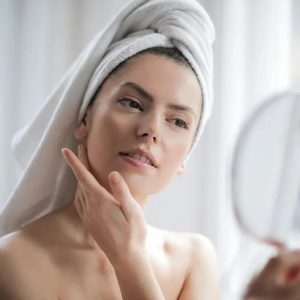
Image: real photography of sensitive skin care.
Application Study: Comfort for Dry and Itchy Skin
Study design: 40 subjects aged 35–80 years with visible dryness and itch, a 4-week double-blind crossover study, vehicle versus a DHAvD-containing formula, and assessment of scaling, erythema, and itch.
Scaling improved with p < 0.001 versus baseline and p < 0.041 versus vehicle. Erythema showed continued improvement over 4 weeks. Itch showed an improving trend, described in the presentation as a perceivable gain in comfort.
All three endpoints showed improving trends with the DHAvD-containing formula. Bar lengths illustrate trends and do not represent exact numerical proportions.
Source: supplied technical dossier. The tested formula contained a commercial DHAvD ingredient, rather than pure DHAvD.

Scalp Care Value: Consumer-Perceivable Comfort
The scalp discomfort cycle: dandruff → itch → scratching → redness → barrier stress → increased discomfort.
Conventional anti-dandruff systems primarily address dandruff-associated microorganisms. BioCalmin adds a comfort dimension through itch relief, reduced irritation, redness care, and scalp comfort.
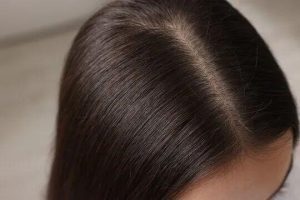
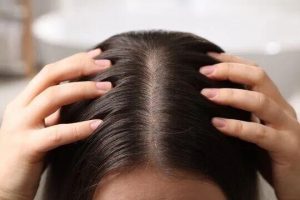
A two-dimensional approach combines dandruff control with scalp comfort. Image: real photography illustrating healthy scalp care.
Application Study: Itch Relief in Dandruff-Prone Scalp
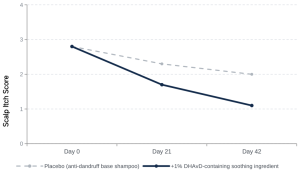
A 42-day shampoo application study used a base shampoo containing conventional anti-dandruff agents. The chart compares placebo (the anti-dandruff base shampoo) with a system containing 1% of a DHAvD-containing soothing ingredient, assessed on days 0, 21, and 42.
With the added soothing system, scalp itch scores continued to decline on days 21 and 42, with p < 0.05 versus baseline. The curves were redrawn from the 42-day application data and illustrate trends only.
The positioning combines dandruff control with itch relief and improved scalp comfort.
Positioning boundary: the original test system contained conventional anti-dandruff agents such as climbazole. BioCalmin’s core value is itch relief, soothing, reduced irritation, and improved scalp comfort. No antifungal or dandruff-treatment claim is made. Source: supplied technical dossier.
Application Matrix: From Skin Care to Scalp Care
Hair and scalp applications span four dimensions: anti-itch, anti-redness, anti-irritation, and antioxidant activity. The table retains all application rows and markers from the presentation.
From shampoos and scalp serums to care after coloring, perming, or bleaching and men’s grooming, one active supports skin and scalp comfort across multiple applications.
| Application | Anti-Itch | Anti-Redness | Anti-Irritation | Antioxidant |
|---|---|---|---|---|
| Sensitive Scalp Shampoo | ● | ● | ● | ● |
| Anti-Dandruff Shampoo | ● | ● | ● | ● |
| Scalp Soothing Serum | ● | ● | ● | ● |
| Anti-Itch Scalp Tonic | ● | ● | ● | ● |
| Hair Color Aftercare | ● | ● | ● | ● |
| Bleaching Aftercare | ● | ● | ● | ● |
| Perm Aftercare | ● | ● | ● | ● |
| Daily Scalp Care | ● | ● | ● | ● |
| Men’s Scalp Care | ● | ● | ● | ● |
| Beard / Shaving Care | ● | ● | ● | ● |
Formulation Science: Release and Skin Availability
DHAvD has a molecular weight of approximately 285.3 and a logP of approximately 3.34, with relatively limited water solubility.
Published research shows that suitable 1,2-alkanediol systems can improve DHAvD release and skin availability. In specific BuG/PeG systems, release within 30 minutes increased approximately 2–4-fold, and the amount reaching viable skin layers increased approximately twofold. Appropriate carrier design helps translate molecular properties into formulation performance.
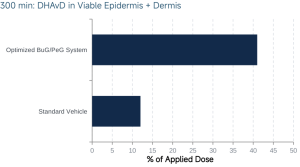
The original presentation chart shows the amount in the viable epidermis and dermis at 300 minutes as a percentage of the applied dose: approximately 12% for the standard vehicle and 41% for the optimized BuG/PeG system.
These results concern specific experimental formulations and do not substantiate a claim that “BioCalmin has 41% skin penetration.” [2]
Formulation Guide
Recommended use level: 0.1–5%. Recommended working pH: 3–8. Processing: add at approximately 45°C or below (≤45°C). Storage: keep cool and protect from light.
Suitable formats: essences, serums, lotions, creams, gels, masks, body care, shampoos, conditioners, scalp serums, scalp tonics, after-shave care, and hair color aftercare.
These parameters are based on PuriPharm’s internal BioCalmin documentation. If they differ from the latest TDS or SPEC, the latest technical documentation takes precedence.
Product Summary: Precision Soothing, Defined by Science
PuriActives® BioCalmin has six core positioning areas: rapid itch relief, visible redness care, inhibition of substance P-induced histamine release, soothing of inflammatory stress through multiple pathways, antioxidant defense, and applications across skin, body, scalp, and hair care.
One molecule. Multi-pathway comfort. Dihydroavenanthramide D brings molecular science to precision soothing.
PuriPharm Co. Ltd. Defined molecule. Proven comfort.
References and Data Sources
1. Schmaus G, Herrmann M, Joppe H, Lange S, Koch O, Pillai R, Röding J. Dihydroavenanthramide D for Anti-irritant and Anti-itch. Cosmetics & Toiletries. 2007;122(11):55–64.
2. Heuschkel S, Wohlrab J, Schmaus G, Neubert RHH. Modulation of Dihydroavenanthramide D release and skin penetration by 1,2-alkanediols. European Journal of Pharmaceutics and Biopharmaceutics. 2008;70:239–247. doi:10.1016/j.ejpb.2008.04.005.
3. Heuschkel S, Wohlrab J, Neubert RHH. Dermal and transdermal targeting of dihydroavenanthramide D using enhancer molecules and novel microemulsions.
4. Sur R, Nigam A, Grote D, Liebel F, Southall MD. Avenanthramides, polyphenols from oats, exhibit anti-inflammatory and anti-itch activity. Archives of Dermatological Research. 2008;300:569–574. doi:10.1007/s00403-008-0858-x.
5. de Yzaguirre MM, Bacchini G, Luna EG, Vila-Martínez E. Anti-Inflammatory Efficacy of Product Containing “Skin Calm Complex” in Vitro Reconstructed Epidermis. Journal of Cosmetics, Dermatological Sciences and Applications. 2014;4:309–315. doi:10.4236/jcdsa.2014.45040.
Application study data are from the supplied technical dossier. Reference 3 in the source presentation does not include the year, journal, volume, pages, or DOI.