NanoActive RosUrsol™
Rosemary Nano-Liposomes
INCI — ROSMARINUS OFFICINALIS (ROSEMARY) EXTRACT · enriched with high-purity ursolic acid and carnosic acid
Botanical intelligence · defined actives · engineered delivery
Powered by PURISOME® FlexVes™ liposome technology
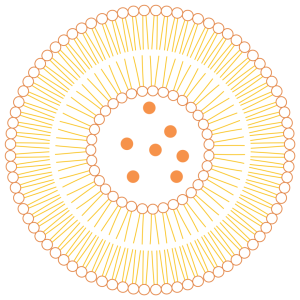
Phospholipid bilayer vesicle — the PURISOME® nano-liposome platform
PuriPharm Co., Ltd.NanoActive™ · PURISOME®
01 · POSITIONING
From botanical extract to precision active platform
NanoActive RosUrsol™ is not an ordinary rosemary extract — it is a standardized botanical active delivery platform.
Rosemary (Mediterranean botanical) → Standardized actives (ursolic acid + carnosic acid) → NanoActive™ (water-compatible platform)
Conventional rosemary extract
· Composition may vary from batch to batch
· Limited standardization of active constituents
· Lipophilic actives poorly compatible with water-based formulas
· Positioning dominated by the botanical story
· Performance strongly dependent on extraction process and base
NanoActive RosUrsol™ rosemary nano-liposomes
· Enriched with defined, high-value phytochemicals
· High-purity ursolic acid + carnosic acid actives
· Water-compatible delivery concept
· Advanced lipid carrier technology
· Cosmetic and food application potential
· Science-driven positioning
The name RosUrsol™ — Ros (rosemary) + Ursol (ursolic acid) — stands for a standardized rosemary-derived platform built on high-value lipophilic phytochemicals, with carnosic acid as the complementary active axis.
01 · POSITIONING
RosUrsol™ at a glance
Four pillars define the platform — chemistry, delivery, biology and application breadth.
Dual botanical actives
Enriched with high-purity ursolic acid and carnosic acid — two chemically defined lipophilic rosemary phytochemicals.
Water compatibility
A water-dispersible delivery form designed for modern water-rich formulation systems.
Multi-pathway biology
Complementary mechanisms spanning skin tone, photo-stress, barrier, inflammation and neuro-skin biology.
Cosmetics + food
The same rosemary-derived defense chemistry serving skin care, scalp care and food-lipid protection.
PRODUCT IDENTITY
Product — NanoActive RosUrsol™ rosemary nano-liposomes · INCI — rosemary extract (ROSEMARY EXTRACT)
Active platform — a standardized rosemary-derived fraction enriched with high-purity ursolic acid and carnosic acid
Technology — powered by PURISOME® FlexVes™ liposome technology
02 · PHYTOCHEMISTRY
Rosemary — a phytochemical platform
RosUrsol™ focuses on the high-value lipophilic active space of the rosemary leaf.
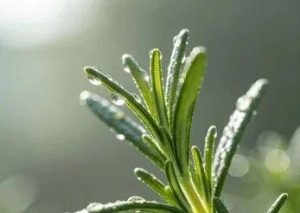
Rosmarinus officinalis L. (Salvia rosmarinus), Lamiaceae — a chemically rich Mediterranean botanical.
NanoActive RosUrsol™ focuses on the lipophilic fraction — ursolic acid + carnosic acid.
| Molecule | Class | Formula | MW | Solubility |
|---|---|---|---|---|
| Ursolic acid | Pentacyclic triterpene | C30H48O3 | 456.7 | Oil-soluble |
| Carnosic acid | Phenolic diterpene | C20H28O4 | 332.4 | Oil-soluble |
| Carnosol | Phenolic diterpene | C20H26O4 | 330.4 | Oil-soluble |
| Rosmarinic acid | Phenolic acid | C18H16O8 | 360.3 | Water-soluble |
| Related phenolics | Polar fraction | — | — | Water-soluble |
Lipophilic fraction — the RosUrsol™ space · Polar fraction — outside this platform’s scope
Molecular data sources — PubChem (CID 64945, 65126) and published rosemary active specifications. Ursolic acid, carnosic acid, carnosol and rosmarinic acid are chemically distinct molecules.
02 · PHYTOCHEMISTRY
Two signature molecules
Defined chemistry first — the foundation of standardization.
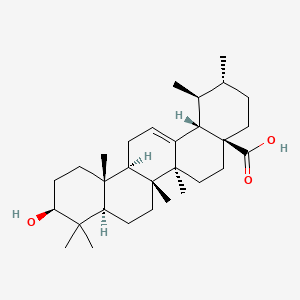
URSOLIC ACID
Pentacyclic triterpene
C30H48O3 · MW 456.7 · XlogP 7.3
CAS 77-52-1
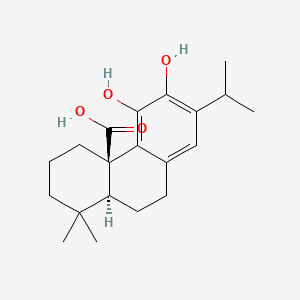
CARNOSIC ACID
Phenolic diterpene
C20H28O4 · MW 332.4 · XlogP 4.9
CAS 3650-09-7
Both are strongly lipophilic — delivery engineering is at the core of this platform.
Structures from PubChem (CID 64945, 65126). Formulas and molecular weights verified against public specifications.
03 · DUAL-ACTIVE SCIENCE
Two signature botanical actives, complementary biology
Each molecule covers different research territories; together they span skin defense, tone and structure.
URSOLIC ACIDpentacyclic triterpene — research areas
· Melanophagy — melanosome clearance · biology of pigmentation · cellular stress response· skin barrier / lipid biology · ECM homeostasis · inflammatory balance
NanoActive RosUrsol™an integrated botanical defense platform
CARNOSIC ACIDphenolic diterpene — research areas
· Antioxidant defense / ROS modulation · Nrf2 cellular defense · photoaging / MMP regulation· inflammatory signaling · TRPA1 / neuro-skin biology · lipid oxidation protection
04 · URSOLIC ACID
Beyond melanin synthesis: supporting melanosome clearance
Published research points to a second axis of skin-tone biology — degradation, not only production.
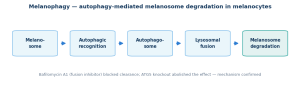
Evidence level 2 · primary research — ursolic acid, in vitro
In α-MSH-stimulated B16F1 melanocytes, ursolic acid (5–10 µM) activated autophagy, promoted melanosome degradation and reduced melanin content.
Bafilomycin A1, an autophagosome–lysosome fusion inhibitor, blocked melanosome clearance; knockout of the autophagy gene ATG5 abolished the anti-pigment effect — establishing melanophagy as the mechanism.
Park HJ et al. Biochem Biophys Res Commun. 2020;531(2):209–214. PMID 32792197.
04 · URSOLIC ACID
From mechanism to visible skin tone
Human evidence from an ursolic-acid-rich botanical system supports the relevance of ursolic-acid biology to skin tone.
Axis 1 — production
Melanogenesis regulation — tyrosinase and melanogenic regulators (TYRP-1, TYRP-2, MITF), demonstrated for ursolic-acid-rich systems in melanocyte models.
Axis 2 — clearance
Melanosome clearance — ursolic acid promotes melanosome autophagy (melanophagy) in B16F1 melanocytes (Park HJ et al. 2020).
Dual-axis tone management — production and clearance together tell a more complete skin-tone science story.
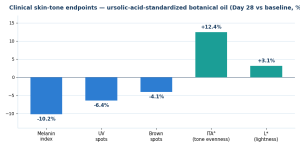
Annurca apple oil extract (AAO), standardized to 784 µg/mL ursolic acid; 2.5% formulation, randomized double-blind placebo-controlled trial, n = 42, 28 days; all endpoints p < 0.001 vs placebo. Maisto M et al. Sci Rep. 2025. PMID 41387498.
04 · URSOLIC ACID
Skin resilience: barrier lipids and ECM homeostasis
Ursolic-acid biology reaches beyond tone — into epidermal lipids and matrix balance.
Barrier and epidermal lipid biology
· Topical ursolic acid accelerated epidermal permeability-barrier recovery (>20% vs control at 6 h) and induced keratinocyte differentiation via PPAR-α — hairless-mouse and HaCaT models (Ahn SK et al. 2007, PMID 17727365).
· Liposome-encapsulated ursolic acid increased ceramides in cultured human keratinocytes and human skin, and collagen in dermal fibroblasts (Both DM et al. 2000, DOI 10.1159/000053280).
A liposomal precedent: the ceramide/collagen evidence above was generated with a liposomal ursolic-acid format — directly relevant to the PURISOME® delivery concept.
ECM homeostasis — not a “collagen booster”
Healthy ECM = synthesis ↔ organization ↔ remodeling. Published evidence suggests context-dependent regulation of extracellular-matrix biology. RosUrsol™ therefore uses balanced language:
· ECM homeostasis · matrix protection · healthy matrix turnover · firmer appearance
Sweeping claims such as “ursolic acid always increases collagen” are deliberately avoided — matrix biology is context-dependent.
Evidence level 2 — primary ursolic-acid research (in vitro / animal / human-skin ceramide assessment).
05 · CARNOSIC ACID
Where direct antioxidant chemistry meets cellular defense
Carnosic acid is not just “a strong antioxidant” — it defends on two complementary levels.
Level 1 — direct defense
· Reacts directly with ROS and free radicals
· Lipid-phase antioxidant chemistry — protection where oxidation begins
· Readily oxidized itself: a chemical quencher consumed in defense
Level 2 — biological defense
· Redox-sensitive cell signaling (Keap1–Nrf2–ARE)
· Activates endogenous defense enzymes
· Protection continues through its oxidized derivatives
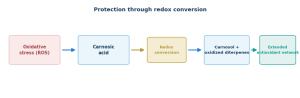
Evidence level 2 — primary carnosic-acid research
Loussouarn M et al. Plant Physiology. 2017. PMID 28916593: when lipids are oxidized by ROS, carnosic acid is consumed and oxidized into derivatives including carnosol; EPR confirmed that carnosic acid — not carnosol — quenches ROS, while carnosol inhibits lipid peroxidation within the lipid phase. Carnosic acid does not remain chemically unchanged while acting as an antioxidant.
05 · CARNOSIC ACID
Helping cells build their own defense
The Keap1–Nrf2–ARE pathway — the cell’s own antioxidant program, switched on by redox-activated carnosic acid.
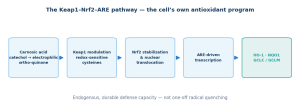
What it means for skin
· Nrf2 is the master regulator of the cellular antioxidant response
· Activation brings endogenous, durable defense capacity — not one-off radical quenching
· Supports photo-stress defense, skin resilience and healthy-aging positioning
Evidence discipline
· Keap1–Nrf2 activation by carnosic acid is established in experimental cell and neuronal models (Satoh T et al. J Neurochem. 2008)
· Confirming skin relevance in fibroblasts and keratinocytes is a priority of the RosUrsol™ research program
Evidence level 2/4 — pathway literature; neuronal Nrf2 data are not presented as human-skin clinical evidence. Pathway diagram redrawn.
05 · CARNOSIC ACID
Interrupting the UV–ROS–MMP cascade
Photoaging is a signaling cascade — carnosic acid intervenes at two defined nodes.
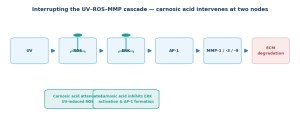
What human skin-cell studies show
· Carnosic acid significantly and concentration-dependently inhibited UVA- and UVB-induced MMP-1, MMP-3 and MMP-9 expression in human dermal fibroblasts (Hs68)
· UVB-induced ROS generation was attenuated; ERK activation and AP-1 formation were suppressed
· EGFR activation was unaffected — suggesting selectivity within the upstream cascade
· UVB-enhanced GADD45 expression (a marker of oxidative DNA damage) was significantly reduced
Park M et al. Exp Dermatol. 2013;22(5):336–341. DOI 10.1111/exd.12138. PMID 23614740. Cascade diagram redrawn; evidence level 2 — human skin-cell research.
05 · CARNOSIC ACID
The evidence in human skin cells
Park M et al. 2013 — the key dataset behind the carnosic-acid anti-photoaging story.
Study design
· Compound — carnosic acid (rosemary phenolic diterpene)
· Models — Hs68 dermal fibroblasts; primary normal human dermal fibroblasts; normal human epidermal keratinocytes
· Stimulus — UVA / UVB irradiation
· Readouts — Western blot, qRT-PCR, enzyme-activity assays
Key findings
· MMP inhibition — concentration-dependent inhibition of UV-induced MMP-1, MMP-3, MMP-9
· Signal blockade — suppressed UVB-induced ERK activation and AP-1 formation
· ROS attenuation — reduced UVB-induced ROS generation; EGFR unaffected
· DNA-damage marker — UVB-enhanced GADD45 significantly reduced
· Cross-model confirmation — fibroblast line, primary fibroblasts and keratinocytes
Park M et al. Exp Dermatol. 2013;22(5):336–341. DOI 10.1111/exd.12138. PMID 23614740. Evidence level 2 — human skin-cell research; not finished-product data for NanoActive RosUrsol™.
05 · CARNOSIC ACID
Calming stress signals upstream
Carnosic acid acts on the signaling chain that drives inflammatory mediators — not merely at the downstream end.
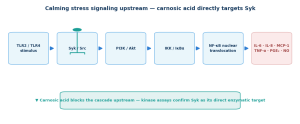
Validated in skin-relevant models
· HaCaT keratinocytes — inhibited IL-6, IL-8 and MCP-1 under SLS / retinoic-acid stimulation
· RAW264.7 macrophages — blocked NO, TNF-α and PGE₂ release upon TLR2 / TLR4 activation
Positioning territories
· Environmentally stressed skin · inflammaging & skin resilience · sensitive-skin positioning · scalp stress & the follicular environment
Oh J et al. Mediators Inflamm. 2012;2012:781375. DOI 10.1155/2012/781375. PMID 22577255. Pathway diagram redrawn; evidence level 2. Cosmetic concept only — no disease-treatment claims.
05 · CARNOSIC ACID
Activating the neuro-skin dialogue
A 2025 discovery links carnosic acid to TRPA1, a cutaneous sensory-neuron channel — a forward-looking science story.
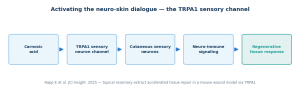
Experimental findings
· Topical rosemary extract accelerated wound closure and reduced fibrosis in an adult mouse wound model
· Carnosic acid was identified as the key active acting via TRPA1
· Mice lacking TRPA1 in sensory neurons lost the pro-regenerative response
Translation into cosmetic language
· skin regenerative biology · neuro-skin communication · skin recovery & resilience · tissue-renewal biology
Rapp E et al. JCI Insight. 2025:e196267. DOI 10.1172/jci.insight.196267. PMID 41129748.
05 · CARNOSIC ACID
2025 regenerative biology: the spotlight study
Rapp E et al., JCI Insight 2025 — how a topical rosemary extract talks to sensory neurons.
01A screen pinpointed the signal
Among multiple botanical extracts, rosemary specifically activated the TRPA1 ion channel — the channel behind the regenerative response in the mouse ear-wound model.
02Carnosic acid is the key active
Carnosic acid — the principal bioactive of rosemary leaf — acts as a TRPA1 agonist on cutaneous sensory neurons, connecting phytochemistry to neuro-skin signaling.
03TRPA1 dependence confirmed
Mice lacking TRPA1 in sensory neurons showed no rosemary-induced regenerative response — mechanistic specificity, not a generic botanical effect.
What it means for ROSURSOL™
· One defined molecule — carnosic acid — carries the activity, supporting the “standardized active” positioning
· Opens a credible neuro-skin and skin-recovery narrative for premium skin and scalp care
· Shows how fast rosemary science is advancing — and why defined actives matter
Claims discipline.These are experimental mouse findings. RosUrsol™ communication language is regenerative biology, recovery and resilience — never wound or scar treatment.
06 · INTEGRATED SKIN BIOLOGY
One platform, multi-pathway defense
The integrated biology map — two molecules, complementary territories, shared outcomes.
Ursolic acid
Melanophagy · barrier lipids · ECM homeostasis · inflammatory balance
NanoActive RosUrsol™
Carnosic acid
Nrf2 defense · UV–MMP protection · inflammatory signaling · TRPA1 biology
SHARED OUTCOME TERRITORIES
Skin resilience · even skin tone · photo-stress defense · healthy aging · skin recovery
07 · DELIVERY ENGINEERING
Powerful actives, inconvenient physics
Ursolic acid and carnosic acid are both strongly lipophilic — excellent chemistry, inconvenient formulation behavior.
7.3XlogP — ursolic acid · strongly lipophilic triterpene
4.9XlogP — carnosic acid · lipophilic phenolic diterpene
The conventional challenges
High-value lipophilic phytochemicals↓ poor water compatibility↓ limited formulation versatility↓ difficult dispersion↓ crystallization / precipitation risk↓ hard to use in clear or water-rich systems
The formulation paradox: the very property that makes these molecules powerful — lipid affinity — keeps them out of the water-rich systems that dominate modern skin care and food innovation.
07 · DELIVERY ENGINEERING
Turning lipophilic botanical actives into a water-compatible platform
The NanoActive™ answer: change how the active behaves in a formula through delivery engineering.
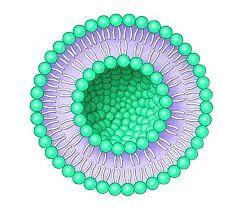
Concept schematic — a lipophilic active carried within a phospholipid bilayer vesicle.
Advanced delivery engineering → water-compatible dispersion platform → expanded formulation possibilities
· The active resides in a lipid-compatible vesicular environment
· Disperses uniformly in water-rich and multiphase systems
· Protects oxidation- and degradation-prone molecules
· Compatible with serums, lotions, emulsions and scalp formats
07 · DELIVERY ENGINEERING
PURISOME® FlexVes™ liposome technology
PuriPharm’s proprietary advanced nano-liposome platform — the technical core of every NanoActive™ product.
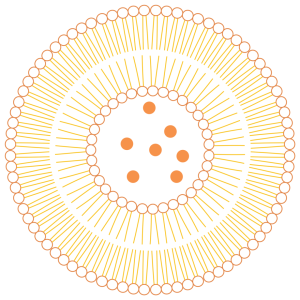
Phospholipid bilayer vesicle encapsulating lipophilic actives (schematic).
Built on more than a decade of nano-delivery R&D and industrialization experience, PURISOME® encapsulates actives in skin-affine phospholipid bilayer vesicles — delivering four core values.
1 · Protection shields oxidation- and degradation-prone actives; supports shelf-life stability.
2 · Delivery enhances stratum-corneum penetration and bioavailability.
3 · Sustained release controlled, sustained release that reduces irritation potential.
4 · Formulation compatibility improves formulation versatility and sensory performance.
07 · DELIVERY ENGINEERING
Designed for the skin interface
Nano-scale carriers interact with skin differently — particle size, surface film and lipid affinity all play a role.

Skin cross-sections — smaller carrier systems distribute deeper into skin (concept schematic, carrier literature).
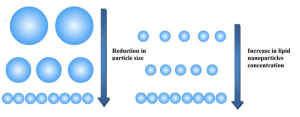
Reducing particle size increases effective nanocarrier concentration and surface contact (concept schematic).
· Lipid affinity — phospholipid vesicles are structurally compatible with the skin’s own lipid architecture
· Flexible vesicles — FlexVes™ vesicles are designed to interact with the stratum-corneum interface
· Surface film & reservoir — nanocarriers can deposit on the surface to form reservoirs, supporting sustained availability
· Protection in transit — encapsulation shields oxidation-prone carnosic acid until application
Conceptual delivery-system schematics (evidence level 4 — carrier literature).
08 · COSMETIC APPLICATIONS
Scalp and follicle care
The follicular unit offers topical carrier systems a unique pathway — and a reservoir.
Nanoparticle deposition along the follicular pathway
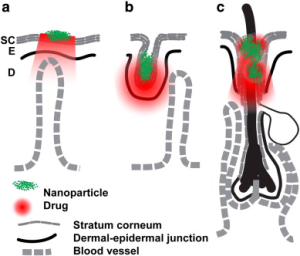
The follicular unit as a delivery reservoir
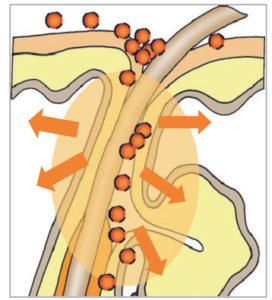
Concept schematics — PuriPharm technical library.
The scalp stress environment
· Scalp oxidative stress and UV exposure
· Sebum-lipid oxidation at follicular openings
· Inflammatory stress in the follicular microenvironment
· Delivering lipophilic phytochemicals to where they are truly needed
NanoActive RosUrsol™ — a dual-active antioxidant and resilience platform for premium scalp care.
Scalp-vitality positioning; no hair-growth or hair-loss treatment claims.
08 · COSMETIC APPLICATIONS
Cosmetic application territories
One active platform, four formulation territories — all compatible with modern water-rich formats.
Skin tone & clarity
· tone-evening serums · post-blemish mark care · brightening serums · dull-skin care
Photoaging & anti-aging
· antioxidant serums · daily environmental-defense serums · anti-photoaging creams · overnight repair serums · mature-skin care
Barrier & resilience
· barrier-support serums · stressed-skin care · lipid-repair creams · sensitive-skin formulas
Scalp care
· scalp antioxidant serums · scalp anti-aging serums · follicular-environment care · oil-control / oxidative-stress scalp formats
Application territories are based on the published ursolic-acid / carnosic-acid evidence base and PURISOME® delivery logic.
09 · FOOD SCIENCE
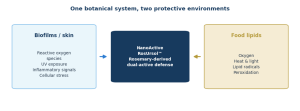
From skin lipids to food lipids
One botanical system, two protective environments.
09 · FOOD SCIENCE
Lipid oxidation: the cascade that spoils food
Understanding the free-radical chain is the basis of every antioxidant strategy.
1 · InitiationLH → L•
Heat, light or trace metals abstract hydrogen from unsaturated lipids.
2 · PropagationL• + O₂ → LOO• · LOO• + LH → LOOH + L•
A self-propagating free-radical chain.
3 · DecompositionLOOH → aldehydes · ketones
Volatile oxidation products form.
Consequences
Rancidity · off-odors · aroma deterioration · color instability · loss of polyunsaturated fatty acids · nutritional degradation
Rosemary diterpenes are lipid-phase defense molecules — they act where the cascade begins: inside the lipid matrix.
09 · FOOD SCIENCE
Protection where oxidation begins — the lipid phase
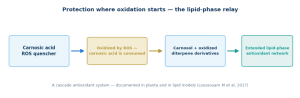
Carnosic acid is the first-line quencher; its oxidized derivatives extend the defense network.
Mechanistic basis
· Carnosic acid scavenges singlet oxygen and free radicals, and is oxidized into derivatives including carnosol
· Carnosol acts directly in the lipid phase, inhibiting peroxidation and stabilizing membrane structures
· This relay broadens the action spectrum — a cascade antioxidant system documented in planta and in lipid models
Relevance to food systems
· Free-radical quenching chemistry in the lipid phase
· Protects unsaturated fatty acids and oxidation-sensitive lipid systems
· Conversion into antioxidant-relevant derivatives extends protection over time
· Rosemary antioxidant diterpenes are compositional markers of food-grade rosemary extract
Loussouarn M et al. Plant Physiology. 2017. PMID 28916593. Evidence level 2/3 — primary rosemary-diterpene research. Mechanism diagram redrawn.
09 · FOOD SCIENCE
The food application space
At the heart of the food story is oxidative stability — flavor, color, nutritional quality and shelf-life support.
Edible oils & fats
· PUFA-rich oils · specialty oils · blended oils · functional lipids
Meat & savory products
· meat products · processed meats · emulsified meat systems · fat-containing savory foods
Bakery & fats
· bakery fats · fillings · nut-based systems · fat-containing snacks
Nutritional products
· lipid-based nutritional products · functional food formulations · oxidation-sensitive nutritional systems
Regulatory context — rosemary extract
Rosemary extract has an established regulatory heritage as a food antioxidant — E392 (extracts of rosemary) in the EU, with carnosic acid and carnosol as its key compositional markers. That heritage applies to the rosemary-extract category; the specific regulatory status of NanoActive RosUrsol™ — botanical source, process, carrier system, nano character, target food categories and labeling — must be verified jurisdiction by jurisdiction. No automatic equivalence to E392 is claimed.
09 · FOOD SCIENCE
Water-compatible formats open new matrix space
An R&D platform opportunity — to be validated matrix by matrix, jurisdiction by jurisdiction.
The conventional limitation
Lipophilic rosemary antioxidants excel in lipid phases — but are difficult to introduce uniformly into water-rich or multiphase systems.
The ROSURSOL™ opportunity space
· Emulsions and nutritional emulsions
· Sauces and aqueous premixes
· Multiphase food matrices
· Beverages — where technology and regulation permit
10 · SUMMARY
Why NanoActive RosUrsol™
Five essentials — and one claims architecture spanning cosmetics and food.
01 Standardized rosemary phytochemistry — not a variable generic botanical extract
02 Ursolic acid + carnosic acid — two defined, high-value actives
03 Complementary biological defense — multi-pathway coverage without synergy inflation
04 A water-compatible delivery platform — PURISOME® FlexVes™ liposome technology
05 Cosmetic + food innovation potential — one chemistry, two industries
THE CLAIMS ARCHITECTURE — DUAL BOTANICAL ACTIVES, MULTI-SYSTEM PROTECTION
Cosmetic science antioxidant defense · photo-stress protection · skin resilience · even skin tone · ECM homeostasis · skin regenerative biology · scalp defense
Food science lipid protection · oxidative stability · quality preservation · flavor protection · color stability · PUFA protection · shelf-life support
NanoActive RosUrsol™ rosemary nano-liposomes · PURISOME® FlexVes™ liposome technologyPuriPharm Co., Ltd. · www.puriactives.com
10 · SUMMARY · REFERENCES
References
1 · Park HJ et al. Ursolic acid inhibits pigmentation by increasing melanosomal autophagy in B16F1 cells. Biochem Biophys Res Commun. 2020;531(2):209–214. DOI 10.1016/j.bbrc.2020.07.125 · PMID 32792197
2 · Maisto M et al. Apple oil as a source of ursolic acid for the treatment of hyperpigmentary disorders with molecular and clinical evaluation. Sci Rep. 2025. PMID 41387498
3 · Ahn SK et al. Simultaneous effect of ursolic acid and oleanolic acid on epidermal permeability barrier function and epidermal keratinocyte differentiation via PPAR-α. J Dermatol. 2007. PMID 17727365
4 · Both DM, Goodtzova K, Yarosh DB, Brown DA. Liposome-encapsulated ursolic acid increases ceramides and collagen in human skin cells. Horm Res. 2000;54(5–6):318–321. DOI 10.1159/000053280
5 · Loussouarn M et al. Carnosic acid and carnosol, two major antioxidants of rosemary, act through different mechanisms. Plant Physiology. 2017. PMID 28916593
6 · Park M et al. Carnosic acid, a phenolic diterpene from rosemary, prevents UV-induced expression of matrix metalloproteinases in human skin fibroblasts and keratinocytes. Exp Dermatol. 2013;22(5):336–341. DOI 10.1111/exd.12138 · PMID 23614740
7 · Oh J et al. Syk/Src pathway-targeted inhibition of skin inflammatory responses by carnosic acid. Mediators Inflamm. 2012;2012:781375. DOI 10.1155/2012/781375 · PMID 22577255
8 · Rapp E et al. Carnosic acid in topical rosemary extract enhances skin repair via TRPA1 activation. JCI Insight. 2025:e196267. DOI 10.1172/jci.insight.196267 · PMID 41129748
9 · Satoh T et al. Carnosic acid activates the Keap1/Nrf2 pathway via S-alkylation of targeted cysteines on Keap1. J Neurochem. 2008.
10 · Commission Regulation (EU) No 231/2012 — specifications for food additives; E392 extracts of rosemary.
Image credits — vesicle schematics, skin cross-sections and follicular schematics, molecular structures — PuriPharm technical library (company archive); structure data from PubChem.