01 · PuriActives® SupraHDA™: Supramolecular Royal Jelly Lipid Care
Multicomponent supramolecular complex. Royal jelly lipid intelligence. Four-dimensional balance.
Four complementary dimensions support skin and scalp homeostasis. Components: Zinc PCA, 10-HDAA, Xyloglucan, and Alpha-Glucan Oligosaccharide.
PuriPharm Co. Ltd.
02 · From One Active to Four-Dimensional Homeostasis
Oily, fragile, and fluctuating skin can combine excess sebum, barrier instability, environmental stress, and microbiome imbalance. SupraHDA™ organizes four functional ingredients into a supramolecular system for sebum, barrier, interface, and microbiome management.
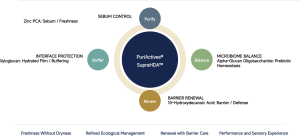
Purify, Renew, Buffer, Balance: four components, four pathways, and three application areas—skin, scalp, and hair. Designed for next-generation skin and scalp care. The presentation describes complementary design roles, which do not themselves establish measured product synergy.
03 · Next-Generation Sebum Care: Managing Homeostasis
01 Oily skin: move from degreasing toward oil/water balance and freshness without dryness.
02 Blemish-prone skin: support microbial diversity and balance.
03 Aging care: extend collagen care to barrier homeostasis and oxidative-stress defense.
04 Scalp skinification: apply skin-care science to sebum, microbes, the barrier, and comfort.
Long-term stability, comfort, and microbial balance extend the goals of sebum care.
04 · Product Identity
Product: PuriActives® SupraHDA™. Chinese name: supramolecular royal jelly acid. Type: multicomponent supramolecular active complex.
Positioning: oily, combination, fluctuating, barrier-fragile skin and scalp sebum imbalance care.
Final INCI follows formal TDS/SPEC. If Royal Jelly Extract (CAS 91081-56-0) is confirmed, include it fully in actual formulation order.
Zinc PCA: sebum/freshness and the stratum-corneum moisture environment.
10-Hydroxydecanoic Acid (CAS 1679-53-4): a royal-jelly-lipid-inspired hydroxy fatty acid.
Xyloglucan: a flexible hydrated polysaccharide network for interface buffering and dispersion.
Alpha-Glucan Oligosaccharide: prebiotic microbiome care.
05 · Purify, Renew, Buffer, Balance
01 Purify—Zinc PCA: sebum, freshness, and environmental management; PCA supports stratum-corneum hydration and zinc-related aging-care concepts.
02 Renew—10-Hydroxydecanoic Acid (10-HDAA): epidermal renewal, NMF-related pathways, environmental antioxidant/aging care, and skin/scalp comfort.
03 Buffer—Xyloglucan: hydrated films, interface buffering, dispersion, sensory properties, and smoother/flexible hair feel.
04 Balance—Alpha-Glucan Oligosaccharide: prebiotic ecology, diversity, and homeostasis, supporting scalp microbiome concepts.
The presentation integrates these roles as supramolecular synergy.
06 · High-Value Actives Need Effective Formulation Design
Challenges: limited aqueous dispersion; crystallization/cloudiness; compatibility between ions and polymers; uneven skin-interface distribution; sensory effects at high use levels; and lack of synergy from simple ingredient addition.
Hydroxy fatty acids and combinations require systematic dispersion, compatibility, interface, and sensory design. SupraHDA™ uses ionic, hydrogen-bonding, hydrophobic, and polysaccharide-network interactions to organize actives and support molecular cooperation.
07 · Multiple Noncovalent Interactions Form a Dynamic Network
Zinc PCA supplies ionic/polar sites. 10-Hydroxydecanoic Acid supplies hydroxyl/carboxyl groups and a hydrophobic chain. Xyloglucan provides a hydroxyl-rich hydrated network. Alpha-Glucan Oligosaccharide provides oligosaccharide hydrogen bonding and microbiome functions.
Hydrogen bonds dynamically associate hydroxyl/polar groups. Ionic association links zinc with carboxyl/hydroxyl groups reversibly. Hydrophobic interactions organize medium-length chains. The Xyloglucan network supports dispersion/structure, while hydration maintains a moist interface.
The design uses reversible, dynamic, cooperative molecular organization.
08 · Five Steps from Formulation to Interface Performance
01 Association: noncovalent interactions dynamically associate four components.
02 Dispersion: polysaccharide networks support uniform aqueous dispersion.
03 Compatibility: adapt to multiple formats and reduce precipitation/cloudiness risk.
04 Retention: hydrated films support interface residence and uniform contact.
05 Performance: express Purify, Renew, Buffer, and Balance pathways.
Design goals: easier formulation, uniform contact, better sensory properties, and multifunctionality.

09 · Zinc PCA: Sebum and Skin Environment Management
Zinc signal: supports sebum management, less shine/stickiness, and control of unfavorable microbial conditions.
PCA moisture logic: PCA is associated with natural moisturizing factors, supporting stratum-corneum softness/moisture and less tightness after sebum removal.
Photoaging support: cellular research reported reduced UVA-induced AP-1 activation/MMP-1 production and supported collagen synthesis.
The zinc/PCA combination links freshness with moisture, barrier, and photoaging-care concepts. The source’s priority wording does not establish historical novelty.
Ingredient-level cellular evidence: Takino et al. Int J Cosmet Sci. 2012;34(1):23–28. DOI: 10.1111/j.1468-2494.2011.00676.x.
Source link from the presentation: https://doi.org/10.1111/j.1468-2494.2011.00676.x
10 · PCA and the Stratum-Corneum Moisture Environment
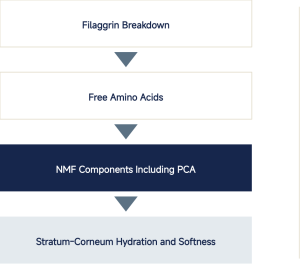
Pathway: filaggrin breakdown produces free amino acids and NMF components including PCA, supporting hygroscopicity and softness.
Zinc PCA combines zinc-related care with PCA’s hydration rationale. NMF is the stratum corneum’s own moisture-retention system, and PCA is an important component. Sebum care can preserve hydration.
Ingredient-level physiology: Clar EJ, Fourtanier A. Int J Cosmet Sci. 1981;3(3):101–113. DOI: 10.1111/j.1467-2494.1981.tb00275.x.
Source link from the presentation: https://doi.org/10.1111/j.1467-2494.1981.tb00275.x
11 · Royal Jelly Lipids: Distinct Hydroxy Fatty Acids
10-Hydroxydecanoic Acid (CAS 1679-53-4): saturated ω-hydroxy fatty acid and a core SupraHDA™ INCI; terminal hydroxyl, carboxylic acid, and medium-length hydrophobic chain. Product claims should rely on this molecule and direct finished-product data.
10-Hydroxy-2-Decenoic Acid (10-H2DA / 10-HDA): representative unsaturated royal jelly fatty acid with more extensive published skin research and an amphiphilic structure. Its literature provides family background and mechanism directions.
The molecules have related structures but are distinct. Shared amphiphilic features support biological and assembly concepts. 10-H2DA literature is not direct test data for 10-Hydroxydecanoic Acid or SupraHDA™.
12 · Epidermal Differentiation and Barrier Maturation
Path A: PPARα, IVL/LOR/FLG/TGM1, terminal keratinocyte differentiation, cornified-envelope formation, and barrier integrity.
Path B: SPT/GBA/ACACA, epidermal lipid production, and intercellular lipid support.
The concept concerns the skin’s own barrier-building programs, epidermal renewal, and cornification.
Royal jelly lipid in vitro mechanism research: Yuan et al. J Funct Foods. 2024;122:106505. DOI: 10.1016/j.jff.2024.106505.
Source link from the presentation: https://doi.org/10.1016/j.jff.2024.10650

13 · NMF Hydration: Supporting Endogenous Moisture Retention
3D human epidermis study of 10-H2DA at 10/20/40 μmol/L. At 40 μmol/L, total stratum-corneum free amino acids increased approximately 70%.
FLG mRNA, filaggrin protein, and free amino acids increased. AQP3 did not show similarly significant changes.
The proposed route promotes cornification and NMF formation rather than only external humectancy. The source’s “endogenous water creation” phrase is presented here as endogenous moisture retention.
These are 10-H2DA model data, not SupraHDA™ finished-product tests.
Gu et al. Cosmetics. 2017;4(4):48. DOI: 10.3390/cosmetics4040048.
Source link from the presentation: https://doi.org/10.3390/cosmetics4040048
14 · Published Human Hydration Study
10 healthy volunteers; UV-induced dry skin; a cream containing 0.01% of a synthetic 10-H2DA counterpart; hydration index assessed on days 7 and 21.
Chart change from baseline: baseline 0.0%, day 7 +28.8%, day 21 +60.4%.
The literature supports sustained-hydration potential in dry/barrier-fragile skin formulations. This is royal jelly lipid literature on a 10-H2DA counterpart, not SupraHDA™ product data.
Duplan et al. Eur J Dermatol. 2011;21(6):906–915. DOI: 10.1684/ejd.2011.1531.
Source link from the presentation: https://doi.org/10.1684/ejd.2011.1531
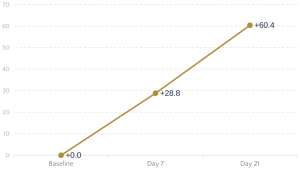
Published human hydration data for a 10-H2DA counterpart: change from baseline (%)
15 · Supporting Cellular Antioxidant Defense
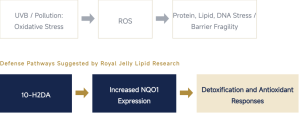
Stress chain: UVB/pollution, ROS, protein/lipid/DNA stress, and barrier fragility.
10-H2DA research: increased NQO1 expression and detoxification/antioxidant responses. Nrf2- and AhR-related signals may participate, with reduced UVB/oxidant-induced cellular damage.
The concept extends radical scavenging to endogenous environmental defense.
Cellular 10-H2DA evidence: Okumura et al. Int J Mol Sci. 2021;22(23):12973. DOI: 10.3390/ijms222312973.
Source link from the presentation: https://doi.org/10.3390/ijms222312973
16 · Two Research Pathways for Collagen Preservation
Zinc PCA pathway: UVA, AP-1, and MMP-1. Research reports inhibition of UVA-induced AP-1, reduced MMP-1, and supported collagen synthesis.
Royal jelly lipid pathway: UVA, ROS, JNK/p38 MAPK, and MMP-1/3. 10-H2DA research reports reduced ROS/MMP-1/MMP-3, supported collagen production, and less cellular senescence.
The design links oxidative-stress and collagen-degradation pathways to firmness, resilience, and youthful radiance concepts.
Ingredient-level Zinc PCA and 10-H2DA literature: Takino 2012, DOI: 10.1111/j.1468-2494.2011.00676.x; Zheng 2013;27(10):1269–1277, DOI: 10.1111/j.1468-3083.2012.04707.x.
Source link from the presentation: https://doi.org/10.1111/j.1468-2494.2011.00676.x
Source link from the presentation: https://doi.org/10.1111/j.1468-3083.2012.04707.x

17 · Microbiome and Biofilm Research
In vitro Staphylococcus aureus study with sub-inhibitory 10-H2DA: MIC 2.25 mg/mL; biofilm quantity decreased 41.9–72.9%; biofilm cellular metabolic activity decreased 73.6% at 1/2 MIC.
Other observations: less EPS formation, adhesion and aggregation, downregulated sarA/agrA/hla, and reduced hemolysis-related virulence.
These findings inform refined ecological-care concepts for oily/fluctuating skin and scalp, without establishing direct product efficacy.
Gao K et al. Molecules. 2022;27(5):1485. DOI: 10.3390/molecules27051485.
Source link from the presentation: https://doi.org/10.3390/molecules27051485
18 · Alpha-Glucan Oligosaccharide: Selective Balance
Ingredient-level human study: an α-glucan oligosaccharide gel, whole-face application twice daily for 2 weeks, and metagenomic/DNA sequence analysis.
Results: improved Simpson Index in initially low-diversity participants; trends toward more S. epidermidis and less S. aureus; C. acnes moving toward a more suitable proportion; support for balance/diversity.
Prebiotic care offers selective nutrition for beneficial microbes and supports ecology rather than sterile skin. Face/body/scalp care concepts extend from these ingredient-level findings.
Duan et al. J Soc Cosmet Chem Jpn. 2021;55(2):176–181. DOI: 10.5107/sccj.55.176.
Source link from the presentation: https://doi.org/10.5107/sccj.55.176
19 · Xyloglucan: Active Delivery, Interface, and Comfort
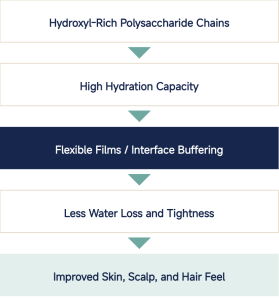
Hydroxyl-rich polysaccharide chains support hydration, flexible films/interface buffering, reduced water-loss/tightness concepts, and improved skin/scalp/hair feel.
Materials research: film-forming Xyloglucan hydrogels, cellular compatibility, maintenance of a moist microenvironment, and platforms for active carriage, protection, and controlled-release research.
Three roles: active carriage, interface protection, and sensory comfort.
Picone et al. Int J Biol Macromol. 2019;121:784–795. DOI: 10.1016/j.ijbiomac.2018.10.078; Infante et al. AAPS PharmSciTech. 2023;24(1):29. DOI: 10.1208/s12249-022-02472-w (skin/hair film-evaluation methods).
Source link from the presentation: https://doi.org/10.1016/j.ijbiomac.2018.10.078
Source link from the presentation: https://doi.org/10.1208/s12249-022-02472-w
20 · Four-Dimensional Integration
Purify: Zinc PCA for sebum and freshness. Renew: 10-Hydroxydecanoic Acid for barrier/environmental-defense concepts. Buffer: Xyloglucan for hydrated films/interface buffering. Balance: Alpha-Glucan Oligosaccharide for prebiotic homeostasis.
Design goals: freshness without dryness, refined ecological management, renewal with barrier care, and performance with a comfortable formulation experience.
21 · Multiple Pathways for Complex Skin Needs
The table retains the presentation’s proposed ingredient, mechanism, and consumer-value mapping. Contributions derive from ingredient/literature research; the mapping does not substitute for direct product validation. In particular, 10-H2DA literature should not be treated as direct 10-Hydroxydecanoic Acid measurements.
| Skin need | Key components | Pathway | Consumer value |
|---|---|---|---|
| Visible shine | Zinc PCA | Sebum-related signals and a fresh environment | Lasting freshness / less recurring shine |
| Pores and blemishes | Zinc PCA + 10-Hydroxydecanoic Acid | Environmental care / biofilm and blemish-trigger concepts | Finer-looking pores / more even texture |
| Dryness and tightness | Xyloglucan + 10-Hydroxydecanoic Acid | Hydrated films / NMF formation concepts | Softness, hydration, and comfort |
| Fragile barrier | 10-Hydroxydecanoic Acid + Xyloglucan | Cornification, lipid synthesis, and buffering concepts | Barrier stability / tolerance |
| Microbiome imbalance | Alpha-Glucan Oligosaccharide | Selective prebiotic support for beneficial microbes | Microbial balance / stable condition |
| Environmental aging | Zinc PCA + 10-Hydroxydecanoic Acid | Antioxidant defense / less MMP-related degradation | Firmness, resilience, and photoaging-care concepts |
22 · Scalp Skinification: Homeostasis Science
Scalp sebum balance: freshness/stability and less recurring oiliness. Scalp microbiome: prebiotic diversity/homeostasis. Scalp barrier: cornification and lipid-environment concepts. Scalp comfort: polysaccharide films buffer interfaces and dryness/tightness. Hair surface care: smoother feel, shine, and combability.
Market language: scalp freshness/balance, microbiome care, barrier care, comfort/hydration, and light smooth hair.
Claims remain cosmetic. No treatment claims for alopecia, medicinal hair growth, seborrheic dermatitis, fungal infections, or permanent dandruff elimination.
The scalp is an extension of skin; the platform supports scalp and hair-care concepts.
23 · Eight Concept Product Directions
Facial: 1 Oil-Balance Serum for oily/combination skin, Zinc PCA with Niacinamide/Panthenol. 2 Microbiome Essence for fluctuating skin, α-glucan oligosaccharide with Ectoin/Betaine. 3 Barrier Comfort Cream for dry/fragile skin, 10-Hydroxydecanoic Acid/Xyloglucan with Ceramides/Cholesterol. 4 Pore Refining Gel for visible pores/blemish-prone skin, gentle-acid alternative strategies and soothing ingredients.
Scalp/hair: 5 Scalp Balance Essence, sebum/microbiome care with water-soluble polysaccharides/peptides. 6 Fresh Scalp Shampoo, mild surfactants for comfort/light roots. 7 Scalp Comfort Mask for dryness/tightness, polysaccharides with Panthenol/Phytosterols. 8 Lightweight Conditioner for smoothness without flatness, amino-acid conditioners.
Suggested partners: Niacinamide, Panthenol, Betaine, Ectoin, Ceramides, Cholesterol, amino acids, mild surfactants, water-soluble polysaccharides, peptides, and phytosterols. Formulation experiments must confirm compatibility.
24 · Formulation Guidance for Multiple Formats
Predisperse in water or add later; avoid prolonged heat; assess electrolyte/anionic/cationic-polymer compatibility; test clarity and long-term stability across pH conditions; verify centrifugation, freeze–thaw, thermal cycling, and light stability; calculate addition from actual active content. Exact specifications, use levels, and conditions follow formal TDS/SPEC.
Facial formats: serums, lotions, creams, hydrogels, sprays, masks. Cleansing/body: facial cleanser, body lotion. Scalp/hair: scalp serum, shampoo, conditioner, hair mask.
Evaluate aqueous and emulsion systems across these applications.
25 · Product Data Roadmap
A Formulation/assembly characterization: aqueous dispersion comparison, turbidity, centrifugation, thermal cycling, FTIR hydrogen-bond shifts, DSC, rheology, and particle size only where applicable.
B In vitro efficacy: FLG, IVL, LOR, TGM1, NQO1, ROS, MMP-1, collagen-related indicators, inflammatory factors.
C Microbiome: S. epidermidis, C. acnes, S. aureus, selective utilization, biofilms, 16S/metagenomics.
D Human skin: sebum, pores, shine, hydration, TEWL, redness, roughness, comfort.
E Scalp/hair: scalp sebum, root freshness, hydration, tightness/itch, visible flakes, combing force, friction, shine, static control, and volume.
Future completed tests will be labeled SupraHDA™ Product Data, clearly separate from ingredient/literature evidence. Build the finished-product evidence chain progressively from A to E.
26 · Conclusion: Modern Royal Jelly Lipid Care
Purify: sebum clarity. Renew: barrier renewal. Buffer: interface protection. Balance: microbiome balance. Skin + Scalp: dual application.
SupraHDA™ combines royal jelly lipid science, zinc functions, polysaccharide interfaces, and prebiotic concepts into a forward-looking homeostasis-care platform.
Royal jelly lipid intelligence. Four-dimensional balance.
27 · References and Related Patents
The references, publication numbers, years, and technical directions supplied in the presentation are retained below. Patents support technical routes/application contexts and are not SupraHDA™ finished-product efficacy data.
1. Takino Y et al. Int J Cosmet Sci. 2012;34(1):23–28. DOI: 10.1111/j.1468-2494.2011.00676.x
2. Clar EJ, Fourtanier A. Int J Cosmet Sci. 1981;3(3):101–113. DOI: 10.1111/j.1467-2494.1981.tb00275.x
3. Duplan H et al. Eur J Dermatol. 2011;21(6):906–915. DOI: 10.1684/ejd.2011.1531
4. Zheng J et al. J Eur Acad Dermatol Venereol. 2013;27(10):1269–1277. DOI: 10.1111/j.1468-3083.2012.04707.x
5. Gu L et al. Cosmetics. 2017;4(4):48. DOI: 10.3390/cosmetics4040048
6. Okumura N et al. Int J Mol Sci. 2021;22(23):12973. DOI: 10.3390/ijms222312973
7. Gao K et al. Molecules. 2022;27(5):1485. DOI: 10.3390/molecules27051485
8. Yuan C-Y et al. J Funct Foods. 2024;122:106505. DOI: 10.1016/j.jff.2024.106505
9. Duan Z et al. J Soc Cosmet Chem Jpn. 2021;55(2):176–181. DOI: 10.5107/sccj.55.176
10. Picone P et al. Int J Biol Macromol. 2019;121:784–795. DOI: 10.1016/j.ijbiomac.2018.10.078
11. Infante VHP et al. AAPS PharmSciTech. 2023;24(1):29. DOI: 10.1208/s12249-022-02472-w
12. Gao C et al. Int J Pharm. 2026;701:127150. DOI: 10.1016/j.ijpharm.2026.127150 (supramolecular formulation trend reference only)
Related patents (publication number, year, and technical direction)
US6514507B2|2002|hydroxy-acid lipid use in skin care
JPH10147514A|1998|preparation and use of royal-jelly-derived hydroxydecanoic acid
US20120237494A1|2012|hydroxy fatty acids for skin barrier care
GB2498543A|2013|hydroxydecanoic acid compositions and skin applications
US10993900B2/EP3041585A2|supramolecular carriers and active delivery
US20230372218A1|2023|polysaccharide–active complexes and personal care
Patents support technical routes and application contexts, not SupraHDA™ finished-product efficacy data.