01 · NanoActive™ 10-HDA: Nano-Encapsulated Royal Jelly Acid
Advanced liposomal active ingredient. Powered by PURISOME® FlexVes™ flexible-vesicle liposome technology. Royal Jelly, Re-Engineered. PuriPharm Co., Ltd.
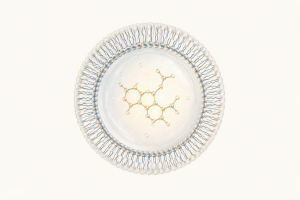
02 · The Royal Jelly Signature Molecule
Royal jelly contains proteins, sugars, lipids, amino acids, and trace components. 10-HDA is a characteristic fatty acid and a marker in research and quality evaluation. It provides a defined molecular active beyond the traditional natural-ingredient concept.
Identity: 10-Hydroxy-2-Decenoic Acid; 10-HDA/10-H2DA; Queen Bee Acid; Royal Jelly Acid; a medium-chain ω-hydroxy unsaturated fatty acid and characteristic royal jelly lipid.
10-HDA is a multifunctional bioactive lipid. Whole-royal-jelly effects cannot all be attributed to it; this presentation focuses on the lipid’s evidence.
03 · From Royal Jelly to 10-HDA
Traditional natural origin, molecular precision, and nano delivery.
1 Royal jelly, a traditional natural ingredient. 2 Identify the signature bioactive lipid. 3 Define molecular 10-HDA. 4 Study multiple skin biological pathways. 5 NanoActive™ liposomal delivery.
Applications: premium skin and scalp care. Defined. Studied. Delivered.

04 · 10-HDA Molecular Science
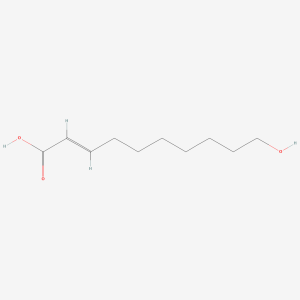
2D structure source: PubChem CID 5312738.
Formula C10H18O3; molecular weight approximately 186.25. Structure: α,β-unsaturated carboxylic acid, terminal hydroxyl, and a medium-chain fatty acid backbone. Class: medium-chain ω-hydroxy unsaturated fatty acid.
Potential: lipid interactions with skin lipids; hydroxyl-mediated hydrogen bonding; amphiphilic biofilm interactions; and a structural basis for epidermal biology research.
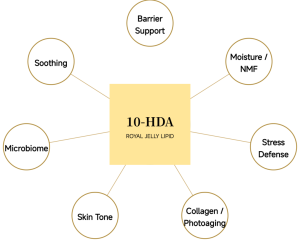
05 · One Royal Jelly Lipid, Multiple Skin Pathways
Seven research directions: barrier support, moisture/NMF, environmental stress defense, collagen/photoaging, skin tone, microbiome support, and soothing.
The presentation organizes an evidence network around one defined bioactive lipid. This mechanism map does not establish finished-product clinical efficacy.
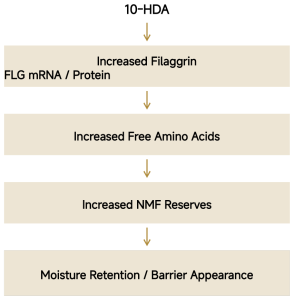
06 · Filaggrin: From 10-HDA to Natural Moisturizing Factors
Gu, Zeng, and Maeda (2017) found induction of filaggrin and free amino acids in cultured 3D human epidermis. This extends hydration concepts into cornification and NMF biology.
Key findings: increased filaggrin expression, FLG mRNA/protein, stratum-corneum free amino acids, and support for NMF formation.
Pathway: 10-HDA, increased filaggrin, free amino acids, NMF reserves, and moisture-retention/barrier appearance concepts.
Source: Cosmetics. 2017;4(4):48. DOI: 10.3390/cosmetics4040048. In vitro 3D epidermis.
07 · Barrier Mechanism Map
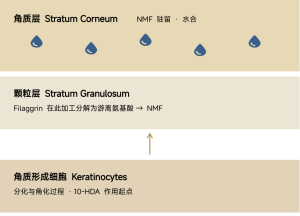
From keratinocytes to the stratum corneum: differentiation support, increased granular-layer filaggrin, amino acid release, NMF reserves, hydration, and a stronger-looking barrier.
Layer schematic: stratum corneum, NMF/hydration; stratum granulosum, filaggrin processing and amino acids/NMF; keratinocytes, differentiation/cornification and the proposed 10-HDA starting point.
Source: Gu et al. Cosmetics. 2017;4(4):48. DOI: 10.3390/cosmetics4040048. The diagram illustrates mechanisms and does not establish product penetration depth.
08 · NQO1: Supporting Epidermal Stress Defense
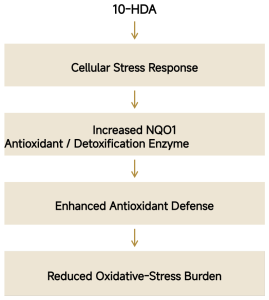
Okumura et al. (2021) identified 10-HDA as an important royal jelly fatty acid inducing NQO1, an antioxidant/detoxification enzyme.
Care contexts: UV oxidative stress, ROS accumulation, pollution/environmental stress, and early oxidative-aging signs. The positioning is defense support, without sunscreen or medicinal claims.
Pathway: 10-HDA, cellular stress-response signals, increased NQO1, enhanced antioxidant defense, and reduced oxidative-stress burden.
Source: Int J Mol Sci. 2021;22(23):12973. DOI: 10.3390/ijms222312973. In vitro cellular/epidermal models.
09 · 10-HDA and UVA-Induced Dermal Damage
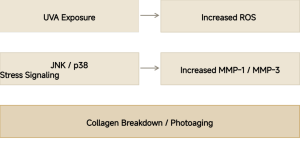
Human dermal fibroblast pathway: UVA, increased ROS, JNK/p38 signaling, increased MMP-1/MMP-3, and collagen breakdown/photoaging.
10-HDA findings: lower ROS and senescence-related changes, modulated MMP-1/MMP-3, supported type I collagen expression, and protection against UVA cellular damage.
Zheng et al. (2013) connect ROS management with downstream MMP modulation and collagen protection.
Source: J Eur Acad Dermatol Venereol. 2013;27:1269–1277. DOI: 10.1111/j.1468-3083.2012.04707.x. In vitro human fibroblasts.
10 · Royal Jelly Biology and Collagen Science
This section concerns whole royal jelly, separate from purified 10-HDA.
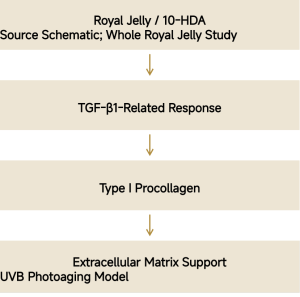
Park et al. (2011), human skin fibroblast UVB model: royal jelly enhanced collagen production, with TGF-β1-related responses, type I procollagen, and extracellular-matrix support.
Concept: protect and preserve youthful-looking skin. Whole royal jelly and 10-HDA findings inform complementary collagen narratives, but whole-royal-jelly results cannot be fully attributed to 10-HDA. The source schematic includes Royal Jelly/10-HDA; the experiment itself tested whole royal jelly.
Source: J Med Food. 2011;14(9):899–906. DOI: 10.1089/jmf.2010.1363. In vitro.
11 · 10-HDA and Melanogenesis
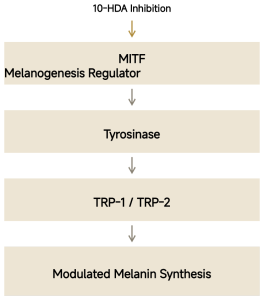
Peng et al. (2017) studied B16F1 melanoma cells and topical mouse skin, showing melanogenesis inhibition involving MITF, Tyrosinase, and TRP pathways.
Models assessed melanin/tyrosinase and topical tone-related indicators. Multi-target concepts support clearer-looking tone and appearance; no pigment-disease treatment claims.
Pathway: 10-HDA inhibition, MITF modulation, Tyrosinase, TRP-1/TRP-2, and melanin synthesis.
Source: BMC Complement Altern Med. 2017;17:392. DOI: 10.1186/s12906-017-1888-8.
12 · Staphylococcus aureus Biofilm Research
In vitro findings: reduced biofilm formation, EPS production, adhesion, aggregation, and mature-biofilm viability.
Genes: reduced sarA, agrA, and hla, associated with biofilm regulation, quorum signaling, and α-hemolysin virulence.
Positioning: a microbiome-friendly skin-purifying strategy managing unfavorable biofilms and environments. Care concepts include oily/blemish-prone skin, sensitive-skin microbiome care, scalp care, skin cleansing care, and fragile barriers. These findings do not establish selective support for all beneficial species.
Gao et al. Molecules. 2022;27(5):1485. DOI: 10.3390/molecules27051485.
13 · The Delivery Challenge
01 Poor aqueous solubility limits direct water-based use. 02 Limited oil solubility constrains conventional oil delivery. 03 Free-state penetration depends on dosage-form design. 04 Direct addition can be difficult to disperse and restrict formulation options.
Biological activity does not by itself establish bioavailability at the intended interface.
14 · PURISOME® FlexVes™: Why Liposomes
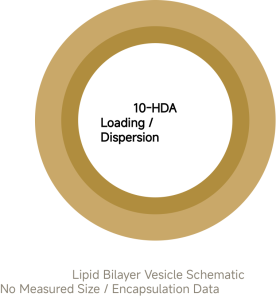
A lipid-bilayer vesicle is a membrane-related carrier architecture for loading/dispersing 10-HDA. It aims to improve aqueous dispersion, compatibility with stratum-corneum lipids, and delivery/deposition potential.
Values: nanoscale delivery, lipid compatibility, dispersion, skin-deposition potential, controlled skin interactions, and formulation flexibility.
The vesicle image is a mechanism schematic, not measured particle-size or encapsulation-efficiency data.
15 · 2026 Independent Nano-Delivery Evidence
Gao et al. (2026) studied Hyalurosomes encapsulating a 10-HDA/matrine deep eutectic solvent, using ex vivo skin and cellular models.
Formulation/delivery: improved dissolution/dispersion and stability, with increased deposition in stratum corneum, viable epidermis, and dermis.
Cells: reduced HaCaT ROS, IL-1α/IL-6/TNF-α; increased HaCaT migration; reduced HFF-1 senescence phenotype.
The formulation is distinct from NanoActive™ 10-HDA. It supports the delivery strategy and does not constitute direct product evidence.
Int J Pharm. 2026;701:127150. DOI: 10.1016/j.ijpharm.2026.127150.
16 · Free and Nano-Encapsulated 10-HDA
Free 10-HDA: limited solubility, dispersion, penetration, and formulation choices.
NanoActive™ 10-HDA with PURISOME® FlexVes™: liposomal dispersion, a skin-compatible lipid carrier, improved delivery potential, greater formulation versatility, and modern skin-care design.
Better delivery offers greater opportunity for biological activity; product performance still requires direct testing.
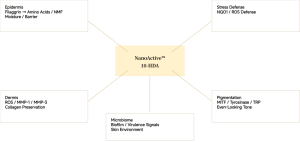
17 · Integrated Mechanism Network
Epidermis: filaggrin, amino acids/NMF, moisture/barrier. Dermis: lower ROS/MMP-1/MMP-3, collagen preservation. Stress defense: NQO1 and oxidative-defense support. Pigmentation: MITF/Tyrosinase/TRP and even-looking tone. Microbiome: biofilm/virulence modulation and skin-environment concepts.
One bioactive lipid, multiple pathways. The network combines Gu 2017, Okumura 2021, Zheng 2013, Peng 2017, and Gao 2022, retaining their original model-level attribution.
18 · Five Core Skincare Values
01 Barrier recovery: filaggrin/NMF and hydration foundations. 02 Anti-stress defense: NQO1-related epidermal defenses. 03 Photoaging care: ROS/MMP and collagen protection. 04 Tone: MITF/Tyrosinase-related pathways for dull/uneven appearance. 05 Microbiome: unfavorable-biofilm management and skin-environment support.
Barrier × Defense × Collagen × Tone × Microbiome connects mechanisms to formulation concepts.
19 · Scalp Is Skin
Scalp pressures: fragile barrier/moisture loss, oxidative stress, microbial imbalance, inflammatory environments, and sebum/pollution.
Skin mechanisms inform scalp concepts: Filaggrin/NMF for hydration; NQO1 for stress defense; biofilm management for microbial care; soothing pathways for comfort. These concepts require scalp-specific validation.
Healthy scalp, a better environment for beautiful hair. The positioning does not claim direct hair growth.
20 · Royal Jelly and Scalp Research Clues
A 2024 clinical observation of a medicated hair tonic containing royal jelly extract associated the combination product with improved scalp moisture/condition and hair condition. Dermal papilla experiments reported changes in some growth-related genes.
Other actives were present; results cannot all be attributed to royal jelly extract or 10-HDA.
NanoActive™ positioning: scalp barrier, moisture, soothing, antioxidant defense, and microbiome care. Skin health guides scalp ecological concepts.
J Soc Cosmet Chem Jpn. 2024;58(1):55–64. DOI: 10.5107/sccj.58.55. Combination-product clinical observation and cell experiments.
21 · Skincare Applications
Anti-aging serum, repair serum, barrier cream, sensitive-skin serum, overnight recovery, tone-care serum, blemish-prone care, microbiome products, urban-defense serum, eye-contour care, premium royal jelly concepts, and post-treatment-inspired care.
Royal Jelly Renewal Serum: photoaging/collagen concept. Barrier Defense Cream: Filaggrin–NMF hydration concept. Bio-Balance Repair Essence: biofilm-management concept.
22 · Scalp and Hair Applications
Scalp serum, ampoule, shampoo, soothing mist, dry-scalp lotion, oily-scalp essence, post-color/perming scalp care, anti-pollution serum, and premium aging scalp care.
Royal Scalp Defense Serum: antioxidant/environmental defense. Scalp Barrier Booster: daily barrier/hydration care. Nano Royal Jelly Scalp Essence: premium nano-delivery and microbiome concepts.
23 · Value for Formulators
01 Easier incorporation addresses free-active solubility, dispersion, and penetration challenges. 02 Lipid-compatible delivery. 03 Water-based formulation design for serums/lotions. 04 Multiple barrier, antioxidant, aging, tone, and microbiome concepts. 05 Premium storytelling: Royal Jelly × Molecular Science × Nano Delivery.
Nature × Molecule × Nanotechnology combines natural-origin narrative, molecular evidence, and delivery design.
24 · Royal Jelly, Re-Engineered
01 A signature royal jelly lipid. 02 Filaggrin/NMF hydration. 03 Epidermal defense and collagen-protection research. 04 Microbiome/tone concepts. 05 Advanced liposomal design to address practical delivery barriers.
NanoActive™ 10-HDA, powered by PURISOME® FlexVes™.
25 · Positioning Matrix
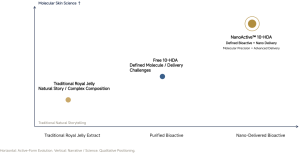
Traditional royal jelly: a strong natural narrative with complex composition. Free 10-HDA: a defined molecule with formulation/delivery challenges. NanoActive™ 10-HDA: Defined Bioactive + Nano Delivery; Molecular Precision + Advanced Delivery.
Horizontal axis: evolution of active form. Vertical axis: narrative/scientific level. The schematic positions the product at molecular precision and advanced delivery; it is a qualitative positioning map, not quantitative comparative data.
26 · References
All ten references from the presentation are retained below.
Molecular-structure source: PubChem CID 5312738. The science concerns 10-HDA (10-Hydroxy-2-Decenoic Acid, C10H18O3), distinct from 10-Hydroxydecanoic Acid (10-HDAA). Final INCI follows the formal PuriPharm Co., Ltd. TDS/SPEC.
PuriPharm Co., Ltd. Royal Jelly, Re-Engineered.
1. Gu L, Zeng H, Maeda K. 10-Hydroxy-2-Decenoic Acid in Royal Jelly Extract Induced Both Filaggrin and Amino Acid in a Cultured Human Three-Dimensional Epidermis Model. Cosmetics. 2017;4(4):48. DOI: 10.3390/cosmetics4040048.
2. Zheng J, Lai W, Zhu G, et al. 10-Hydroxy-2-Decenoic Acid Prevents Ultraviolet A-Induced Damage and Matrix Metalloproteinases Expression in Human Dermal Fibroblasts. J Eur Acad Dermatol Venereol. 2013;27:1269–1277. DOI: 10.1111/j.1468-3083.2012.04707.x.
3. Park HM, Hwang E, Lee KG, et al. Royal Jelly Protects Against Ultraviolet B-Induced Photoaging in Human Skin Fibroblasts via Enhancing Collagen Production. J Med Food. 2011;14(9):899–906. DOI: 10.1089/jmf.2010.1363.
4. Peng CC, Sun HT, Lin IP, et al. The Functional Property of Royal Jelly 10-Hydroxy-2-Decenoic Acid as a Melanogenesis Inhibitor. BMC Complement Altern Med. 2017;17:392. DOI: 10.1186/s12906-017-1888-8.
5. Okumura N, Ito T, Degawa T, et al. Royal Jelly Protects against Epidermal Stress through Upregulation of the NQO1 Expression. Int J Mol Sci. 2021;22(23):12973. DOI: 10.3390/ijms222312973.
6. Gao K, Su B, Dai J, et al. Anti-Biofilm and Anti-Hemolysis Activities of 10-Hydroxy-2-Decenoic Acid against Staphylococcus aureus. Molecules. 2022;27(5):1485. DOI: 10.3390/molecules27051485.
7. Perminaite K, Fadda AM, Sinico C, Ramanauskiene K. Formulation of Liposomes Containing Royal Jelly and Their Quality Assessment. DOI: 10.1166/jnn.2021.19053.
8. Gao C, Liu F, Yang S, Wang Q, Yang C, Liang R. 10-Hydroxy-2-Decenoic Acid/Matrine Deep Eutectic Solvent Encapsulated in Hyalurosomes for Enhanced Transdermal Delivery and Antioxidant Efficacy. Int J Pharm. 2026;701:127150. DOI: 10.1016/j.ijpharm.2026.127150.
9. Enhanced Skin Penetration of 10-Hydroxy-2-Decenoic Acid via Anionic Polymer Formulations and Skin Hydration Modulation. J Dermatologic Sci Cosmet Technol. 2026;3(1):100144. DOI: 10.1016/j.jdsct.2025.100144.
10. The Effectiveness of Medicated Hair Tonic Containing Royal Jelly Extract. J Soc Cosmet Chem Jpn. 2024;58(1):55–64. DOI: 10.5107/sccj.58.55.