01 · PuriActives® SLL: Sodium Lauroyl Lactylate
Technical product presentation. INCI: SODIUM LAUROYL LACTYLATE. Formula C18H31NaO6, MW approximately 366.4 g/mol.
Multifunctional lactylate interface technology for skin and hair care. More Than an Emulsifier. PuriPharm Co., Ltd.

02 · More Than an Emulsifier
Positioning: a multifunctional interface ingredient.
01 Emulsification: uniform oil/water dispersion and O/W interface stability. 02 Mild cleansing: an anionic structure supporting mild-system design. 03 Lipid compatibility: a C12 chain and lactylated headgroup for complex lipid formulations. 04 Skin/hair sensory properties: softer, refined cleansing and care experiences.
Its amphiphilic structure participates in oil/water interfaces, surfactant assemblies, and lipid formulations across skin and hair applications.
03 · From Strong Cleansing to Cleansing Quality
Traditional focus: strong cleansing, high foam, and simple emulsions. Modern needs: mild cleansing, barrier-conscious design, lipid compatibility, refined sensory properties, multifunctionality, and skin/scalp-friendly concepts.
SLL offers an interface-chemistry approach to these formulation needs.
04 · Product Identity
The product information table and molecular structure are retained below.
Class: acyl lactylate, anionic surfactant. CosIng function: Surfactant–Emulsifying.
Sources in the presentation: PubChem—Sodium Lauroyl Lactylate; EU CosIng; Johnson et al. Int J Toxicol. 2024.
Source link: https://pubchem.ncbi.nlm.nih.gov/compound/Sodium-lauroyl-lactylate
Source link: https://ec.europa.eu/growth/tools-databases/cosing/
| Item | Information |
|---|---|
| Product | PuriActives® SLL |
| INCI | SODIUM LAUROYL LACTYLATE |
| Chinese INCI | 月桂酰乳酰乳酸钠 (Sodium Lauroyl Lactylate) |
| CAS No. | 13557-75-0 |
| EC No. | 236-942-6 |
| Molecular Formula | C18H31NaO6 |
| Molecular Weight | Approximately 366.4 g/mol |
| Ingredient Class | Acyl Lactylate · Anionic Surfactant |
| CosIng Function | Surfactant – Emulsifying |
05 · Fatty Acid × Lactic Acid Chemistry
Lauric acid, a C12 fatty acid, combines with lactic-acid/lactylate chemistry. The schematic shows esterification followed by neutralization to the sodium salt.
Fatty-acid-derived lipophilicity and lactylate-derived hydrophilicity produce a balanced amphiphilic architecture: a molecular bridge between water and lipids.
06 · How SLL Works at the Interface
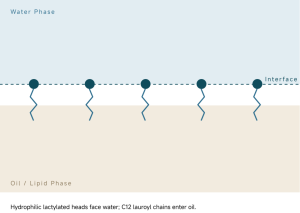
The hydrophilic lactylated head faces water; the hydrophobic C12 lauroyl chain enters the oil/lipid phase.
01 Adsorption: molecules migrate to the oil/water interface. 02 Organization: the chain anchors in oil and the head faces water. 03 Dispersion support: interface organization provides a structural basis for stability.
This amphiphilic architecture supports emulsions, cleansing systems, and lipid formulations.
07 · Emulsification and Interface Management
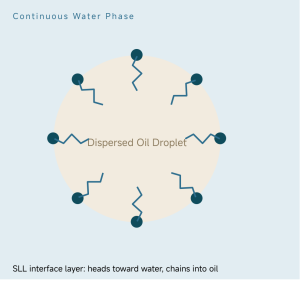
The schematic shows an oil droplet in a continuous water phase, surrounded by SLL with heads toward water and chains into oil.
Supports uniform dispersion, O/W emulsions, homogeneity/stability, combined emulsifier systems, and a refined feel in creams, lotions, and serum emulsions.
The presentation cites EU CosIng: SURFACTANT–EMULSIFYING.
Source link: https://ec.europa.eu/growth/tools-databases/cosing/
08 · Interface Engineering Across Formulation Structures
Oil/water interfaces: stabilization of emulsions and dispersions. Surfactant assemblies: complex cleansing structures, foam, and after-feel. Lipid-rich systems: dispersion and organization of ceramides, cholesterol, and other lipids.
SLL participates at multiple structural levels from adsorption to system organization.
09 · Mild Cleansing System Design
SLL’s anionic surfactant structure supports soil/sebum removal in combined systems, balancing cleansing with after-feel.
Formats: facial cleansers, body/hand washes, bathing products, and mild-cleansing concepts.
Patent context: cleansing, moisturization, lather, and skin feel. WO1998027193A1, Personal cleansing bar composition containing sodium lauroyl lactylate (1998); WO2007100784A2, Acyl lactylate compositions for rinse-out and leave-on applications for skin and hair (2007).
10 · From Clean to Comfortable Clean
The source compares conventional clean/tight/dry after-feel with an SLL formulation concept of clean/soft/comfortable/refined after-feel.
Published formulation goals: skin softness, moisturization, creamy lather, and improved after-feel. These reflect combined formulations, not effects attributable entirely to one ingredient.
Patent sources: WO1998027193A1; WO2007100784A2.
11 · An Interface Partner for Barrier Lipid Formulations
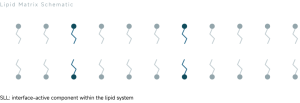
Ceramides + Cholesterol + Fatty Acids + SLL interface support.
Roles: dispersion, interface activity, co-emulsification, and lipid-delivery design. The lipid matrix is schematic.
US20240000681A1 (2024) includes SLL in designs containing Ceramide NP/AP/EOP, cholesterol, and free fatty acids/precursors. This is a patent disclosure, not PuriActives® SLL clinical data.
Patent title: Chemical compositions providing long-lasting skin pH control for improving skin-barrier function and treatment of skin-barrier disorders.
12 · Barrier-Friendly Formulation Architecture
SLL supports the architecture of lipid-based barrier-care products.
Combination logic: SLL interface support + Ceramides + Cholesterol + Phytosphingosine + Fatty Acids + Humectants.
Formats: barrier cream, ceramide lotion, sensitive/dry skin care, post-cleansing care, and lipid-rich serum. This formulation rationale does not by itself demonstrate clinical barrier repair.
13 · Moisturization Starts at the Interface
Hydration involves humectancy, occlusion, lipid organization, cleansing mildness, and emulsion quality.
SLL primarily supports interface, lipid, and cleansing dimensions of comfortable moisturization systems.
Patent context: skin softness, moisturization, cleansing, and foaming. WO2007100784A2 (2007); WO1998027193A1 (1998).
14 · From Skin to Hair
One molecule supports skin/hair formulation contexts. Published directions include shampoo, mild shampoo, scalp cleansing, rinse-off care, leave-on hair/scalp concepts, and hair grooming products.
15 · From Foam Quantity to Foam Quality
EP0562720A1, Hair shampoo (1993), examines acyl lactylates with alkyl polyglucosides (APG), including Sodium Lauroyl Lactylate-related systems, to address coarse APG foam.
Patent example range: acyl lactylates 3–15%, preferred 4–8%. These are patent-system ranges, not PuriActives® SLL recommendations.
Fine-Tune the Foam. Elevate the Cleansing Experience.
16 · Published Shampoo Formulation Examples
WO2007100784A2 (2007): approximately 3.0% SLL in a clear mild shampoo example concerned with cleansing, foam, viscosity, and pH stability; approximately 2.0% in another shampoo example for mild cleansing/sensory performance.
These are published examples, not recommended use levels. SLL has a documented hair-cleansing formulation history. Relevant attributes: cleansing, foaming, viscosity, pH stability, and sensory properties.
17 · Hair Fiber and Scalp Interface
Scalp: cleansing-system design, sebum/soil removal, freshness, mild formulations, and lipid-compatible care.
Hair: cleansing sensory properties, softer after-feel concepts, creamy foam, lipid-containing formulations, and conditioner/mask support.
Cosmetic scope excludes hair growth, anti-hair-loss, follicle repair, and hair-thickening claims.
18 · SLL and Modern Hair-Care Concepts
Reduced-sulfate cleansing, APG shampoos, scalp barrier care, ceramide hair care, lipid-replenishing shampoos, sensitive-scalp cleansing, premium cream shampoos, and scalp/hair serum emulsions.
An interface ingredient bridging cleansing technology and lipid care.
19 · SLL Interactions with Model Lipid Membranes
Gooran N, Tan SW, Yoon BK, Jackman JA. Int J Mol Sci. 2023;24(11):9283. DOI: 10.3390/ijms24119283.
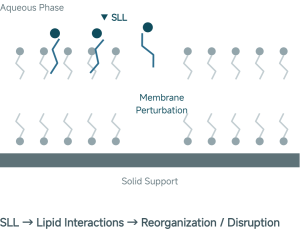
Methods: QCM-D, quartz crystal microbalance with dissipation monitoring; EIS, electrochemical impedance spectroscopy; SLB, supported lipid bilayer; tBLM, tethered bilayer lipid membrane.
The study tracked SLL insertion, reorganization, and disruption of model membranes. The schematic shows aqueous phase, SLL, membrane perturbation, and solid support. Model lipid membranes are not equivalent to the human stratum corneum.
Source link: https://doi.org/10.3390/ijms24119283
20 · Research Possibilities Beyond Emulsification
Lactylate membrane-interactive behavior offers research perspectives for cleansing and lipid-care design.
Directions: advanced cleansing, scalp hygiene, personal cleansing, microbial membrane research, and functional surfactant systems. These are research concepts without therapeutic claims.
Source: Gooran et al. 2023.
21 · Application Matrix
Skin: facial cleanser, cream cleanser, body wash, hand wash, moisturizing lotion, barrier cream, ceramide cream, facial emulsion, sensitive-skin care, lipid-rich serum, body lotion, and post-cleansing care.
Hair: shampoo, mild/cream shampoo, scalp cleanser/care, conditioner, mask, hair milk, leave-on emulsion, ceramide hair care, and lipid-replenishing care.
22 · Combination Design
Surfactants: APG, amphoteric, anionic, and nonionic systems. Lipids: ceramides, cholesterol, fatty acids, vegetable oils, and esters. Conditioning: glycerin, panthenol, hyaluronic acid, phytosphingosine, niacinamide, proteins, and amino acids.
Formulation versatility requires experimental compatibility testing; not every combination is presumed compatible.
23 · pH and Formulation Window
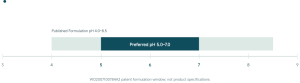
Published patent window: pH 4.0–8.5; preferred pH 5.0–7.0. The scale shown spans 3–9.
These are WO2007100784A2 acyl-lactylate skin/hair formulation windows, not product specifications.
pH 5–7 informs mildly acidic skin-care, gentle scalp-care, and hair-cleansing concepts.
24 · Reported Cosmetic Use
2024 CIR safety-assessment reported maximum use concentrations: 10% in rinse-off skin cleansing; 6.1% in leave-on body/hand products. These are reported concentrations, not product recommendations.
Chinese historical-use references in the PPT: approximately 10% rinse-off and 1.25% leave-on. Historical use is not a recommended level; the latest official inventory/public information governs interpretation.
The source describes peer-reviewed assessment, multiple categories/concentrations, Chinese use records, and rinse-off/leave-on applications.
Sources: Johnson et al. Int J Toxicol. 2024; Chinese ingredient-inventory public-use information. Regulatory/database statements are retained from the supplied PPT and have not been independently updated for this conversion.
25 · Safety Assessment Foundation
Johnson W Jr, Bergfeld WF, Belsito DV, et al. Safety Assessment of Alkanoyl Lactyl Lactate Salts as Used in Cosmetics. Int J Toxicol. 2024;43(4 Suppl). DOI: 10.1177/10915818241259694.
The source summarizes the Expert Panel conclusion as safe under current uses/concentrations when formulated to be nonirritating and nonsensitizing. This assessment includes the family containing Sodium Lauroyl Lactylate.
Foundation: established use, peer-reviewed assessment, rinse-off/leave-on contexts, and INCI recognition. This is a formulation-safety framework.
Source link: https://doi.org/10.1177/10915818241259694
26 · One Ingredient, Multiple Formulation Advantages
Emulsify: oil/water interface management. Cleanse: mild-system design. Stabilize: uniform dispersions. Condition: skin/hair sensory properties. Lipid compatibility: support for barrier-lipid formulations. Skin + Hair: dual application.
PuriActives® SLL integrates emulsifier, surfactant, and lipid-system support functions in a lactylated amphiphilic molecule.
27 · More Than an Emulsifier
Smarter interface management. Better cleansing/care sensory experience. Broader possibilities from skin to hair.
PuriActives® SLL: The Lactylate Interface for Modern Skin & Hair Care.
PuriPharm Co., Ltd. INCI: SODIUM LAUROYL LACTYLATE.
28 · Scientific References
Peer-reviewed literature, patent publications, databases, and regulatory sources from the presentation are retained below. Patents list publication numbers, titles, and years; applicant information is outside the source material.
Source link: https://doi.org/10.3390/ijms24119283
Source link: https://doi.org/10.1177/10915818241259694
Source link: https://pubchem.ncbi.nlm.nih.gov/compound/Sodium-lauroyl-lactylate
Source link: https://ec.europa.eu/growth/tools-databases/cosing/
PEER-REVIEWED LITERATURE
1. Gooran N, Tan SW, Yoon BK, Jackman JA. Unraveling Membrane-Disruptive Properties of Sodium Lauroyl Lactylate and Its Hydrolytic Products: A QCM-D and EIS Study. International Journal of Molecular Sciences. 2023;24(11):9283. DOI: 10.3390/ijms24119283
2. Johnson W Jr, Bergfeld WF, Belsito DV, et al. Safety Assessment of Alkanoyl Lactyl Lactate Salts as Used in Cosmetics. International Journal of Toxicology. 2024;43(4 Suppl). DOI: 10.1177/10915818241259694
PATENTS
WO2007100784A2 (2007)— Acyl lactylate compositions for rinse-out and leave-on applications for skin and hair.
EP0562720A1 (1993)— Hair shampoo.
WO1998027193A1 (1998)— Personal cleansing bar composition containing sodium lauroyl lactylate.
US20240000681A1 (2024)— Chemical compositions providing long-lasting skin pH control for improving skin-barrier function and treatment of skin-barrier disorders.
DATABASES & REGULATORY SOURCES
PubChem — Sodium Lauroyl Lactylate
EU CosIng — Sodium Lauroyl Lactylate
Cosmetic Ingredient Review / Expert Panel for Cosmetic Ingredient Safety
Current Chinese Inventory of Existing Cosmetic Ingredients and official public ingredient-use information
Patents list publication numbers, titles, and years; applicant information is outside this material.